
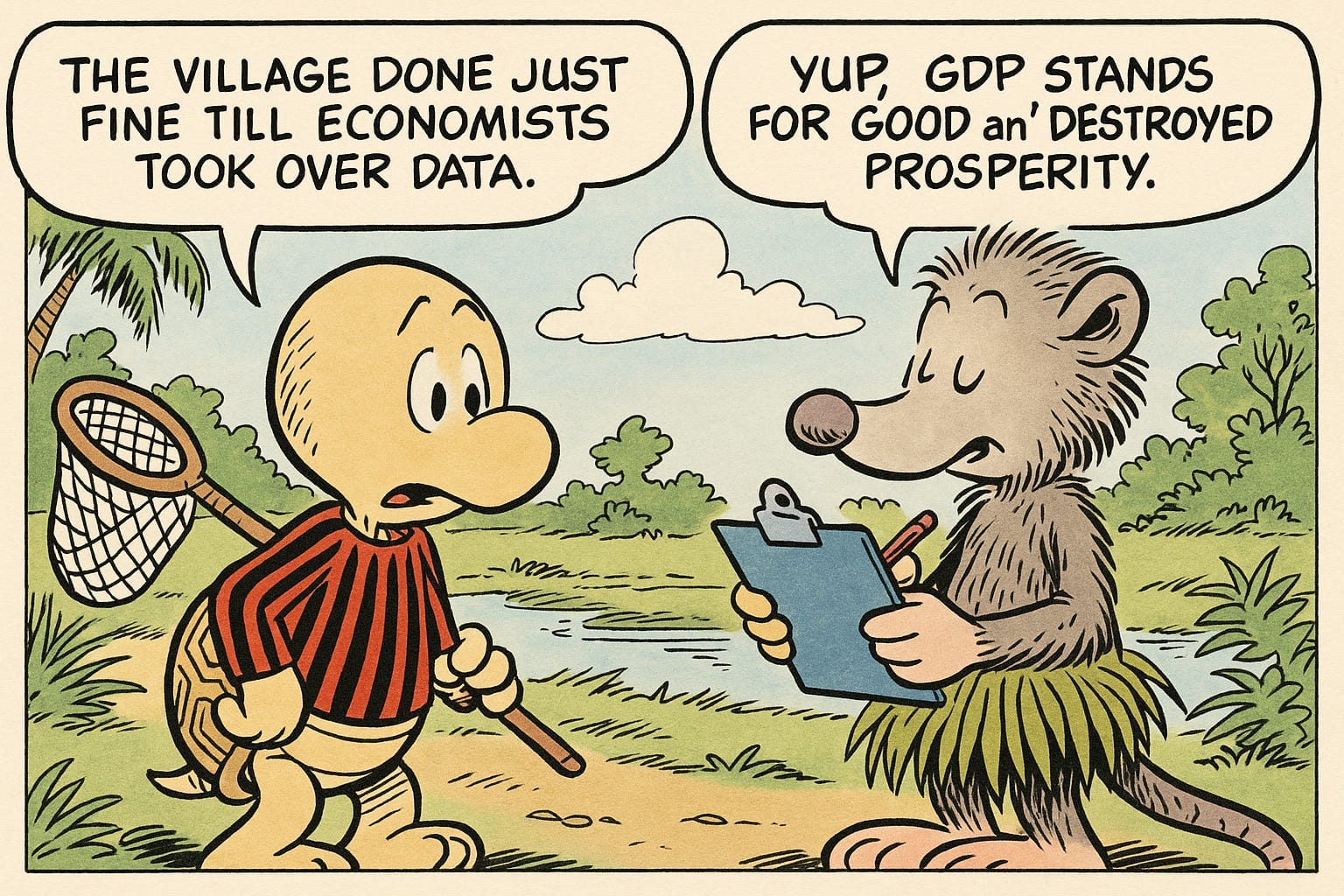
There was an Opinion piece I saw in the Fiji Times recently called “Let’s make rich villages poor: The GDP scam.”
Every critique of GDP sounds great until you notice what’s missing: local data ownership. The global argument against GDP’s blindness to real well-being—its disregard for food sovereignty, care work, and ecological health—is true but incomplete. What makes it incomplete is that even the proposed alternatives, like the Gross Ecosystem Product or the Multidimensional Poverty Index, still rely on data extracted and standardized under OECD and IMF frameworks.
OECD systems depend on data uniformity to preserve comparability, credit ratings, and loan conditions. If communities were to control their own data, they would control how value is defined. That would undo the epistemic power that keeps the global South dependent on donor institutions for validation.
Decolonize Accounting is a reader-supported publication. To receive new posts and support my work, consider becoming a free or paid subscriber.
Fiji’s 1193 villages already live by the logic of vanua: resilience, reciprocity, and shared care. Their data should not be captured for external valuation. Yet GDP-based accounting systems classify these communities as poor because they do not transact in cash. New ecological indices repeat this logic, converting restoration into valuation rather than sovereignty.
True accounting reform begins when data sovereignty is embedded in the measure itself. A better approach is that communities must be the custodians of their data, determining how it is gathered, verified, and interpreted. Only then can the metrics of prosperity emerge from the lived ecology of people and place, not from the institutions that have mismeasured them for decades.
Fiji doesn’t need more indicators to replicate what it cannot already access with GDP. It needs control over its own data. That is where prosperity begins.
Our regional wealth begins not with higher GDP or greener indices, but with the right to define value through our own data.
Also, it’s important to be clear what the purpose of GDP is. As a measurement of growth, it derives value from its connection to debt and access to credit. Nations pursue higher GDP figures because international financial institutions use those numbers to determine loan eligibility and repayment capacity (the standard threshold for developing countries is 60% debt-to-GDP). Likewise, when countries adopt so-called alternative economic or ecological indicators, their value is often limited to accessing aid, rather than transforming economic relations. Both loans and aid remain institutionalized under OECD governance, reinforcing the same hierarchies of dependency that GDP has evolved into.
For Pasifika, true independence will not come from adopting new global metrics but from building data sovereignty. There is no better model of indigenous stewardship or recalibration of ecological and social well-being than for these nations to collect, manage, and interpret their own data according to their own values of vanua and community resilience. By controlling the full life cycle of their data—from collection to interpretation—they can define, or maybe redefine prosperity in terms of balance, reciprocity, and restoration rather than only extraction and growth.
Once data ownership is secured, Pasifika can use their aggregated knowledge to establish translocal markets that reflect real ecological and social exchange. These markets would not depend on western-imposed oversight, validation, or external certification but would instead operate through local networks grounded in shared ecological realities. In this system, value would circulate through stewardship rather than speculation, and data would serve as an instrument of solidarity rather than surveillance.
In short, our regional wealth begins not with higher GDP or greener indices, but with the right to define value through our own data.