
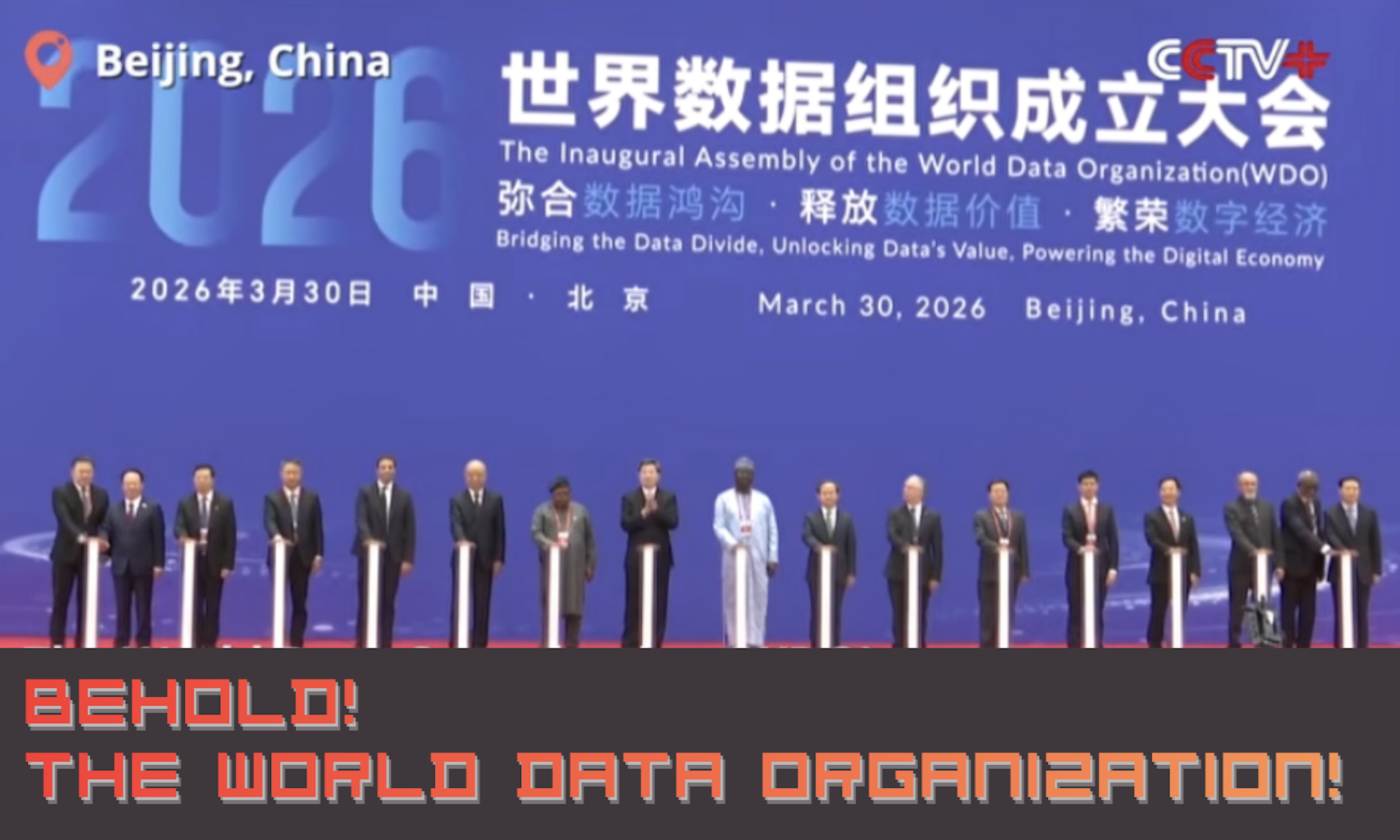
Not Washington, not Wall St. Not Silicon Valley, not Geneva, not Brussels… Now Beijing will disrupt the West’s data compliance chain!
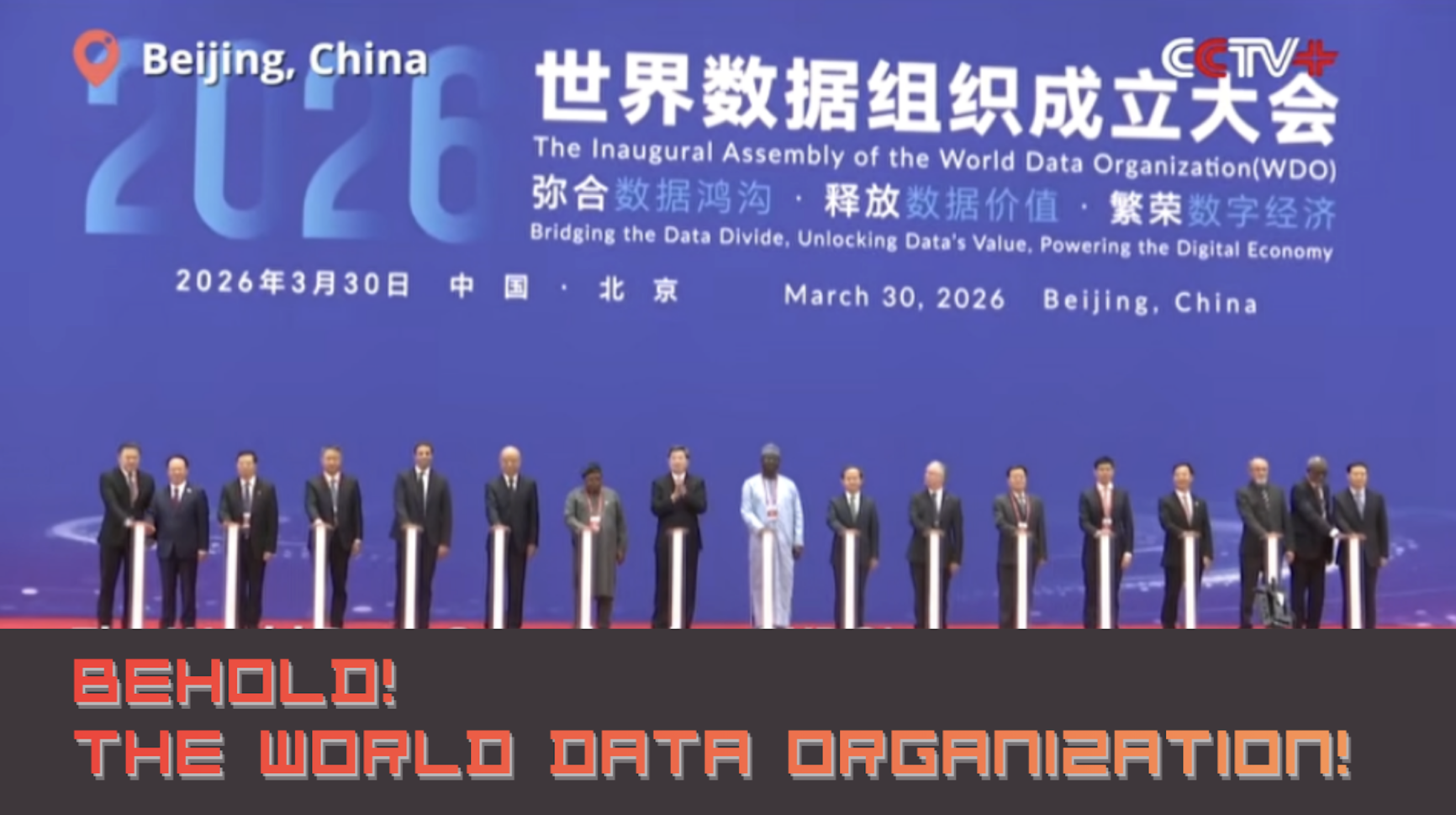
The World Data Organization was inaugurated on March 30, 2026, in Beijing, making it the first professional international organization dedicated to data development and governance. Its founding membership of more than 200 institutions from over 40 countries — spanning enterprises, universities, think tanks, and financial institutions across 14 industry sectors — marks it as a serious institutional entry into terrain that Western-anchored bodies, from the WTO to the OECD’s tax and digital economy frameworks, have claimed by default rather than by consent.
The WDO is so new that there is not even a website where the Charter is published, and the information that accessed is from translating videos posted on mostly Chinese video sites like Douyin and Bilibili.
The WDO does not seem to be a response to any recent crisis and it is more likely to be an international projection of a domestic policy architecture China has built methodically over the preceding decade. In 2017, Xi Jinping identified data as a new factor of production. By 2020, the Communist Party of China had formally elevated data to the fifth factor of production alongside land, labor, capital, and technology. In 2023, China created the National Data Administration and became the first country to adopt national accounting standards for data assets — allowing companies to record informational holdings on national balance sheets, a step no Western accounting standard-setter had taken. The WDO is therefore the multilateral face of an apparatus that already functions domestically and in which the rules, standards, and institutional logic were not produced through the consensus procedures that govern bodies like the ISO or the ITU, where Western states and their corporate ecosystems have exercised structural influence since the post-war settlement.
The geopolitical logic of the WDO’s timing, however, is propitious. Washington’s deployment of the CHIPS Act and successive rounds of semiconductor export controls has demonstrated that the United States is prepared to use its position in existing multilateral institutions, and its leverage over allied regulatory systems, as instruments of containment. China’s response has been institutional: creating forums in which the United States cannot exercise veto power, and in which the Global South has formal membership rights rather than observer status. The WDO’s charter, while not published, but mentioned in the CCTV report, establishes the organization as a voluntary, non-binding association with equal participation and voting rights across its membership — a structural contrast to the weighted voting arrangements that define Bretton Woods institutions and the governance models of bodies in which OECD members hold disproportionate influence over standard-setting outcomes.
Also, the WDO serves as a counterweight to the accelerating harmonization of the SDG-SNA-SEEA nexus that I discussed in The Black Paper (here or here) — not because it offers a superior accounting standard, but because it introduces a competing institutional venue in which the question of who governs data cannot be answered by reference to OECD statistical consensus alone. The Black Paper’s central finding is that no single binding instrument fuses SDG reporting, SNA revision, and SEEA implementation, but that harmonization proceeds through modular governance shells — indicator metadata, statistical guidance, financing conditions, and trade-regulatory uptake — which together form a compliance stack that concentrates jurisdictional authority over environmental and economic data outside the communities that produce and steward it. That architecture has functioned without serious institutional friction because the bodies that set standards, the bodies that verify compliance, and the bodies that control financing access have been structurally continuous: Geneva, Brussels, Washington, and the multilateral development banks they capitalized. The WDO does not reproduce that continuity. Its Beijing headquarters, its non-binding charter, its equal-voting membership structure, and its explicit mandate to serve Global South capacity-building create the conditions under which an alternative compliance chain — one that begins with community-verified data, FPIC-embedded protocols, and intemerate auditing rather than SNA-compatible classification — can claim institutional recognition rather than remaining a methodological dissent. To be clear, the WDO is not a decolonial institution. It makes it a fault line in the previously seamless surface of global data governance, and it is within this space where decolonial intervention becomes possible.
According to a translation of a WDO informational video on the Chinese website Bilibili:
“Data has been clearly defined as a factor of production, but how it flows across countries, industries, and systems has not yet formed a global consensus. The establishment of WDO is equivalent to building a round table where all parties can sit down on the eve of the possible fall of the digital iron curtain. Jack Perry, chairman of the 48-group of British member units of the World Data Organization, said one thing: worth the quality. Data has no borders, they flow in the cloud, but at the same time, they can also become factors that create barriers, so we must work together. I see China facing the problem. Looking for solutions that make the results of digital economic development more inclusive. So, this organization is not a new government agency under the United Nations, but a digital living room initiated by China and with global participation.”
This is precisely the opening that translocal data markets require. The colonial architecture of global compliance and trade has operated through a specific mechanism: standards produced in Geneva, Brussels, and Washington are presented as universal and technical, obscuring the distributional interests encoded in them. Privacy frameworks like GDPR, data localization rules, and cross-border data flow agreements negotiated through bilateral investment treaties have privileged the compliance cost structures of multinationals headquartered in the Global North. As discussed in Jiangxi trade, they are the multinationals headquartered in Brussels and Geneva that continues to frame Global South’s inability to meet global data compliance standards, blaming their lack of technical resources and expertise rather than acknowledging that the standards themselves were designed without them and work against their interests. The problem gets framed as “they need more training and infrastructure” when the actual problem is that the rules were written by and for someone else.
The WDO’s stated tenet — bridging the data divide, unlocking data’s value, powering the digital economy — registers this exclusion as a problem to be solved, even if the governance model it proposes remains oriented toward digital economy growth and industry consensus rather than toward the FPIC-embedded, sovereignty-grounded data regimes that marginalized communities require.
The opportunity the WDO represents is therefore, realistically conditional. It creates a new institutional venue in which the compliance chain can be contested on a different terrain. And it just so happens that Beijing’s interests in breaking down Western regulatory barriers are aligning with Global South interests in escaping OECD-enforced data governance asymmetry.
Considering what is possible with this new WDO program, we should consider intermediaries to produce equitable outcomes for marginalized communities. While they do not need to depend on the WDO for their legitimacy, they may be able to access the WDO’s institutional architecture as a lever — seeking investment, standards recognition, capacity-building mandates, and working group status — while maintaining the community-verified, independently audited protocols. I will address this in a following post about translocal intermediaries.
Go to next: Translocal Intermediaries
Previous: The in-between space is a Caravanserai
*This is the fourth of a five-part series called Sequence of the Seashells, outlining decolonial data governance and translocal market infrastructure, which is all about describing how communities can reclaim authority over the compliance chains that determine the value of their own ecological and social data.
The sections are What is Data, The Crusoe Economy, The in-between space is a Caravanserai, Behold! The World Data Organization, and Translocal Intermediaries.Please share and subscribe!