
Imagining translocal data markets and exchange
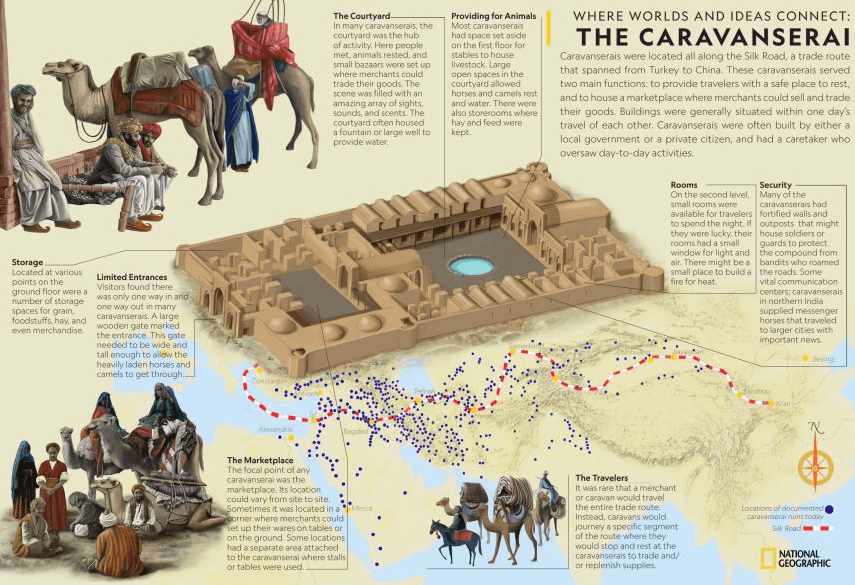
What I seek to illustrate in these five posts that make up The Sequence of the Seashells* is in all of its pluralities, a reminder that data rules of trade and exchange are vibrant and that we all have the capacity to access the 21st century economy with rules and infrastructure that do not exclude, oppress, enclose, or dispossess us. Translocal data markets are possible, operating like a commons, an in-between space that is structured, accountable, and intermediated.
We should consider that the traditional caravanserai that dominated pre-capitalist trade was truly an in-between space: a hub where goods, information, and trust were exchanged. The caravanserai was so much more than a truck stop off the interstate, it was a place where merchants rested, animals were cared for, news circulated, and credit arrangements were made. The caravanserai existed to make movement safe and reciprocal, combining storage, logistics, and social governance in a single physical site.
Travel Sketches between Empires
Hafiz Abru’s account in his Persian embassy to China, preserved in the Zubdatu’t Tawarikh, gives us a rare ground-level view of this system in operation along the Central Asian routes of the early fifteenth century. Aside from the remarkable and exotic cargo, what the account makes visible is the intermediary infrastructure that made the journey possible at all: the caravanserai keepers, the translators, the local governors who guaranteed safe passage, the provisioning networks that sustained a diplomatic party across thousands of miles of difficult terrain. When the system worked, it did so because every node in the route had an obligation to the next. Reciprocity was a trust network relaying a logistical logic that is relational to one another.
Wilfrid Blunt’s account of the Golden Road to Samarkand and Edward Schafer’s study of the T’ang dynasty’s engagement with foreign goods and peoples in The Golden Peaches of Samarkand together illustrate what this circulation actually produced. The T’ang court’s appetite for Central Asian horses, Sogdian silver, Persian textiles, and the performers and animals that traveled the same routes as merchants attributes political economy as a maintenance of relationships. Schafer meticulously catalogs what arrived in Chang’an. Sure, the peaches, the ostriches, the glass, the music, all the goods of trade, but the real value were the networks that again, like in Hafiz Abru’s account, kept Eurasia in productive contact across languages, religions, and imperial systems that had every reason to be hostile to one another. The caravanserai was the infrastructure that made this possible. It was moral as well as economic. Its value came from maintaining continuity — ensuring that distant communities could trade without continually falling into predation. Even its architecture reflected this ethics: open courtyards for transparency, multiple gates for inclusivity, and rules of hospitality that bound travelers to the host community.
Ibn Khaldun and the Asabiyyah
Ibn Khaldun, writing in the fourteenth century, gives this a theoretical frame that neither the World Bank nor the IMF has yet absorbed. The concept is asabiyyah — a term that resists clean translation but carries the sense of group feeling, social solidarity, the binding force that makes collective action possible across kinship lines, across occupational differences, across the ordinary frictions between metropoles. In the Muqaddimah, Ibn Khaldun develops asabiyyah not as a moral ideal but as a material force. It is what allows a group to defend itself, to sustain long-distance trade, to build institutions that outlast any individual member. Without it, dynasties would collapse and economies would cease to circulate. What the caravanserai provided was relational infrastructure — the protocol and reciprocity that allowed asabiyyah to function not only within a community but between them.
Muhsin Mahdi’s 1957 study is important here because he reads Ibn Khaldun as a philosopher of history in the full sense — someone who identified the internal logic by which civilizations generate the conditions of their own demise. For Ibn Khaldun, the problem is not external conquest, even though conquest eventually follows. The problem is what happens to asabiyyah when a civilization reaches the sedentary, urban, palace-building stage of its development. As a systemic thinker, his evaluation of empire is as relevant now as it was seven hundred years ago. He identifies wealth accumulation, the deepening division of labor, and the ruling group’s increasing removal from the reciprocal obligations that originally allowed it to consolidate power. He recognizes that rift when administration replaces solidarity; when mercenary armies replace citizen fighters; when tax collection ignores mutual and general welfare. Each of these conditions may appear individually rational, but collectively they hollow out the social fabric that made the whole structure viable. What remains is a governance empty of the relational content that originally gave it force.
In the opening chapter of one of my favorite novels, Cities of Salt, Abdelrahman Munif captures what Ibn Khaldun theorizes. Before the Americans arrive and before Wadi al-Uyoun is erased, the community’s moral economy is already under pressure from the merchants who pass through it. One of the saltmen addresses it directly: “How can you compare someone who works all year for his wage with another who makes more profit in a single moment.” The saltman is not asking this hypothetically. It is a judgment uttered with contempt. What Munif shows in that first chapter is that the people of Wadi al-Uyoun are not naive about the merchant’s indignation. They see it clearly. They have a moral framework that measures a person by their relationship to labor, land, and the obligations of the community they belong to. There is no lack of moral clarity, but what they do lack is the institutional infrastructure to defend that clarity against the force that is coming for them. The caravanserai, at its best, was the traditional practice, the interaction that slowed exchange down enough for obligation to operate, that made the fast merchant answerable to the slow community. When it disappeared, when the pipeline replaced the courtyard, what Munif’s saltmen knew became indefensible, and nothing remained to enforce it.
Even the Vakatabu…
In 2023, an intervention was held in Fiji among the chiefs, a vakatabu—a recognition that a new development discourse was needed to slow down for renewal and rejuvenation, strengthening the resilience and agency of Pasifika communities.
Slowing down is not a cyclical argument in the fatalistic sense. Ibn Khaldun is not saying that all civilizations will collapse, however, what he identifies is a specific mechanism of decay is the attention to reciprocity — the replacement of obligation-based interactions with accumulation and extraction. The caravanserai, on this reading, is the expression of asabiyyah extended across distance. It makes strangers into temporary members of an obligation network. The merchant arriving from Samarkand and the merchant departing for Tabriz do not need to know each other personally. They need to trust the institution that holds them both accountable to the same rules of hospitality, fair dealing, and mutual protection. That trust is asabiyyah at the infrastructural level — not the exclusionary solidarity of one tribal group against another, but the distributed, procedural solidarity of a commons that works because everyone using it has a stake in its integrity.
The neocolonial postwar economic order
This is what the postwar international economic order dismantled. The Bretton Woods institutions replaced reciprocity and obligation-based transactions with the conditionality regime. The structural adjustment program replaced the caravanserai with the pipeline. Communities that had sustained long-distance exchange through networks of reciprocal obligation for centuries were told that development required submission to a technical compliance system designed elsewhere, administered by specialists, and accountable to creditors rather than to the communities it claimed to serve. Ibn Khaldun would have recognized the pattern without needing the vocabulary of neoliberalism to describe it. The asabiyyah of the Global South was deliberately attenuated — by debt, by enclosure, by the conversion of communal land into collateral, by the replacement of local governance with compliance frameworks obtusely written so that the governed would remain strangers to the rules that bound them.
Restoring translocal data markets is, among other things, a project of restoring asabiyyah at the infrastructural level. Not sentiment. Not nostalgia. The concrete work of rebuilding the intermediary nodes — the clearing systems, the storage cooperatives, the broadband commons, the community insurance pools — through which reciprocal obligation can be made materially effective across distance, across difference, and across the governance gaps that extraction has deliberately widened.
Marx and St. Thomas Aquinas
As to the future, Thomas Aquinas, in Summa Theologica, Question XCVII, addresses the conditions under which human law may legitimately change. His answer is carefully structured: law should not change for the sake of change, because the stability of law is itself a social good — people organize their lives around it, and disruption carries a cost even when the new law is better than the old. But law must change when it no longer serves the common good it was designed to protect. What Aquinas is describing, in the language of scholastic theology, is an accountability standard. The law is justified by its relationship to the community it governs and the obligations it upholds. When that relationship breaks down, or when the law serves accumulation rather than the common good, or when compliance regimes become instruments of exclusion rather than frameworks of participation, then the ground for change is right for rebellion, or in the case of compliance, restoration.
Like Aquinas, restoring laws for the common good, Marx also describes in his Critique of Hegel’s Philosophy of Right. When one considers that Marx is really discussing law’s claim to universality against bourgeois interests and greed, what may appear to be revolutionary is simultaneously the most conservative argument available (Marx. 58). In the postwar era, the question of revolution as systemic change has time and again been captured by the same interests it claimed to displace. What presents itself as transformation — the developmental state, the structural adjustment program, the green economy, the digital platform — reproduces wealth accumulation and economic disparity under new administrative language, leaving the population whose security was invoked as justification no closer to the common good that both Aquinas and Marx, from opposite ends of history, understood as the only legitimate ground for law.
While the postwar global supply chains have changed the way we produce, consume, distribute, and value exchange, 21st century data should be seen as the paradigm shift, the great equalizer that can both flatten north-south disparities and provide access for all those who have been largely excluded from economic participation: indigenous peoples; peasant farmers and fisherpeoples; migrant communities displaced by climate or war; the racialized and structurally excluded urban communities.
A language of relationships
If the world does not look like a caravanserai, we should consider that the technical language across all sectors of compliance excludes people — including native English speakers — from participating in what should be as simple as a handshake or a formal greeting on the mat, a kūkākūkā in Hawaiian, or more broadly a Pasifika talanoa. Exclusion is often engineered through language before it is enforced through law. This technical complexity is treated as professionalism or expertise, yet much of what governs economic life is, at its core, an elaboration of basic human agreements: to count honestly, to verify what is true, to honor obligation, and to steward shared responsibility. When these processes are buried beneath inaccessible terminology, communities are taught to believe that governance belongs to specialists and technologists rather than to themselves. Aquinas would recognize this immediately: a law that the community it governs cannot read has already begun to fail its purpose.
Decolonizing accounting therefore begins by translating institutions back into the language of relationships, where economic participation is understood not as submission to technical systems, but as the organized extension of trust, faith, morals, ethics, and virtues. The caravanserai did not require a compliance manual. It required a shared understanding of obligation. That understanding is what we should be restoring— not in stone courtyards along the Silk Road, but in the distributed, community-anchored infrastructure of a translocal data market that the 21st century both demands and makes possible.
go to next Behold! The World Data Organization
previous: The Crusoe Economy
References
Aquinas, Thomas. Summa Theologica. Translated by Fathers of the English Dominican Province, Burns Oates & Washbourne, Ltd. 1947. Question XCVII.
Blunt, Wilfrid. The Golden Road to Samarkand. Hamish Hamilton, 1973.
Hafiz Abru. A Persian Embassy to China: An Extract from Zubdatu’t Tawarikh of Hafiz Abru. Translated by K.M. Maitra, Paragon Book Gallery, 1970.
Ibn Khaldun. The Muqaddimah: An Introduction to History. Translated by Franz Rosenthal, Princeton University Press, 2015.
Mahdi, Muhsin. Ibn Khaldun’s Philosophy of History. George Allen and Unwin, 1957.
Marx, Karl. Critique of Hegel’s Philosophy of Right. Translated and edited by Joseph O’Malley, Cambridge University Press, 1970.
Munif, Abd al-Rahman. Cities of Salt. Translated by Peter Theroux, Vintage, 1989.
Schafer, Edward H. The Golden Peaches of Samarkand: A Study of T’ang Exotics. University of California Press, 1963.
*This is the third of a five-part series called Sequence of the Seashells, outlining decolonial data governance and translocal market infrastructure, which is all about describing how communities can reclaim authority over the compliance chains that determine the value of their own ecological and social data.
The sections are What is Data, The Crusoe Economy, The in-between space is a Caravanserai, Behold! The World Data Organization, and Translocal Intermediaries.Please share and subscribe!