The foundation for economic and ecological justice begins with our accounting system.
Intemerate Accounting is a just, fair and equitable ecological accounting scheme assessing the value of our ecological-economic interactions, and applying the resulting data toward reversing climate change’s impacts through restoration. Accordingly, this accounting scheme values our data offsets, rather than measuring the commodity or resource itself.
We can all provide customary services of conducting inventories, collecting statistics, publishing data, determining conditions and trends, examining and analyzing changes, summarizing data, collecting and describing, compiling, measuring, researching, monitoring, managing our ecological biodiversity, that interaction is economic and traditional, and when we manage our commons, we restore the planet and our humanity.
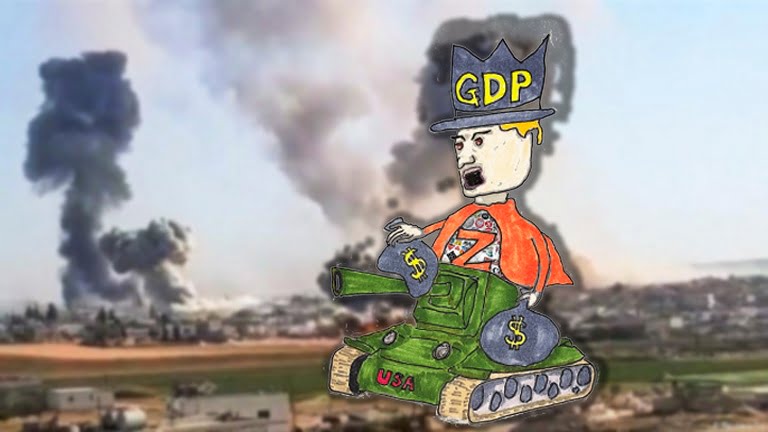
The rationale over how we account for GDP is important. The United States has a disproportionately unfair and unjust advantage over most other countries over how it accounts for military expenditures.
The US BEA pushed for these accounting revisions before the UN System of National Accounts back in 2008. Arguing that “national security” benefits our national income as a fixed asset is a spurious logic that only benefits militarized economies, especially considering that the more just, fair and equitable “ecological security” was rejected.
Fixed assets are essentially infrastructure, or “common good” accounts that CANNOT easily be converted into cash. What the US did was change how we accounted for weapon systems, away from being an inventoried expenditure, something we account for when we take it off the shelf.
Imagine that in 2008, we could just as easily have had environmental degradation and resource depletion and household work accounted for in our national income estimates.
Here is the argument from the U.S. Bureau of Economic Analysis as to why Military Weapon Systems need to be treated as a fixed asset:
“The 1993 SNA states that destructive military weapon systems designed for combat, such as warships, fighter aircraft, and tanks, should be treated as intermediate consumption by general government rather than as fixed assets. This treatment is problematic for several reasons:
It fails to recognise that weapon systems provide a nation with economic benefits by protecting the liberty and property of its citizens.
It fails to recognise the role of capital in the production of defence services.
It fails to recognise that existing military equipment have value and can be sold.
When a government sells or transfers used military equipment, the treatment requires a counter-intuitive accounting entry of negative intermediate consumption.
The distinction between destructive equipment and non-destructive equipment that can be used for peaceful purposes is difficult to make in practice.
The treatment of military equipment used by the military is inconsistent with the treatment of the same equipment (for example, armoured vehicles) used by internal police.
The treatment is inconsistent with the latest international public sector financial accounting standards.
Many countries now maintain military equipment for long periods and are concerned about scheduling and providing for its replacement. “
To be clear, high GDP does not always mean that countries need to focus on military systems. Sometimes, as in the case with China, it really does mean positive growth of national income. The difference is that in China, the evidence is tangible with the rise of living standards and the hundreds of millions of people having moved out of poverty over the last two decades. Contrast that with the United States where millions have fallen out of the middle class and stagnant wages have only increased the cost of living. If people have less financial security and environments become more fragile when GDP increases, then clearly there is something wrong with how we account.
Imagine if ecological justice hawks and warrior accountants were sitting at this table rather than war department weapons industry and war machine lobbyists.
This is why ecological revisions to our national accounting system needs the participation of developing countries, indigenous and customary peoples and poor and impacted peoples. We would never allow this….
Maxim: Economies measure our interactions with people and the environment. Arrow: Aim for trans-local and inter-global reciprocity for a restoration economy.
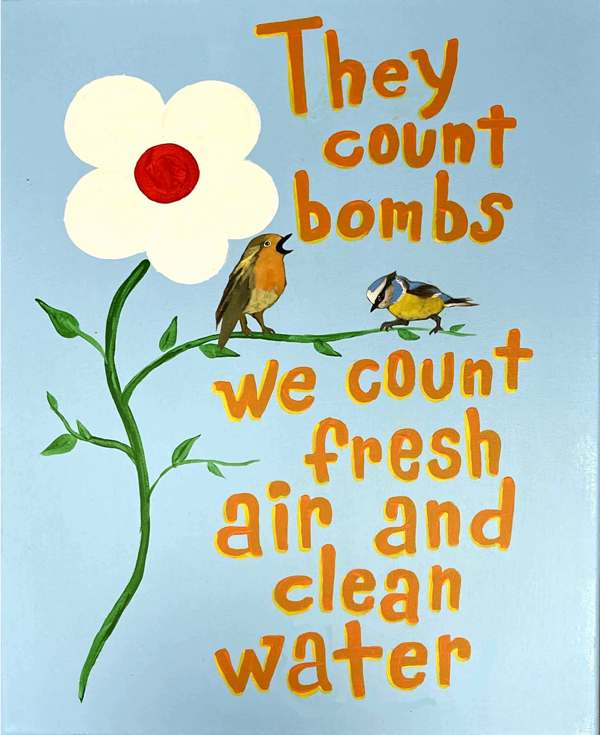
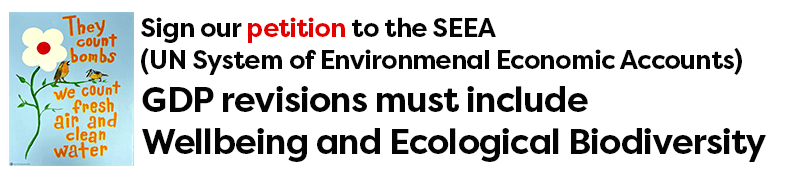
As people of the ocean, forests, mountains and plains, people in cities, farms and rural spaces, we have long engaged in trade and supply chains. That is a reciprocity that we must restore because it belongs to us, not investment cabals. Militarized economies that count bombs before trees, and values the shroud of industry before fresh air and clean water have done their damage relegating some families to pick through the waste of our consumption while others flounder in luxury, unwilling to hear the wails of extinction, the loss of habitat and the asphyxiation of those struggling for breath. The shifts of nature have turned violent, yet economies continue to privilege the actions of those muted in gated communities rather than warriors defending regions from plunder and the millions of hands repairing the open wounds of environmental degradation and resource depletion.
To some degree, the evolution of our species has been bound and stacked atop totemic signifiers that have derived a historicism of “us” and “them” and “we” and “none.” As a specie we dotted the planet in social constructs across all environments as if testing the limits of who we are and how we self-identify. We are a mountain people, an ocean people, an island people, a desert people, a warrior people, a hungry or thirsty people, we are a people that are chased away, and we are a people that build walls. It would not be wrong to say that most of our existence on this planet has been as nomadic peoples and that our commitment to spaces and locales are based upon historicisms that may be little more than geographical bubbles.
Maxim: Survival of the fittest is a lie. Arrow: Our planet thrives with mutual aid, and as we see again and again, being the strongest never guarantees our survival; rather, the inverse is true, as power and greed has hastened collapse and extinction.
Civilization as we have come to understand it, was built the moment we began to understand the benefits of our division of labor and our understanding of exchange, markets, and supply chains. We gave it those us-and-them names, and also numbers that signified “many” and “none.” Now those numbers, define the Anthropocene, numbers like 7 and 8 billion, which some futurists predict may one day become none if this planet should soon become an uninhabitable wasteland.
Our totemic identifiers may have become little more than placeholders establishing imagined legitimacy of a fictionalized history suggesting that to be civilized means to have been found or discovered. The powerful have attained recognition by subscribing to an economic belief emphasizing that “survival of the fittest” privileges the bully.
However, it is Nature that continues to prove the inverse to be true: that mutual aid and inter-dependence is the path to survival. Our ecological biodiversity is the principle truth, not the power wielded by privatization and militarization. Our population, the 7 soon 8 billion, that is not the number of extinction, those are the 7 and 8 billion pairs of hands that will restore our ecological biodiversity, and define our Wellbeing.
Whether islands in oceans, or mountain villages, or gated in cities or affluent suburbs or enclosed in shantytowns and ghettos, we have evolved far beyond the historicist’s vision of an origin story. Ours is a story of supply chains. We divide our labor, we engage in exchange.
Whether we walk or sail or fly whether we journey or aimlessly drift, the geography of islands, deserts, oceans, and mountains may, to some degree have determined how natural partitions give boundaries to who we are, but the movement of people towards markets of exchange reject the imposed partitions of states and islands and instead recognize oceans, mountains and deserts as merely the spectacle between markets, the interstitial space that would eventually define the breeding ground for military campaigns and conquest and the wastelands of nuclear testing or dumping. We are all migrants living within and between markets of exchange.
Some may self identify as puritans, yet they trade as cannibals, as violent traders that cannibalize markets. Their economy is predatory and fierce. In the history of the world, there is no greater example of a cannibalistic system than the waning days of neoliberalism when Wall Street spectacularly imploded our financial system as investment markets consumed their own debt, hungered for credit default swaps, and feasted on derivatives and debt securities.
As we have imposed the capitalist moniker atop every tower and monument, will this system remain as if the conclusion of our human development has only evolved to reach this place?
No.
How can we approach human reciprocity and exchange when the stratifications of trade and commerce divide us? When assumptions over economic and ecological biodiversity continue to privilege a discourse that governs the flow of trade towards a center of power that manipulates what is political, sovereign and legal, the production or truth, the manufacturing of consent punishes difference and deviancy with tactics of exclusion, obfuscation, and containment.
We cannot consent to climate proposals that are backdoor privatization schemes enforcing how we count, examine, protect, nurture, analyze, collect, describe, compile, publish, monitor, manage, and value our environments.
We cannot enforce Sustainable Development as another top-down process where international organizations try to exploit our consent.
This is the time for Peoples of the World to mobilize against a common foe, against those forces of tyranny and industrial greed perpetuating a system that continues to alienate us from our indigenous and customary interactions with our land and resources.
We support sound climate goals and respect the science, but not at the expense of alienating us from humble traditional livelihoods.
We are trans-local and inter-global, and require an economy that is just, fair and equitable.
Maxim: GDP is not healthy for people and planet! Arrow: Changes to National Accounts must include a robust revision of our Wellbeing and Ecological Biodiversity.
We have nearly 50 years of evidence that our national accounting system has been grossly unjust, enforcing immense disparities between the so-called advanced economies and the rest of the world.
How our countries account for economic growth has put our environments at risk. The aggregates for GDP, or our Gross Domestic Product, are built upon the eroding pillars of Production, Consumption, Distribution and Exchange of Goods and Services, with no accounting of our Wellbeing or Ecological Biodiversity.
With this new United Nations environmental accounting system, there is a tremendous opportunity for developing countries, indigenous peoples, and interfaith groups to mandate Wellbeing and sound ecological priorities, that could set a new just, fair, and equitable path forward in how we measure our interactions with the global economy.
Maxim: The logic of Disaster Capitalism has shackled Carbon PPM in our Atmosphere. Arrow: Ecological Data is a Peoples Commons, a 21st century pathway for people to participate in an economy based on restoring our climate.
When the pillars for measuring economic growth were built between the World Wars they were designed to measure industrial outputs, labor, land and resources, and trade in international markets; interactions that would give value to our national monetary system. When it was standardized by the United Nations in the 1950s, GDP was adopted to provide all the newly formed countries with an economic roadmap that would help navigate their way into the international system.
Upon its adoption, it was not intended to be a neocolonial or anti-communist tool, as different countries and economic systems used national accounting in ways that privileged their own social and economic strengths. It was simply a guideline to measure our industrial economic interactions.
After the dissolution of the Soviet Union in 1989, GDP was revised to reinforce the neoliberal privatization and capitalization tools that entwined transnational corporations with freemarket governments, giving investment regimes tremendous economic advantages over small economies.
The objectives of that 1993 national accounting revision became a system that benefited the priorities of privatization and capitalization at a time when the unipolar, neoliberal system was well positioned to take advantage of desperate economic conditions resulting from the Soviet collapse. Today, climate change is no different: Disaster capitalism is a vulture preying on Vulnerability, Fragilty and Conflict.
Despite attempts to include environmental degradation and resource depletion, and household work into our national accounting system, in the 2008 revision, national accounting was again revised, this time to include military systems and Research and Development, further enhancing the priorities of militarized and advanced economies, while ignoring global health and our ecological biodiversity. Despite the fact that in that very same year, the Wall Street financial collapse proved that the neoliberal system was not only grossly unfair, and unjust, but also systemically deficient, privileging the corporate 1%.
Maxim: A top-down consent process in not consent! Arrow: We must invoke free prior and informed consent, and develop our our own methodologies!
Maxim: Ecological Data is a Peoples’ Commons and is not for the management by privatized and militarized conservation regimes. Arrow: Invoke new accounting methodologies valuing our interactions with peoples and the restoration of our environments.
Restoration of our ecological biodiversity belongs to the People, not for the financial benefit of privatized and militarized Conservation Regimes.
Maxim: A Peoples’ Campaign is inter-global. Arrow: We must aim for trans-local exchange. Reciprocity in the 21st century must not contain or obstruct people-to-people development of our ecological engagement. We all share in our ecological biodiversity.
What is ecological works. That is the fundamental by which we should be measuring our laws and economies.
We can no longer afford to talk about our economy as something divorced from ecology. We need to be clear that in the case of our planet, our ecology works. Millions of years of evolution has created an ecosystem of mutual interactions, and for thousands of those years– maybe tens of thousands– humans have developed a notion of economy: of trade, infrastructure and supply chains.
It is simple enough to trace the evolution of law and economic principles and we can readily pinpoint the moments in history when industry-friendly governments promoted their laws above the laws of nature. As we look for solutions to fix our existential crises, why do we turn to outdated economic models that created these crises to begin with?
Throughout industrialization, militarized economies continues to enslave, displace, rob, contaminate, contain, obstruct and exterminate cultures and environments. An economy must EQUALIZE and REPAIR that wrong.
Revising national accounts can promote a new system that brings our economy and ecology into harmony.
The World Council of Churches and the Pacific Conference of Churches hosted a webinar on the Reweaving the Ecological Mat program conducted by the Pacific Theological College, the Pacific Conference of Churches and the Oceanic Centre for Arts, Culture and Pacific Studies, University of South Pacific. The REM program was a three year program that explored how our ecology, economy, and cultural wellbeing could be a viable and tangible way to account for our future.
If climate change is the greatest threat to our existence on this planet, what the REM program did was to offer a solution on how to reverse climate change and pollution while promoting wellbeing and development for our region. This was done not by asserting another top down program demanding our consent, rather, through a bottom up program that respects and values people and planet.
Dr. Reverend Cliff Bird discusses the Oikonomics, a return to the ecological, economic, ecumenical and cultural relationship from which these terms derive;
Dr. Elise Huffer introduces the cultural and wellbeing factors necessary for any Pacific development scheme;
Arnie Saiki lays out what is behind the intermerate accounting scheme; and
Daphne Kiki, provides a view of the role our Pacific youth will need to play to shape our way forward.
What I think is clear is the role our churches and other religious institutions are going to need to perform to promote a new accounting framework if we are to survive the greatest existential challenge we have ever had to make.
Question 1: Do you have comments on the overall draft of the SEEA Ecosystem Accounting?
SEEA intervention from the Intermerate working group on data, statistics and valutation
Ecological accounting is the foundation that we, as an interdependent global society, require to determine economic value and to safeguard that which cannot be given price. The SEEA and our preferred approach to ecological accounting both spring from the recognition of this fact.
This is because these values are unreliable indicators of the overall impact of production on our lives and our planet, being based on the exchange prices of labour, land and other factors or resources which are in turn skewed by exchange rates, historical conventions and the relative scarcity of the item in the market in which it is purchased and consumed.
The logic of the SEEA is, as often repeated in the draft document, the provision of reliable data and information to facilitate decision-making.
Indeed, the document does provide clear definition on ecosystems, their extent, condition and interaction with the economic.
We applaud the effort to develop a platform that would allow adoption of environmental-economic accounting by national statistical offices and countries across the globe.
Historical Background
However, considering how the SEEA has progressed since the World Commission on Environment and Development in 1983;
Proceeding to the formation of the Integrated Environmental Economic Accounting workbook in 1992 where it was affirmed that “the economy was a part of nature and that integrated environmental and economic accounting should not consist in an economic accounting of the environment; rather, the economy should be treated as part of an environmental accounting system;”
Recognizing that the revision of the SNA in 2008 rejected environmental degradation and resource depletion because it was “too experimental”, while moving Military Systems from an inventoried account to a fixed asset, which embraced a value of National Security over our global ecological security;
Recalling that the 2012 Central Framework where environmental accounting structures are being harmonized for private investment regimes;
And concerned that the current 2020 Ecosystem account where our ecological asset valuations are set to be standardized to investment markets;
As a working group we feel the need to intervene with a People’s equation for an ecological-economic account
We submit that biodiversity underlies both current and future factors of production. Climate change and environmental degradation constitute a massive factor in reducing wealth creation, and pose imminent danger to effective democratic and economic systems.
We submit that environmental assets and ecological services are defining features of our choices with regards to civilization and human settlement. Individual administrative areas, especially cities are already historically defined by environmental conditions, most notably the availability of water and arable land. It is fundamental for the maintenance of human civilization that reference conditions be established and restored in a manner that combines the advantages of technology, democracy and traditional stewardship. We submit that ecological accounting will only be effective if it increases communities’ sense of engagement and efficacy in recording, safeguarding, and increasing ecological value.
We respectfully reject this initiative, and ask you to support a People’s Revision of ecological-economic accounts, and submit our equation to be considered for the improvement and democratization of the current national accounting system.
Comments by sets of chapters
Question 2. Do you have comments on Chapters 1-2 of the draft SEEA Ecosystem Accounting?
1.4.3 Connection to the System of National Accounts In earlier iterations of the SEEA (2003), the aspiration for reversing climate change was to fold GDP into the SEEA. At face value, that would suggest that degradation would be accounted for as a deficit rather than to enhance the value of depletion. We feel that in principle, it is disingenuous to expand the value of ecosystem assets in order to compensate for degradation and loss. This inversion of now folding the SEEA into the consumption and production values of GDP will do very little to reverse climate change and instead seeks to use ecological accounts to enhance GDP by expanding the value of ecosystem assets, which benefits further privatization of our public assets like water.
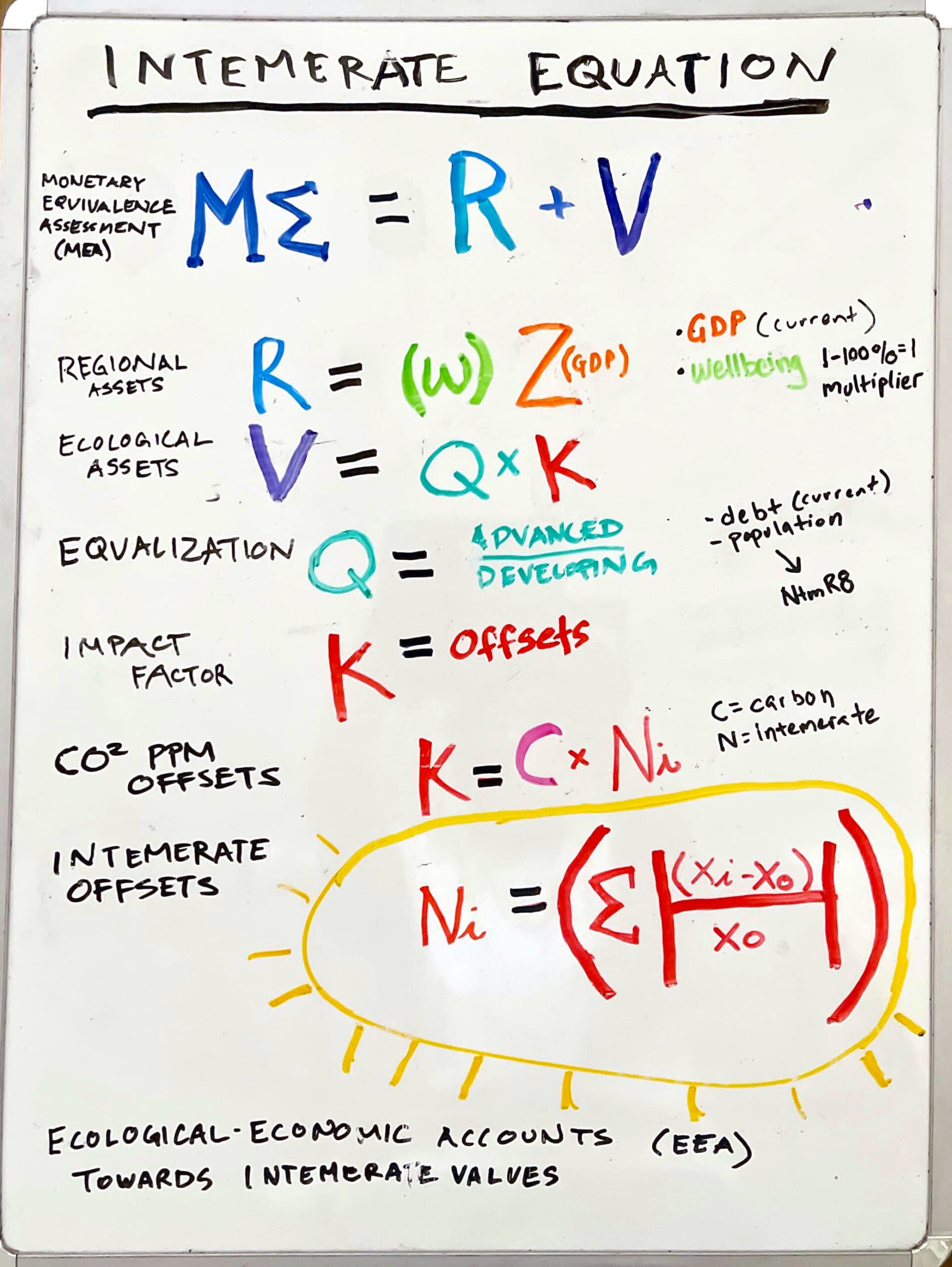
Our intemerate equation does not put a value on our ecological biodiversity, anymore than we would put a value on immaculate conception. If we believe that existentially, our ecological biodiversity is sacrosanct, one would not undervalue degradation by overvaluing depletion. In our accounting matrix, we acknowledge GDP and the function of investment markets and service industries. What we have done was to put the value on what we call the intemerate offsets, thereby treating restoration as a service, and allowing states to transition away from GDP at their own rate, while measurable indicators value restoring our ecological biodiversity towards the intemerate baseline.
While GDP may very well reflect the US and privilege NIPA over other accounting systems, by definition, our national accounts are supposed to mirror a country’s economy. For developing countries, GDP has never adequately reflected the productive interactions between peoples and their environment. Hence, our intemerate accounts, establishes an accounting sidetable for developing countries who will benefit from a restoration economy. It will not take anything away from already existing industries and partners, but our accounting sidetable will adjust GDP towards our intemerate assets, and place well being as a modulator to the country’s GDP.
Question 3. Do you have comments on Chapters 3-5 of the draft SEEA Ecosystem Accounting?
Addressing 5.8x, While we understand the need to mainframe and standardize aggregated values, particularly for investors, the weighting of values does not properly account for the relationship that people have with their land and resources. Our ecological data must remain the property of the state/community. It will be far too easy to perpetuate economic disparties through capitalizing data if we standardize the measurements of standards and fllows. It will be far too easy to undervalue that which is sacrosanct, and overvalue that which primarily values degrading and depleting industries.
Our intemerate model values the offsets and monetizes the incremental restorative offsets rather than commodify ecological assets, and weighs values according to people and their relationship to their resources. What is standardized are the offsets, and those can be valued to the marketplace.
Question 4. Do you have comments on Chapters 6-7 of the draft SEEA Ecosystem Accounting?
The benefit of the SEEA has been an in depth analysis and description of linking biodiversity and ecosystem services. I would only add that we all have the opportunity to measure, to count, to examine, to protect, to nurture, to analyze, to collect, to describe, to compile, to publish, to monitor and manage our environments. This is a service, and it is how we interact with the environment. Global peoples need to play a greater role in ecosystem services. It is the Peoples interactions that should be accounted for in our national economies.
Question 5. Do you have comments on Chapters 8-11 of the draft SEEA Ecosystem Accounting?
Understanding that there are different strategies for monetizing ecosystem services, the SEEA has an opportunity to promote a system where traditional and customary peoples who have stewarded their lands and environments for generations will benefit as we move towards a restoration economy. It is also important for people to “own” and manage their own ecological data. The environmental data will be a tremendous revenue source for people, especially as markets for environmental data become more defined.
The intemerate accounting framework includes a financial scheme that includes equalization, promoting just, fair and equitable accounts.
Question 6. Do you have comments on Chapters 12-14 of the draft SEEA Ecosystem Accounting?
In 12.30 of this draft, it states that it was considered that there was no market of institutional mechanism by which the restoration costs are confronted with the benefits associated with the change in environmental quality.
I beg to differ, and would cite that the justification of moving weapons systems to being a fixed asset was extremely imaginative, even if it does not make sense in the context of valuing peace. Valuing weapons systems according to the value of national security is a slight of hand that is also, probably very difficult to justify when weighted against the value of our environment, our ecological biodiversity and our general welfare.
The best accounting minds in the UNSD might easily dismiss our intemerate equation because it does not fit into conventional aggregates or standards, but then, those same accounting minds should also put to task the same energy to remove how weapons systems are accounted for. The best accounting minds should also consider how intemerate accounting– how a people’s accounting framework– can reverse the impacts of climate change and move the global economy forward in a way tht embraces the spirit of the 1983 World Commission on Environment and Development, and find ways to enhance the global economy rather than to manage it under the same economic system of management that led to the ecological miasma we are currently in. Thank you for your time and the opportunity to submit this intervention.
Hello everyone, my name is Arnie Saiki and I’m part of an independent working group on data, statistics, and valuation. working on an ecological-economic accounting system that we call intemerate accounting. Intemerate means pure, inviolate, and sacrosanct, and it is predicated on the notion that our ecological biodiversity is existential and as such cannot be valued as a commodity. What can be valued however are the offsets and our interaction with each other and our environment, and that is the foundational principle behind our intemerate accounting scheme.
We are at a time when we are all seeking solutions to a planet in crisis. As evident, the world is clearly in crisis and while most of us have put the coronavirus pandemic at the forefront of dealing with the social and economic aftermath, the crises of climate change looms larger in the background. Setting the clock back a year to before the pandemic, it’s important to remember that the neoliberal economic system was already in turmoil. National public debt had already surpassed the 90% debt-to-GDP threshold of the advanced economies and developing countries had already begun to shift their attention towards China and the Belt and Road Initiative because it provided a much better alternative than the western counterparts.
The COVID-19 pandemic exacerbated any notion of economic recovery, and while COVID-19 is blamed for our economic downturn, it’s important to remember that the economic downturn happened in 2008 with Wall Street financial collapse and how the larger economies remained solvent through debt vehicles like Quantitative Easing of which trillions of dollars were poured into the advanced economies.
Because of time, I’ll leave the economic reading there, and if there are disputes we can come back to that, I just want to make clear that we understand that COVID-19 was not a catalyst for our economic downturn, but rather a symptom.
So having said that, as we look for solutions to fix our economic and ecological crises, we have to understand that the interactions between our ecology and economy are absolutely and fundamentally intertwined. When there is a disconnect between the ecology and economy, the assumption should be that there is something that is not working. In the case of our planet, our ecology works. Millions of years of evolution have created an ecosystem of mutual interactions, and for thousands of those years, humans have developed a notion of the economy: of trade, infrastructure, and supply chains that interacted with the world. The ecology is what works. That is the fundamental by which we should be measuring our economies, our laws, our trade, infrastructure, and supply chains. Not the other way around.
It is simple enough to trace the evolution of law and economic principles and we can readily pinpoint the moments when industries promoted these laws above the laws of nature. So when we look for solutions to fix our existential crises, why do we turn to economic models that have created these crises, to begin with?
But of course, the crisis of climate change, biodiversity loss, and the threats to our ecological sustainability is much greater than either the coronavirus or collapsing economic failures, as these are long-term, fundamental, and existential and cannot be fixed with a vaccine.
What provides some hope, however, is our young people who can fight for change. Young people travel to the far reaches of their imagination every day and find solutions to problems. It doesn’t necessarily matter whether they believe in magic, spells, incantations, religions, or abstracted political or economic notions of democracy, justice, capitalism, communism, or karma. These are all distractions. What is needed is good global governance, a strong regulatory regime, and an economic interaction that works for people’s health, and the environment, our ecological biodiversity as a whole.
There will not be an economic miracle as long as neoliberal principles of privatization continue to militarize people’s access to their environments and basic livelihood. It is absolutely evident that how we begin to heal this existential crisis is by restoring our ecological biodiversity while promoting people’s interactions with their environments.
How we do this is to implement a new ecological accounting paradigm. There are many methodologies and routes that can be utilized and we should encourage indigenous and local methodologies to be explored. But we need to be clear that this does not include the privatizing of environments by conservation cabals that end up privatizing technologies in surveillance, monitoring, protecting, etc, nor should we be valuing resources like water as commodities that can be traded in futures trades on wall street.
First and foremost, we should promote a transitional national accounting scheme that includes well-being while valuing the restoration of our ecological biodiversity.
As part of the Reweaving our Ecological Mat program, our objectives were to reimagine the Pacific to restore our ecological biodiversity while supporting the developmental needs of our peoples and created an equation that could be used as a national accounting side table.
As we pursued this we realized that this accounting side table could be used to support trade, infrastructure, and supply chains for the benefit, and within the logic of our ecological biodiversity across developing countries, particularly in the ACP.
Now in the time of the coronavirus, it has become apparent that we may have created a transitional equation that allows all economies to shift towards greater equalization.
The intemerate equation is tangible, it is like a seed that we can plant and begin to reframe the global economy to a place where economy and ecology can once again be harmonized.
And while it is something tangible to provide hope, I don’t want to suggest that this is the only solution. This will require work and mutual cooperation, and there are some who will violently obstruct any attempt to promote just and equitable governance, even at the risk of planetary existence.
and how I come to use this somewhat obscure word is that it really defines the idea that our ecological biodiversity is existential and as such cannot simply be valued as a commodity, but rather valued as part of a pure and sacrosanct system. The other thing is that the root, temer means fear or dread, which is an apt description of how I think we feel about the world if our economic system does not change.
Officiating the Voices in the Deep (VOID) art exhibition, it’s really good to hear the President of The Republic of Fiji, His Excellency Major-General (Ret’d) Jioji Konusi Konrote, speak so favorably about the Reweaving the Ecological Mat movement.
With his attention fixed on these issues around our ecological biodiversity and the process for national accounting, the hope that he references might turn to practice and action.
Our Pacific Voyagers carry a tremendous burden. They carry the weight of our history and who we are as Pacific Islanders. They are risk takers who defy western conventions to prove that our traditional knowledge has a place in the world. They are revolutionaries who defy decades of the colonial system that has sought only to diminish our customary knowledge and technologies. As heroes of the Pacific, they have also become metaphors for struggle, for faith, for diligence and resilience.
As Pacific Islanders, we hold our traditional navigators high because they represent the value of who we most identify with in the world. Culturally, we move through the world with the regality of ambassadors. When we speak, our voices are heard and our music and dance brings joy.
Yet when it comes to valuing our inherent Pacific assets, why do we suddenly become weak, dependent, our hands wide, arms stretched across the ocean as if we have lost our way home. How do we not know our own value?
Our ecological assets are immense, yet for some reason, we do not believe in the value of our ecological assets. As part of the global economy, we have the ability to interact with the world as equals– with mutual cooperation and exchange.
There is a constellation that our Pacific Navigators have traditionally followed. In Hawaiian it is called Hanaiakamalama (“cared for by the moon” otherwise called the Southern Cross) and its alignment with the navigational starline to Ka Iwikuamo’o was a backbone for our Pacific Voyagers to traverse our Liquid Continent.
Our ecological way forward is in view, and just as our Pacific Voyagers can stand on the shore and look towards the heavens to know when it is time to voyage, it is time for our leaders to move us forward now, rather than hold us back by signing legally binding investment and trade agreements that will further tether us to the post-colonial ambitions of our so-called big brother countries.
The navigational star line is in front of us. Our regional economic well-being is in front of us. There is a rational accounting framework that reflects who we are and measures our engagement in the global economy.
When one considers the wake-up call that is Covid-19; or that the western economy is in shambles; or that Australia’s fear of losing its control over the Pacific to China who is offering the region access and infrastructure; or that there are new data technologies in communication, finance and artificial intelligence that would benefit our regional security; or that there may be an economic incentive to finally liberate us from our struggles against extractive industries, depletion and degradation… it is as if the heavens finally heard the clarion call of Epeli Hauofa and lifted the obstructions and barriers that have kept us tethered to the yoke of colonialism.
And so, if we are so free then why are we still standing on the shore with our hands and arms outstretched? Maybe we have lost our understanding of value, the way that we almost lost our ability to read our navigational star lines. What motivates our liberation in the Pacific must be more than cultural, it also has to be economic, for if it is not, we will not be able to adequately address climate change on our terms, nor will we be able to remain in our homes. But what is the future that we want? Is it to enhance our well being and steward our environment with our own resilient technologies?
This requires investment and capital that neither Australia nor the US will provide, unless they can own and privatize it. With a new ecological accounting framework, we can increase our national accounts and provide our own services to meet the needs of our region.
Who is really saying that the Pacific cannot assert an economic-ecological scheme independent of the post-colonial privatization agenda?
For those who say “no,” then they are no different from the early colonizers who set fire to our voyaging canoes, ensuring that they restrict our movements. Whose vision do we really hold when we dream, what language do we speak? It is evident that the only ones who would seek to inhibit our attempts to advance our ecological-economic ambitions are the very same ones who want to continue exploiting our resources.
A Pacific economy should not simply be a dream or something one hopes for.
But what is the cost of this Just, Fair and Equitable society? Is there a value of the dream?
Ecological Economic Accounts provides a formula for how we can actively protect and restore our ecological biodiversity. Rather than simply give value to what we extract, we can also account for the cost of environmental damage, revalue our food and water security and our well being?
Value and costs are tricky because they are terms that can slip in and out from being measured with money. Not everything that one buys is valuable, while what has the most value can often not be monetized no matter how much investment markets try to assign a monetary value on our public and existential goods.
If we approach the world as a commodity, then it is only the few who expend capital that are setting the costs by placing its value in the marketplace.
And if the few who expend capital enforces the commodification of the world, then it is we in the world that has to change what things are worth.
National accounting is supposed to mirror our economy, our society, our interactions. If GDP is the standard by which we measure our economy, it is obvious we have no place in it. If we do not manufacture, if our populations are too small to have a viable well rounded labor source, if our production capacity is limited to just a few resources like coconuts, shells or fish bones, if the transport of our goods across borders cost too much, if we do not have an aircraft carrier, then clearly we are not looking at ourselves in a mirror. We are not seeing who we are, that we are all Pacific voyagers.
In 2013, Dr Wayne Kublalsingh gave an inspiring Ted talk called “An Island not for Sale.” He addresses the inherent value of our economic life through the microcosm of Trinidad.
I hope everyone is having a good day, and that everyone is well.
Intemerate Accounting addresses a subject that many find to be technically challenging and I can’t say that I have been successful in my attempts to engage people with the fundamental question about national accounting systems—that question, primarily, is why do small economies and developing countries not have the same access to valuing their economies as the large, industrial, advanced economies do?
But I think that maybe I’ve been asking the wrong question all along, what I should be asking is, “Has everyone had a good day? Are you all well?”
If you are not well or if your day was not as good as it usually is, if you feel tired, or anxious because things seem bleak, or if you feel like the work that you are doing is underappreciated, or that your household cannot support itself and you’re having to rely upon your uncles and aunties for help even though you know that they too are struggling, then maybe we have to rethink what is of value to our lives, or our families, or our communities, or our countries, or our region, or our world.
On the other hand if we are hopeful, and motivated and as a whole feel that what we do has purpose and that there is food and clean water and that there is security in our environment and that in mutual aid we can help provide for others, these are the qualities of well being.
An economy is after all, a measurement of all of these things and how they interact with each other, and especially with nature.
Well-being is very important. When I ask, have you had a good day? It has value. Our homes have value because we are raising our families. Our houses of worship have value because they are nurturing our communities; our governments have value when they provide for our general welfare.
And if we are fed and provided for, what is the value of giving thanks or helping the household? What we generate has value. Our education, the road we travel, the sights , sounds and fragrances we pass, the litter we pick up from the side of the road and shorelines, our environments and the ecological biodiversity that sustains us, these are our natural, cultural and well being assets and they are important. What we do counts. And that is our economy. And so imagine, that we all have a baseline, or a standard by which we measure our good days and bad.
And so as we look at our lives, we know that some things can be monetized and some things can’t. Can my personal well being or my household be bought and sold on the market? Well, yes, our personal health data can be bought by insurance companies or health services, and of course our homes are put on the market, but not everything can be monetized, nor should it be.
There are some things that are sacrosanct, sacred, pure, intemerate, and should not have a monetized value placed upon it.
One example of this is our ecological biodiversity. Should our environment be valued against the cost of carbon in our atmosphere? Why should the large economies that make trillions of dollars offset their pollution by managing or accounting for our environments that we have stewarded for generations.
The value of our environments are far more valuable than the pollution and waste that they use to produce and consume goods in trade. So why do the people who manage their companies, the CEOS and COOS be more valuable than we who manage our environment, our elders and kupuna who hold deep knowledge over our interactions with our environment. National accounts make no sense in what and how they value, they are irrational. So what about rational accounts?
This is what this intemerate accounting touches upon, it is about how we transition from a GDP national accounting system to a rational accounting system. We know what has value and how to account for things. We all have the opportunity to measure, to count, to examine, to protect, to nurture, to analyze, to collect, to describe, to compile, to publish, to monitor and manage our environments. This is a service, and it should be accounted for in our national economies.
Whether some things can be monetized or not is a technical question that is valued in marketplaces. While some values are highly personal and cannot be accounted for in markets, other values can. By recognizing that we live in a global economy and that our interactions count does have value.
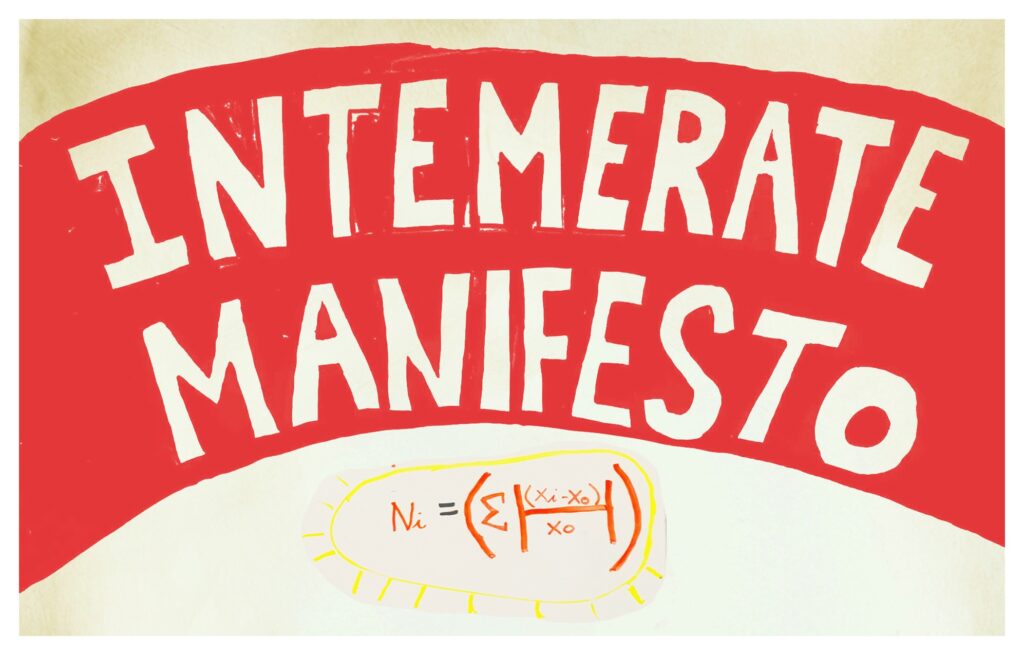
The intemerate offsets (N) are the data measuring the changes of where we are currently to the baseline. If we are speaking about restoring a particular crab specie on a remote island, that may not have such consequential value compared to another crab specie that is bought and sold in urban or regional markets, but what happens when that data is merged with a regional index, or aggregated in an index of marine life restoration or a remote island restoration index or any other aggregates that can be “packaged” and “traded” in data markets and exchanges? That data has value and those collecting that data are providing a valuable service.
There are so many factors that go into how we account for monetary values, and by no means does that not take value away from that which is not monetized, but what an accounting shift will do is address our access to markets.
So with our resume and qualifications, how is it that our national accounts are so low? Why are we poor?
Why are we classified as developing countries? Is it because we’re remote?
It can’t be, because being remote should be accounted for as an asset. Is it because our populations are small? They are small, which means that our GDP per capita should be the highest in the world…
As we begin to think about these questions, we should begin to see that our local interactions can impact the global economy, and that is at the heart if this economic justice campaign. We do not need to put a price tag on our water and commodify it to know that it is valuable.
Measuring data offsets CAN be quantified. This is why building our data baseline is so important. By including the intemerate accounts as an accounting side table to GDP, it will modify how we value extraction, degradation and depletion, as it directly correlates to our well being, stewardship and restoration.
There is a technical aspect to this accounting matrix that I will elaborate upon in another post, but this formula is very much worth exploring. In fact, I would go further and say that we cannot afford to ignore the math.