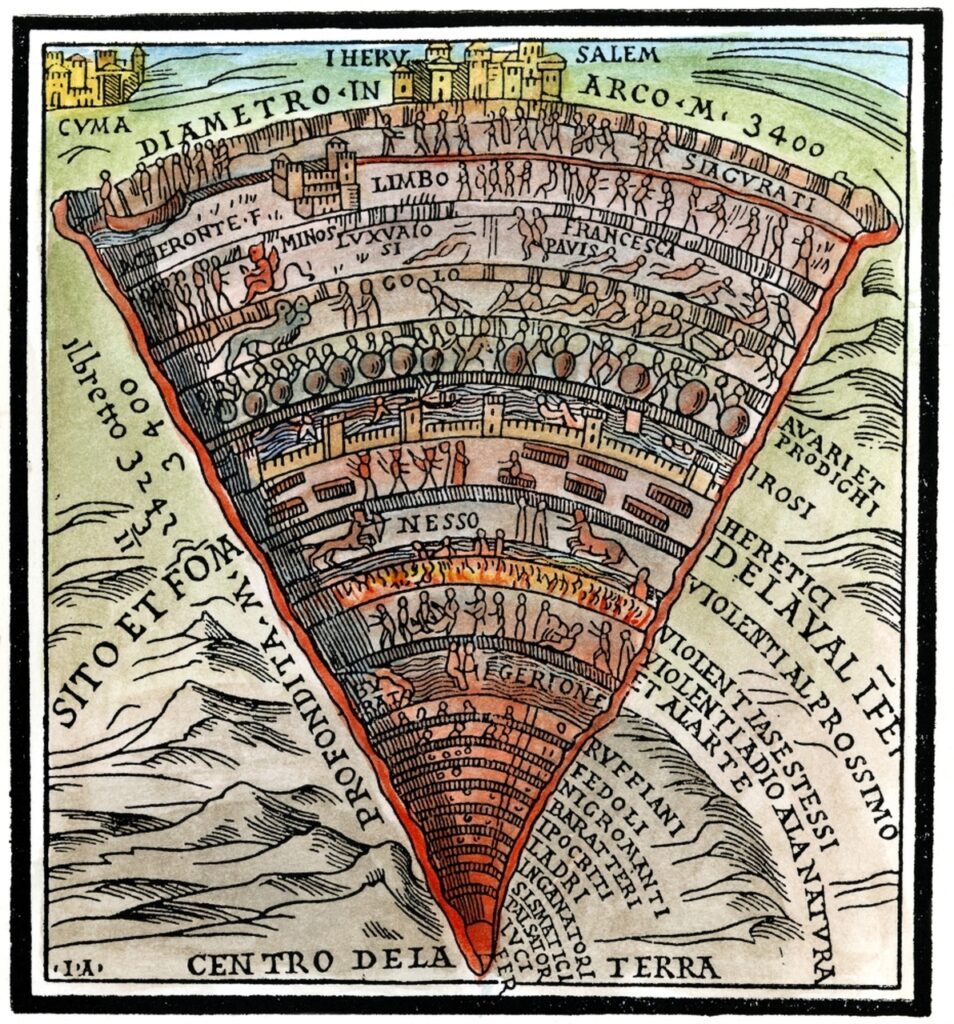
Our relationship with the natural world has been a topic of discussion and contemplation for thousands of years. In recent times, the urgency of addressing the ecological crisis has brought the need for a more integrated approach to the forefront. Exploring the intersection between economics and spirituality argues that incorporating spiritual values into economic decision-making can lead to a more sustainable and equitable world.
Data Reciprocity and Data Localism address the urgent issues of data sovereignty, privacy, and equity in the digital age. It recognizes the need for a radical transformation of our economic and social systems in order to achieve these goals.
The ecological crisis is one of the most pressing challenges facing humanity today. Climate change, habitat destruction, and the loss of biodiversity are just a few of the many problems that threaten the survival of countless species and the well-being of the planet. The root cause of these problems is often traced back to a human-centered worldview that sees the natural world as a resource to be exploited for human benefit.
Economics, as a discipline, is primarily concerned with the allocation of scarce resources to meet unlimited human wants and needs. However, the current economic system often prioritizes profit over other values such as social and environmental well-being. This has led to a number of negative consequences, including income inequality, environmental degradation, and the depletion of natural resources.
Spirituality, on the other hand, offers a different perspective on the relationship between humans and the natural world. Many spiritual traditions view the natural world as sacred and see humans as part of a larger, interconnected whole. This worldview emphasizes the interdependence of all living beings and the importance of living in harmony with the natural world.
The integration of ecology, economics, and spirituality offers a path toward sustainability by incorporating both scientific and spiritual perspectives on the relationship between humans and the natural world.
One of the key benefits of this intersection is the creation of a more equitable and sustainable economic system. Data measuring our well-being, for example, can be a tool addressing our spiritual values such as compassion and cooperation, and result in economic decision-making guided by a deeper sense of purpose and responsibility. This can lead to a more equitable distribution of resources and a greater emphasis on environmental protection and sustainability.
Throughout history, the spiritual exchange of goods and markets has played a significant role in many cultures and civilizations. In ancient times, bartering was a common practice, where goods and services were exchanged without the use of currency. This exchange was often guided by spiritual beliefs and values, such as the belief in the interdependence of all living beings and the importance of mutual support.
In some indigenous cultures, the concept of the “gift economy” was central to the exchange of goods and services. In these societies, resources were shared freely and individuals were encouraged to give generously to those in need. This was seen as a way of building community and strengthening social bonds and was often guided by spiritual beliefs about the interconnectedness of all living beings.
Religious markets, such as the Suq in the Islamic world, have also played a significant role in the exchange of goods and services. These markets were often a hub of economic activity and served as a place for merchants and traders to exchange goods and services. They were also a place for religious and cultural exchange, where individuals from different backgrounds could come together to exchange ideas and goods.
The concept of “fair trade” and provenance in supply chains has emerged as a way of incorporating more holistic values into an economic exchange. Fair trade is based on the idea of creating a more equitable and sustainable economic system by ensuring that workers and producers in developing countries receive a fair price for their goods and services.
Data Reciprocity and Data Localism
Data Reciprocity and Data Localism recognize that data is a valuable resource that has the potential to empower communities and individuals, but that this potential is often exploited by large corporations and governments. Therefore, any solution to these global challenges must prioritize the rights and needs of people over the profits of a few.
A 21st-century economy integrates the intrinsic value of data and its role in shaping our lives. We must acknowledge the rights of individuals and communities to control and benefit from the data that they produce and shift from a paradigm of surveillance and exploitation to one of transparency and reciprocity.
• Prioritize data localism. We must empower local communities to take control of their own data, and promote decentralized systems that allow for greater autonomy and self-determination. This includes advocating for open-source software, community-owned data centers, and community-led data governance structures.
• Foster a culture of data reciprocity. We must recognize the importance of mutual exchange and collaboration, and promote systems that allow for fair and equitable sharing of data. This includes advocating for data cooperatives, data commons, and open data initiatives that benefit all members of a community.
• Prioritize data privacy and security. Individuals and communities have the right to control how their data is collected, used, and shared and that this data is protected from unauthorized access and misuse.
• Prioritize education and awareness. All people have access to accurate information about their data and are empowered to make informed decisions about their impact on the digital landscape.
• Recognize and honor the interconnectedness of data and our lives. Break down the false dichotomies of data versus privacy, and individual versus community, and realize that we are all part of a larger, interdependent web of data.
• Recognize and honor the potential for data to create positive social change. Promote data justice and equity and ensure that data is used to facilitate social and environmental sustainability, rather than perpetuating systemic injustices.
Data Reciprocity and Data Localism recognize the urgency of the global crises we face in the digital age.
An integrative approach to ecological economics and spirituality is the creation of a more holistic understanding of our interactions with ecological biodiversity. Translocal markets recognize the importance of protecting the natural world not just for its own sake, but for the well-being of all living beings and for future generations.
The intersection between economics and spirituality offers a path toward a more sustainable and equitable world. By incorporating spiritual values into economic decision-making, we can create a more holistic and compassionate economic system that prioritizes the well-being of all living beings and the planet as a whole.
In very concrete terms, how we move the global economy is to reform our national accounting system. As long as the wrong things are valued without the counterweight of the right things being valued (like our environment and wellbeing), the global economy will be incapable of a just and equitable change.
The Intemerate Equation addresses this very issue. The equation is tangible in that how we account for restoration fulfills three things: 1) it embraces indigenous and local methodologies to value and interact with their environment; 2) encourages data ownership so that communities can be more self-determining; and 3) promotes people-to-people translocal and interglobal exchange. From a national perspective, a new accounting framework provides the Global South with a path away from the trappings of debt dependency and boomerang aid schemes towards a true mirroring of our economic value, seeking the elimination of the tiered structure that provides advanced economies advantages over developing countries as well as greater access to capital for disadvantaged, displaced, and impacted communities.
Progressive International published an excellent article by Max Ajl called The NIEO in a State of Permanent Insurrection” where he writes, “Production of goods under the law of generalized commodity production, accumulation of value, and for exchange value cannot deliver a decent world. Capitalism cannot be reformed. There must be a shared horizon of production of goods and services for use, with prices engineered to achieve a worldwide just distribution of these goods, social rights guaranteed, and political institutions created to allow for the human reproduction of the ecology. There must be appropriate and ecologically modulated sovereign industrialization alongside regional collective self-reliance.”
We mostly know what the problems are. While we may not know the history that has led us to this place, collectively, we understand the failures of free market capitalism, the myopic pursuit of neoliberalism, and the enforcement mechanisms used to entrench peoples and countries. It is time to sit down and address a tangible pathway forward.
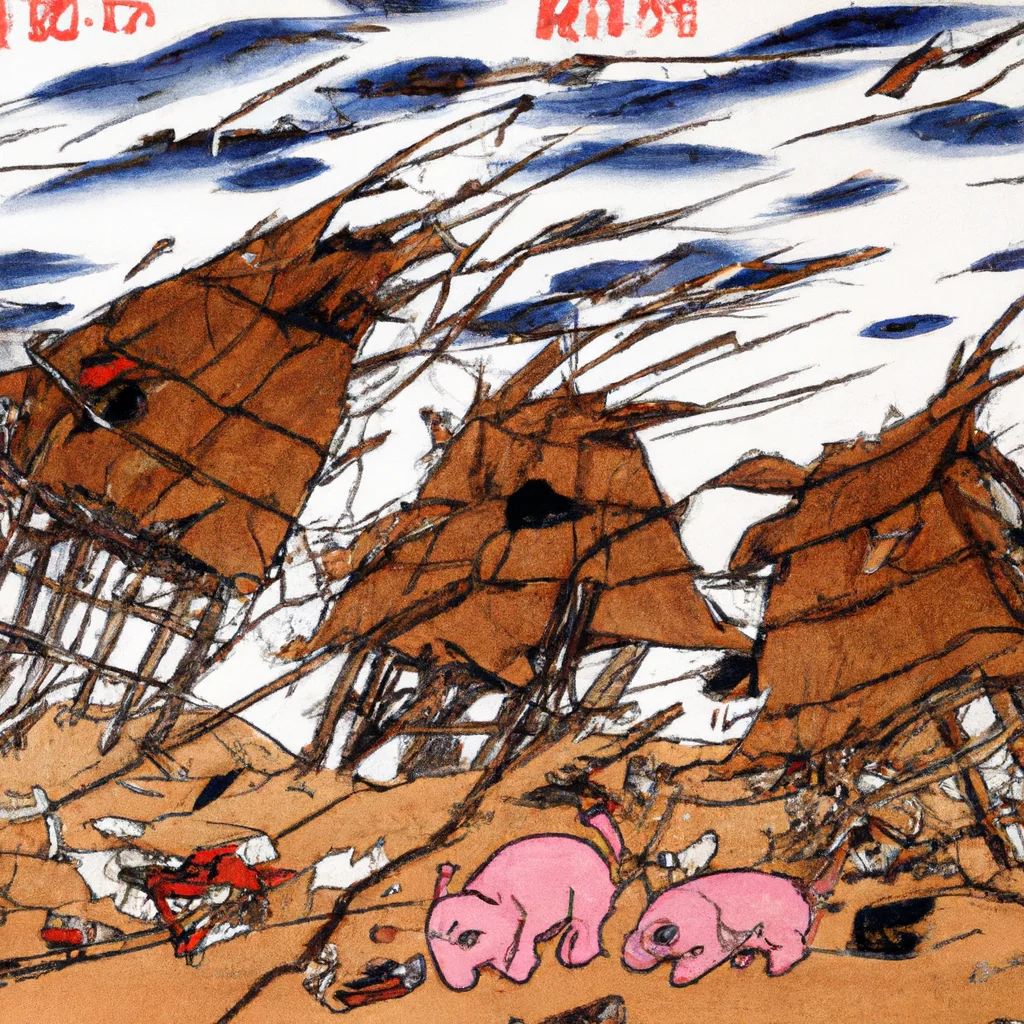
Pasifika could draw upon the story of the three little pigs to illustrate how Kiribati, Tuvalu, and the Marshall Islands might be the very countries to stand up to the economic tyranny of eco-neoliberal efforts to devalue their homes.
Providing solutions for the climate crisis requires the collaboration of local communities, national governments, and international policy stakeholders. Currently, financially based climate solutions ultimately benefit the very same countries most responsible for the climate crisis. Whether aid-for-climate adaptation initiatives, insurance schemes, cap and trade, or blue/green bonds, these schemes are either unsustainable or predatory, systemically excluding people and communities from benefitting from advancing their own interactions with their environment.
Focusing on local methodological engagement as well as the slippery topic of political and economic self-determination, Intemerate Earth has produced an index to gauge countries that would most benefit from rethinking how we account for our ecological biodiversity while providing inclusive market solutions for local and sustainable well-being. For example, as we begin to produce indicators of National well-being, how we aggregate that data as a cooperative side table to adjust GDP, we could collectively build upon our economic capacity for resilience, adaptation, and/or mitigation.
The children’s tale of the Three Little Pigs is generally understood as a story of adaptation. One pig builds a house of straw that does little to protect him from the hungry wolf who will huff and puff and blow his house down. The second little pig assembles his house out of wood, once again succumbing to the terror of the wolf. The third little pig constructs a brick house that withstands the wolf’s advancements. The story concludes with the wolf being driven away by the resilience of the pig who had adapted technologies to stop the wolf’s aggression.
If this were a story about the predatory ambitions of international finance and the profit motivations of capitalism’s worst abuses, then the wolf would not stop at a brick house. The geopolitical ending would result in the demolition of the brick house through either military force, legal shenanigans, or debt. The wolf in this story is a persistent predator and as long as we remain in this fairytale, the wolf will continue to find back doors and cunning motivations to get what he wants.
Pasifika could draw upon the story of the three little pigs to illustrate how Kiribati, Tuvalu, and the Republic of the Marshall Islands (RMI), might be the very countries to stand up to the economic tyranny of capitalism’s effort to devalue their home. A policy consultant has described the situation of these three atolls as such, “Tuvalu has an amazing plan, but no money; RMI has an idea for a plan but hasn’t consulted and has no money; Kiribati has no plan but a ton of money!” Despite over a quarter-century of data measuring the fragility factors of low-lying countries, the very survival of these countries has been compromised by dismissive inaction, revealing how climate-based solutions have only been as good as profit-based motivations. By regionalizing alongside a multilateral system, a better outcome for the three little atolls would be to manage a market for their own ecological data, one that would provide better access and more capable technologies for resilience. People should benefit from their interactions with their environments as it is that value that is intrinsic to the ecological biodiversity of the region.
Presently, we are in a time when the hegemonic system of predator and prey could potentially be dismantled, giving way to a mutual understanding that the rules of nature need not be defined by privatization and predatory capitalism. Climate negotiations should be applying a notion of mutual fair play in market economies, where the rules of an economy reflect the well-being of straw dwellers, branch dwellers, and brick dwellers as they do economic predators. The ecological biodiversity of our planet is entwined with the economic stewardship of peoples, traditions, and communities and it is the interaction of these markets that should benefit from ecological services most.
If the wolf were the global capitalist institutions, the three little atolls would have little or no defense against the predatory advancements of large economies leveraging aid or citizenship for duplicitous resource or data management schemes. However, if the three island nations were to change the rules by adopting a regional plan that would altogether sidestep its relationship with the wolf, then we could begin to transition away from the predatory nature of spurious climate financing.
Financing mitigation and adaptation, the three atoll nations should consider a regional alliance where they would own their ecological data across their combined EEZs, and leverage that data to create the kind of infrastructure that would allow them to stay in their own homes, research and develop their own technologies, and develop their own accounting protocols to account for the value of environmental data that is both global, as well as locally owned and derived.
Profit and privatization motivate eco-neoliberal economies to undermine sound climate policy. Over the years, we are seeing both green and maritime protected areas created and normalized in the non-self-governing territories of the Pacific, and that includes the occupations and territories of Australia, France, New Zealand, and the United States. The accounting of these large swathes of maritime areas is not owned, managed, or accounted for by Pasifika governments or the customary rights holders, rather they are for the benefit of the administering power. The creation of these maritime protection programs utilizes technologies developed by Department of Defense contractors and the environmental data is owned by federal agencies.
By itself, this may not seem like much, but that is because the little pigs are only concerned about mitigation and adaptation. As time goes by and severe weather becomes more and more of an issue of existence, the large economies understand very well that small economies will surrender their territories for citizenship. What the little pigs might not know is that how we account for our environment may soon be adopted into national accounting matrices. But what if the three little pigs understood that sharks, a lion, and a bear would create a biodiversity of power that facilitates a program to determine their own future, whether straw, stick, brick, or reconstituted plastic waste, and devise their own resilience schemes?
Consider that the combined exclusive economic zone and total interior area (EEZ + TIA) of Kiribati, Tuvalu, and the RMI is about 6.18 million square kilometers (an area in size between Australia and India) and that the combined population is about 183,000, this would put their population density at about .0004. As a reference, the population density of Australia is about 3.3 (population/area). When you consider the population index of an area of Kiribati, Tuvalu, and RMI and realize that the average GDP per capita is about $2,444 annually (compared to Australia at about $58,000) one should wonder if a new accounting scheme that embraces environmental stewardship would essentially raise the national accounting figures of the population several thousand percent, thereby affording these atoll nations with the ability to not only stay in their homes but to access the kind of financing that could produce technologies as inspired as Laputa, the floating island in Jonathon Swift’s Gulliver’s Travels.
If left unchallenged, it may take decades for national accounting systems to fully transition from GDP to an SEEA (System of Environmental-Economic Account), but for the smallest and most vulnerable economies to initiate that transition away from a unipolar market to a new multipolar market and begin to write the rules for what this accounting scheme should look like, financial benefits might be measured in years, if not months. Without an appropriate institution that is inclusive of the customary, indigenous, and national rightsholders, no market economy of any significance is possible, and all climate policy will be driven by the same hegemonic institutions and industrial entities that benefitted from exploiting and perpetuating our climate crisis.
Regime change is a threat that is more immediate than any typhoon and the huff and puff of the most militarized economies coupled with the manipulations of the media can topple nearly any government.
Adopting a multipolar financial scheme that would create a market for ecological data (one that is outside the rule-making processes of Wall Street) would have been impossible after the advancement of the 1991 post-Perestroika Washington Consensus that enforced a global economic and legal regime dominated by the United States and the international institutions.
While the unsustainable markets of this economy had been challenged, alternative systems were undermined by regime change, uprisings, sanctions, and any number of advancements that the wolf could muster. Regional groupings like the Bolivarian Alliance, BRICS, the EEU, and the Melanesian Spearhead Group had sought to provide economic stability outside the dominant sphere of the Washington Consensus and there have been many attempts to undermine these integrations through a litany of coups and assassinations reminiscent of the decade of decolonization in the 1960s. Even the containment and obstruction of the China-led Belt and Road Initiative is hypocritical and provocative, particularly as the debt of the advanced economies has far surpassed the GDP debt thresholds by trillions of dollars, far more than the collective debt of the developing countries. When you consider that trillions of dollars of debt can only be leveraged by militarized promises of private access and ownership, one must wonder why the relatively low debt obligations of developing countries should be an issue of concern to the stability of global markets.
It wasn’t until the 2008 financial collapse that fissures in unipolar global governance emerged, and a new multipolar system occurred with the rise of the BRICS economies. Having created an alternative operational system that can bypass US sanction power, currency exchange, and investor-state enforcement, the possibility for countries and economies to transition towards a more balanced trade and infrastructure development seemed promising. Unfortunately, as every government has become aware, regime change is a threat that is more immediate than any typhoon and the huff and puff of the most militarized economies coupled with the manipulations of the media can topple nearly any government.
But while the shroud of the wolf looms large, that should not prevent a new operational system that accounts for the management of our ecological biodiversity to occur. We should not have to surrender to Wall Street’s climate financing schemes to reverse climate change, particularly when the option for a fair and equitable transition is rooted in our very existence.
Tangible? Potent? Spectral? Will the Intemerate Equation be a thing to behold, free-floating between the gravity of capital markets and the spirit of ecological and economic justice? Image from AG Roja’s video “Naeem.”
Expressing the failure of COP 27 is neither a pessimistic avowal that global climate policy is incapable of meaningful change, nor is it a nihilistic admission that the restoration of our planetary capacity to survive has moved beyond the tipping point. The failure is the systemic disconnect between the rich industrialized economies of the Global North and the inability of the Global South to advance an alternative multilateral system that can operate in parallel with the rich countries. As long as a unilateral network of dependency is enforced, one without the option of access and infrastructure, developing countries will remain tethered to corporate interests and the investment regime.
The pronouncement of success at COP 27 is that vulnerable countries will now be able to access funds to tackle loss and damage. The reporting of the details remains vague, but we should already be prepared to challenge this initiative as a backdoor investment scheme. The pathway for this fund appears to be dependent upon commercial industries investing in our most vulnerable countries. The debt-laden governments of the Global North will be unable to sustain a loss and damage fund and it will thereby fall upon the commitments of private sector interests that can afford the insurance policy to cover the risk of loss and damages, particularly as they will be the ones to profit from their “future anticipated losses.”
New Accounting Standards
To really appreciate the obtuse justification for these new accounting standards, I recommend following the hyperlinks as they illustrate just how different financial standards are between the OECD countries and the rest of the world. In 2021, new accounting standards were adopted by the Federal Reserve to mitigate “current expected credit losses” (CECL), estimating allowances for that loss. In the 2008 UN SNA (Chapter 12: The Other Changes in Asset Accounts), those losses are reported in national accounting aggregates not as liabilities, but as assets that can contribute to how the too-big-to-fail financial institutions would report this to national statistical offices. However, the only ones that would benefit from such convoluted designs, are the very countries and economies that have the ability to make these spurious claims and get away with it.
Private sector industries are easily poised to pay multi-million dollar insurance premiums, particularly when they are structured so that future “anticipated losses” will cover the risk
The BIS (Bank for International Settlements), has addressed how to account for risk and losses, and in 2020, published a paper that forecasted the time-varying probability distribution of future losses due to extreme conditions. Essentially what this means is that insurance companies have an instrument with which to predict and account for climate-based catastrophes in the most vulnerable countries, countries that will also be most receptive to attracting corporate industries like Big Ag, aquaculture, R&D, tourism, and nature-based investments like water (now a Wall Street traded futures index), marine energy, ecosystem management, waste, and renewables. Private industries are easily poised to pay multi-million dollar insurance premiums, particularly when they are structured so that future “anticipated losses” will cover the risk. The only real benefit that might come to these host countries will be new tax revenue, but that will be dependent upon the terms of these negotiations and whether they accept or reject tax-avoidance conditions by foreign-owned entities.
Other climate fund options that have been devised recently are the blue or green bonds, but these are unsustainable and eligibility for these funds usually comes with a cost that will ultimately boomerang back to the funder.
Transitioning away from capitalist solutions
Finding solutions to our global ecological and economic crisis requires an understanding that our ecological biodiversity is shared between the oldest, largest, youngest, and smallest of our species and the mutual interconnectedness of everything in between. The Anthropocene, the geological recording of humanity’s impact on the planet, locates the very industries that have degraded, depleted, and exploited our health and environments, tracing our residue along geological striations that read like a roadmap to our own extinction. While there is controversy among geology departments over the legitimacy of an Anthropocene, there was also once a group of scientists denying manmade climate change. And even with an abundance of divine oracles and soothsayers distracting us from real solutions while predicting chaos and doom, the causes of our climate crisis have never been a secret to anyone.
Since the 19th century, the captains of industries have rejected the most decent of principles in the name of progress, profit, and nationalism, and have done so under the banner of capitalism. As long as the structures of capitalism are in opposition to the health and well-being of people and the environment, there can be no transition to a just, fair, and equitable economy. But anti-capitalist motivations should also not come at the expense of people gaining access to finance, capital, modes of production, and exchange. What we need to focus on is how we transition from their economy to ours. We cannot rewrite the trajectory of the last 200 years, but we can equitably regulate how capital is exchanged in ecologically based markets by accounting for our interactions with restoring our environments rather than as commodity-based natural capital.
The Anthropocene, the geological recording of humanity’s impact on the planet, locates the very industries that have degraded, depleted, and exploited our health and environments, tracing our residue along geological striations that read like a roadmap to our own extinction.
While it is undeniable that the operations of free-market capitalism, liberalized trade policies, and deregulated markets have caused irreparable damage to communities and environments, the answer to the problems of capitalism may not actually be the flow of financial and investment capital itself, but the accounting structures embedded within our current economy that privilege privatization and commodity markets over collectivization and ecological ones.
Behind the Curtain: National Accounting Systems
An overlooked, yet viable action that would transition the global economy towards one that values sustainable development is to reform our national accounting system. This includes the accounting of degradation and depletion as a liability rather than as an asset. Sustainable development includes household work, and rejects the accounting of military systems as a fixed asset unless we can include our ecological biodiversity as a national security issue, and repurpose weapons to be tools for restoration, regeneration, and reparation, repurposing weapons as tools of mass reconstruction.
Where this action needs to be directed is the obscure but highly essential System of National Accounts within the UN Statistical Division, (SNA, UNSD). Currently, the SNA codifies how we measure our national accounts, or GDP, and is dominated by OECD members. The United States is the only major economy that does not conform to the SNA international standard, stubbornly clinging to its ability to liberally and quickly maneuver through its own accounting revisions with NIPA (National Income and Product Accounts). As with much of the international order, it is the SNA that follows NIPA, indicating just how U.S. exceptionalism exploits the rules-based system it claims to uphold.
If we are to restore our ecological biodiversity and reverse climate change, the Statistical Division needs to be more inclusive of developing countries, indigenous peoples, and impacted communities. We achieve this by altering how we account for our interactions with our environment and value what is most sacrosanct in all our myriad and diverse ways. We cannot accomplish a just and equitable economy as long there is a top-down imperative to value environments on commodity-driven initiatives that seek to manage and privatize what we have traditionally stewarded. It is up to us to own our data, value our interactions with our green and blue spaces, and facilitate our own distributive networks of exchange by choosing our own multi-faceted pathways for development.
The intersection of diverse peoples and communities, our spiritual networks, and our local and customary agencies is evident everywhere and nothing should interfere with our mutual interconnectedness.
There are two ways to achieve this. The first is to campaign and petition the SNA to include us in the revision of national accounting systems. That is likely to be a slow and cumbersome process as large economies will bully us with technical jargon that will keep us playing catch up despite the fact that our customary knowledge is far more valuable than their lexicon of obtuse terminology. The second, or preferred option, is to utilize our own tools and methodologies to measure our interactions with the environment and incorporate a regulated exchange of capital with the kind of access and infrastructure necessary to uphold sustainable markets and development.
Our community networks are strong. The intersection of diverse peoples and communities, our spiritual networks, and our local and customary agencies is evident everywhere and nothing should interfere with our mutual interconnectedness. The profit-motivations of market-driven industrial interests are stalwarts for containing and obstructing genuine security and development.
As we step back to really examine our economic interactions, we should be amazed by our protocol and reciprocity. How is it that the governments of advanced economies are the most heavily indebted? If we consider these governments as proxies for industrial self-interest, we would find that the rhetoric of democracy, justice, transparency, and rules-based mechanisms are misaligned with so much hypocrisy that those who define those terms most are the very ones that weaponize those ideals for the benefit of industrial greed.
The Audacity of Debt Repayment
The United States alone currently has a nearly 120% debt-to-GDP ratio, meaning that government taxpayers currently hold about $27 trillion in public debt. For perspective, the combined public debt of the ACP countries (Africa, Caribbean, and Pacific) is ~$1.3 trillion. When you consider that the total population of the ACP is ~1.2 billion, and the population of the United States is ~337 million, the per capita holding of debt in the U.S. is well over 50 times greater than in the ACP. Another way to read this is that each U.S. taxpayer owes ~$80,000 and each ACP citizen owes ~$108. This is a population-to-debt difference of 740-to-1.
Ecological and economic justice cannot happen unless the United States addresses its hegemony and unfurls the sail that will set economies free to engage in multilateral markets of exchange.
So the question we should be asking is how does the proverbial 1% have access to 99% of the debt without any strategy of debt repayment while the ACP countries remain tethered to debt repayments, all while the economies of the Global North continue to degrade, deplete, and exploit peoples and environments? The clearest answer is that the United States has something to leverage to the international investment cabal– the owners of the debt–and that is its military. The United States has 750 bases in 80 countries. No other country has a military presence remotely close and all countries face the threat of destabilization, regime change, and sanctions. The winds of ecological and economic justice will blow when the United States addresses this hegemony and unfurls the sail that will set economies free to engage in multilateral markets of exchange.
The history of the UNFCCC Conference of Parties has been a trajectory where the agenda of the advanced economies, led by the United States– a proxy of the international investment cabal and industrial regimes– has continually asserted its own interests over the security and well-being of people and planet.
Since the Kyoto Protocol (1997) and President Bush’s withdrawal from the COP 3 Protocol in 2000, we have only seen consolidated efforts to destabilize, undermine, and reject sound climate policy. Additionally, with the advancement of the Sustainable Development Goals, we have seen tremendous global efforts to create a viable program that seeks to address the 17 goals and the 169 targets. These targets, however, are mostly designed with a pathway for privatizing the management of data through private investment and industry. It is the accounting of that data that the large economies seek to own and use to create a value on nature for the benefit of investors and industries. And since this data cannot be accounted for twice, developing countries, indigenous peoples, and impacted communities will once again be removed from the value chains of our ecological biodiversity and public health.
COP 28: We’ll bring the bread.
In this regard, COP 27 is a ruse. For COP 28, we might want to consider regulated versions of capital exchange where developing countries, indigenous peoples, and impacted communities benefit from our own traditional or customary data sets and engage in a regulated form of market exchange that protects our biodiversity and profits from a growth model that restores our environments, revitalizes our communities, and repairs our histories.
Urgency matters. We may not have time for a picnic at COP 28, but between now and then, consider protocols for exchange and methodologies for valuing our interactions to restore environments. If all we are concerned with is reversing climate change, it may be as easy as surrendering one’s home to private capital and global wealth funds, but what we need to be fighting for is an equitable redistribution of global wealth because this planet and our future belong to all of us.
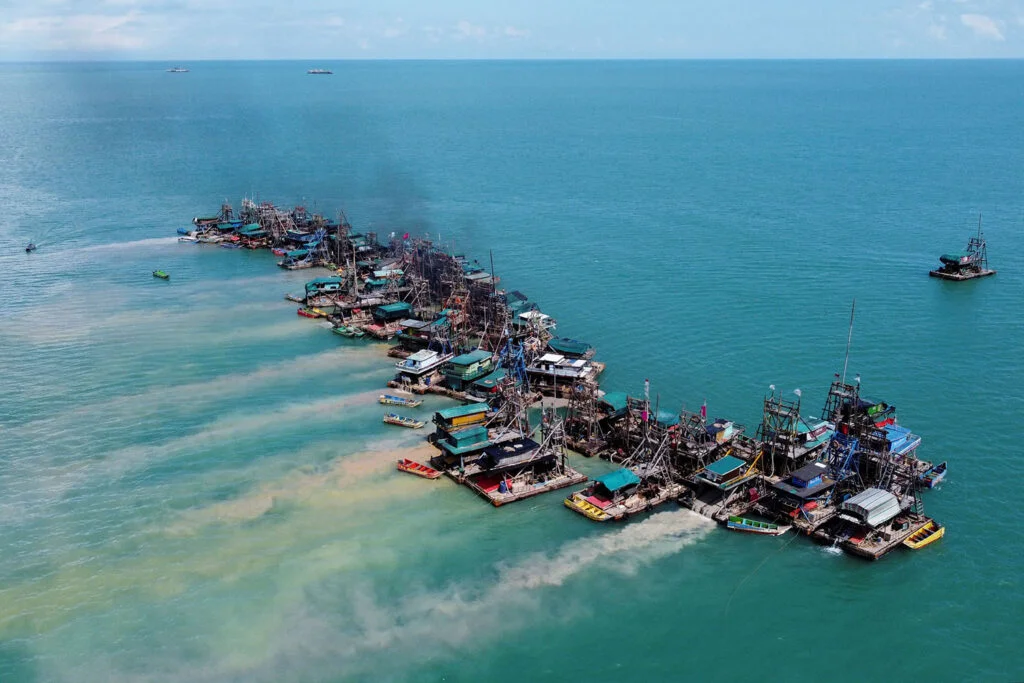
An aerial view shows wooden pontoons equipped to dredge the seabed for deposits of tin ore off the coast of Toboali, on the southern shores of the island of Bangka, Indonesia, on May 1. Willy Kurniawan/Reuters
Deep seabed mining (DSM) is the latest extractive industry threatening the ecological biodiversity in a little known frontier we call the deep seabed. The entanglement of extractive industries in the Pacific is a vestige of its racist and imperialist past when the Pacific was little more than a ripe fruit targeted at being picked, a follow-up to economic interests that degrade, deplete, pollute, oppress and profit from a long history of despair, dispossession and alienation. In the Pacific, DSM will exploit our common heritage while undermining the genuine security of our customary ocean home. Yet, the talking heads of these mining interests asserts that for remote islands and poor impacted peoples, this new industry will generate huge economic windfalls and provide the missing piece guaranteeing sustainable development in the Pacific.
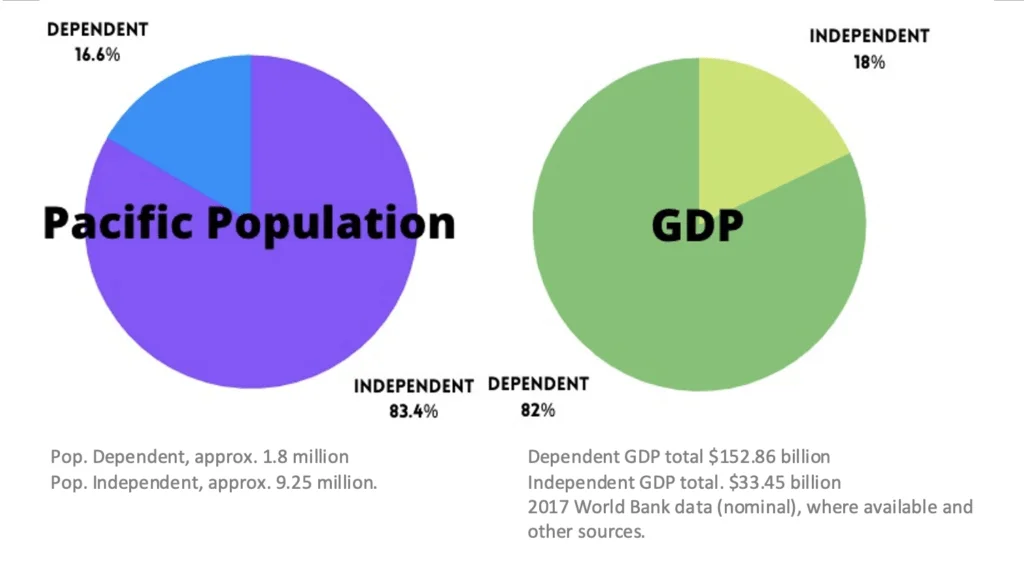
There are about 30 Pacific Island Countries and Territories* with varying political and economic administrations. While there are twelve fully independent Pacific Island countries the rest have populations and economies dependent upon colonial or former colonial metropoles amassing an area approximately 31 million square kilometers (19 million sq miles). Pasifika or the Pacific Continent is a body of water that is about as large as the entire land mass of this planet. And within this vast area is a population of about 11 million people, most of them poor by World Bank standards, with the independent countries classified as least developing or low-performing countries. The territories and occupied nations, however, are an exception since their economies are tied to the advanced economies. The populations of these areas while comprising only about 16% of the total regional population, generally reflects the high GDP of the administering powers.
Indeed, perhaps the greatest obstacle for small developing countries under the current economic system is that there are few options outside of tourism and our fisheries for participating in the global economy. We are classified as underdeveloped or low performing because of poor infrastructure, lack of access, or corruption. Our governments are reminded that we are cursed by remoteness and small size and that we are hindered by a reliance upon a development aid scheme that refuses to recognize or value our inherent wealth, since only our extracted resources have a market value. In this context, one can perhaps see why DSM appears as an attractive option to the developing states of the Pacific.
Consider Nauru, for example, a small Pacific Island state once rich with guano. After having depleted its commodity resource it was close to becoming a failed state, with few available options for viably participating in the global economy. Nauru has since become an offshore tax haven for the rich and a detention center for migrants seeking asylum in Australia. Although the detention centers are closed, this tiny country had become notorious for human rights abuse and global health violations from lack of infrastructure and oversight. Nauru is now the target for DSM, which the government wholly embraces despite the regional protests of Pacific peoples who understand that the promotion of this industry will create conditions that will not only threaten the biodiversity of the region but disrupt the traditional livelihoods that people and communities depend upon.
The proponents for DSM– investment regimes, the military subcontractor Lockheed-Martin, many in the tech industry who greenwash precautionary principles by asserting that the minerals in the deep seabed will lower greenhouse gas emissions–are looking to secure licensing with small island states and are offering what seem like lucrative contracts to fragile Pacific Island governments. The ISA, the International Seabed Authority, tasked with protecting our common heritage of humankind, is ultimately deciding upon the future of DSM. But DSM is not simply another fruit to be picked, a benign nodule that has fallen from a fruit tree to be sold at the market. DSM is an extractive industry predicated upon the inherent racism, degradation and depletion of our human dignity and ecological wellbeing. The heritage of humankind should be measured by our interconnectedness with life, our mutual interaction with people and planet.
Against this seemingly inevitable buildup towards DSM, over the last decade environmental, scientific, indigenous and civil society organizations have all flagged precautions against DSM. People are organizing to resist DSM through a moratorium or ban on mining. The Pacific Conference of Churches have also put forward a spiritual dimension challenging DSM and the further degradation and depletion of our regional resources, arguing that our wellbeing is intrinsic to our interactions with the ocean, our home and our economy.
Framing the Problem: It’s Accounting Stupid!
The question we should be asking is how it has come to be that a territory as vast as the Pacific Continent, rich with culture, traditional practice, and an immense ecological biodiversity has one of the lowest performing measurements of GDP per capita? Pacific peoples should be the wealthiest in the world. with per capita wealth like the fictional country of Wakanda from the movie Black Panther, or at least Dubai.
When advanced economies exclude countries based upon their lack of commodities or resources for exploitation, that is not the failure of small countries, it is the failure of an international accounting regime that has willfully and woefully excluded populations for the benefit of embracing their own industries and profit.
When advanced economies exclude countries based upon their lack of commodities or resources for exploitation, that is not the failure of small countries, it is the failure of an international accounting regime that has willfully and woefully excluded populations for the benefit of embracing their own industries and profit. This is the institutionalized theft and legalized fraud common to the economics of extraction.
Countries like Nauru with its population of just over 10,000 shouldn’t be cozying up with DSM industrialists just to receive a piddling of percentage points of profits and some infrastructure. Rather, a Pacific-wide population of 11 million responsible for the ecological stewardship of 31 million sq. kilometers has tremendous value if we were to measure our economies according to conservation systems rather than in extraction, degradation and depletion. Yet there is no inclusion for this data in the current economic accounting system.
Revisions of the UN System of National Accounts (SNA), as far back as 1993, included considerations to account for ecological degradation and depletion. Yet despite revisions and alternative accounting programs, they were continually rejected, accused of being too experimental. On the other hand, the inclusion of military systems and R&D is deemed legitimate because somehow “national security” and “anticipated losses” could be adjusted into GDP aggregates. The accounting of degradation and depletion could have already begun to reverse greenhouse gases in our atmosphere, reduced poverty indicators globally, and provided greater protections to our ecological biodiversity decades ago.
In 2021, the UN Statistical Division did finally adopt a System of Environmental and Economic Accounts (SEEA), even though it was far less rigorous than the 2003 manual. With each revision, the influence of industrialized economies readily dismissed the obligations of good environmental governance, until it could mainframe a system that would ultimately benefit corporate investment and privatization regimes.
If we were to charge industrialized economies with an unprincipled, immoral global negligence, the perpetrators would be those who would sacrifice our climate security to ensure that all our natural assets would conform to a market economy. Unless our Pacific leaders can initiate their own regional accounting revisions, small Pacific Island states will never be able to contribute to the global economy on par with other regions. Governments should be lobbying the UN Statistical Division to demand that they explore alternative accounting methodologies that benefits all regions, not just industrialized ones.
Spirituality and Wellbeing are Rightsholders in the Global Economy.
Until we begin the process for revising our national accounts we need an accounting that is informed by our spirituality and wellbeing. We cannot genuinely understand the value of our ecological biodiversity, until we have a principled and moral base with which we can measure our interactions with people and our environments. This is not to say that organized religions should determine an economic value based upon our spiritual practice, rather, that our houses of worship are like divining rods guiding our assessment of what is pure and sacrosanct in the wellbeing of our people. And it is precisely this fostering of our wellbeing that is grossly lacking from our economics.
An organization is challenging this very issue. The IF20, a G20 Interfaith Forum, is promoting a webinar, “Ecological Racism and Deep-Sea Mining in the Pacific.” One of the organizers of this event, Rev Dr Upolu Luma Vaai from the Pacific Theological College in Fiji– at the forefront of addressing ecological issues regionally– forwards that “racism is not just a human issue, it is also an ecological issue,” and it is the very systemic racism inherent in the global economic system that threatens our ecological regional stability.
If the “antidote for ecological racism is to accept and embrace the full dignity and sacredness of ecology,” then the outcome of this meeting should be to identify actionable paths where the anti-racism initiative in the IF20 can influence policy making both in the Pacific and the international community. It is precisely through the actionable path of ecological accounting, that spirituality and wellbeing can begin to repair the damage from commodity driven mining ventures.
Ending the Violence of GDP.
If we are proposing to revise National Accounting systems to be reflective of equity, human dignity and community self-determination, we need to have a much more robust conversation about the international classification of indicators and how we measure and value our economic interactions with people and planet.
For the weight that GDP is given, it provides a very poor measurement of the global economy and is arguably the leading structural deficiency most responsible for climate change, the loss of our ecological biodiversity, and conditions of poverty on our health and wellbeing.
Factors of production and consumption, distribution and exchange of our goods and services are economic aggregates, and as such have been used extensively to determine the wealth of our economies. The current global standard is GDP 0r Gross Domestic Product, and certainly since it was adopted as a standard measurement in the post-war era, it has been described as an economic mirror measuring the inputs and outputs of production and consumption and the flow of capital between countries. But for the weight that GDP is given, it provides a very poor measurement of the global economy and is arguably the leading structural deficiency most responsible for climate change, the loss of our ecological biodiversity, and conditions of poverty on our health and wellbeing.
There are historical postwar reasons that GDP was adopted to be the global standard for measuring our economy, and it has not come without cautionary warnings of what an unprincipled pursuit over these standards would result in and the potential negative impacts on the health and wellbeing or our populations. By ignoring the warnings of national accounting requiring comprehensive and considerable adjustment and engagement with global needs, GDP has ceased to be a useful measurement of our economic interactions and has instead become a weapon, a tool for oppression, degradation, depletion and wealth consolidation.
Simply put, economies measure our interactions with each other and environments and if all we are doing is measuring industrial inputs and outputs, then we are reflecting an economic measurement that is as accurate as a house of mirrors at an amusement park fun house.
As the current economic measurement, GDP is an optical illusion that does little to reflect our interaction with each other and the environment. image link
Towards a Fair and Just International System of Ecological Accounting
For the Pacific, the decision is simply whether the region wants to advance climate objectives on its own, or wait for the industrialized Global North to invent another eco-neoliberal top-down consent scheme that will provide some immediate cash in hand while greenwashing climate objectives for the benefit of the wealthy few. Since GDP has been weaponized and used to justify systemic theft of human and environmental capital, the authority over the 21st century requires that we immediately put into practice a revised statistical accounting system focusing on the three things that GDP has ignored: global wealth redistribution, reversing climate change, and restoring our ecological biodiversity.
Ecological and economic justice issues like climate change, our ecological biodiversity, systemic racism, and wealth disparities should have always been a factor in the way that we measure national economies. The importance of statistical national accounting is to raise the development and engagement of our populations, which means to end poverty, not cause it; to sustain our common heritage, not exploit it for the benefit of the few; to pursue an accounting of peace, not privilege the profits from war and armaments; and to promote health and wellbeing, and recognize that what is spiritual is our planet and the interdependence of life.
We know that ecological accounts can be financialized and self-sustaining, so it is important that the Pacific establishes a regional regulatory framework that accounts for its ecological data on its own terms. How we do that does not necessitate that we throw the global economy into shock, because there are transitional approaches that governments and national central banks can utilize to adjust new statistical inputs and outputs the same way monetary controls are used to prevent inflation.
What most stands in the way, however, are the industries that cling to their share of global wealth and who have primarily benefited from the social instability caused by exploitation, degradation, and depletion. Captains of industries have the means to incentivize all kinds of destabilizing, obstructive, and containment strategies but they also have the ability to cooperate and understand that co-opting or controlling environmental and social governance should not be their sole objective. We are all responsible for our collective future and should work together to shift our statistical global accounts to reflect the needs of future generations. Transitioning our global economy should not be a top-down policy initiative, but a bottom-up peoples approach that is inclusive not exclusive; with benefits that are accountable to all rather than arbitrary and capricious for the few.
Disentangling extractive industries from the Pacific is a moral obligation that speaks to the systemic racism and disregard for our ecological biodiversity. Deep seabed mining is no different from the terrestrial degradation and depletion that has impeded the development of our own ecological and economic interactions. If we are to repair this systemic fraud around national accounting systems, the only action is systemic reparations. If only as an anti-racism initiative, the ISA needs to recognize that the common heritage of our ocean is not simply another fruit to be picked. Our common heritage of humankind is our interaction with people and planet.
*Occupied or dependent territories include Christmas, Cocos, Norfolk (Australia), Rapanui or Easter Island (Chile), West Papua (Indonesia), New Caledonia, French Polynesia, Wallis and Futuna (France), Cook Islands, Niue, Tokelau (NZ), American Samoa, Guam, Hawaii, Northern Marianas Islands (US), and the Pitcairn Islands (UK).
Characters from the Intemerate Equation respond to how Wall Street’s new IEG Natural Capital Asset can only be a privatization initiative that commodifies Nature.
A new Wall Street Asset class has emerged with the announcement of the Intrinsic Exchange Group (IEG). Although there are no details given as to what this is except on their website where they define what “IEG is” and what “IEG is not,” I think it is fairly safe to say that what it is, is a privatization scheme for natural capital that follows the announcement of Wall Street’s Water privatization initiative, devised last year when water entered the futures market.
While no details have emerged (because outside of a hegemonic takeover there is not likely to be any just, fair, or equitable details), I suspect that there are going to be many attempts to throw a lot of money at this to try to build capacity and cooperation with other countries and central banks to allow for private interests to set the value for our environments. Coming from the Advanced economies, the IEG is essentially allowing Colonialism 5.0 to pave a road forward.
If we step back, it is obvious that the Global North’s inaction is a manipulative effort to exploit the desperation of the Global South to race towards programs like citizenship-for-territory, or other aid packages that will buy their allegiance while offering no tangible solution. In the case of the Pacific, large economies can leverage tremendous value from the privatization of maritime resources, particularly if people choose to surrender their territory for citizenship from a metropolitan state.
Whether oceans, forests, or deserts, the value of our biomes are our global commons. We simply cannot treat our ecological biodiversity as commodities, because the less we have the more valuable it becomes for markets. IEG is not a drive to save humanity, this is a fetishized initiative, a kind of “Squid Game” where the last-people standing will be rewarded with inscribing their names on a stone tablet that may never be seen, as there may be no future generation to see it.
It’s these kinds of utilities that appear to check off the environmental sustainability box in ESG reporting, but it does so at the expense of people and their rights to access. So I cannot help but wonder if much of the military base building near aquifers, or the licenses given to industries that contaminate our ground water, inflates the commodity scarcity pricing of water, and if it does, what does that do to how we access water?
As a bulwark to this kind of degradation and depletion, the Intemerate Equation is another kind of index altogether. But rather than it being managed by Wall Street, an intemerate index will be managed by and benefit the very same communities that are doing the work.
This is particularly relevant as the IUCN recognizes the central and essential role of indigenous communities in stewardship and conservation of biodiversity. There is a high potential for creating new financial markets based on the measurement of our interactions rather than on the valuation of commodities, shifting the demand for extraction towards one that values service.
Two papers address this shifting landscape. The first,A Legal Theory of Finance, holds that “financial markets are legally constructed and as such occupy an essentially hybrid place between state and market, public and private;” and that “the law-finance paradox tends to be resolved by suspending the full force of law where the survival of the system is at stake.” The second paper, “Beyond Financialisation:The Need for a Longue Durée Understanding of Finance in Imperialism,”summarizes that under financialization, “we have been living in a new era of capitalism, characterized by a historical shift in the finance-production nexus. Finance has begun to behave abnormally towards production. It has assumed a disproportionate economic size and, more importantly, has divorced from ‘real’ economic pursuits.”
This is the moment to seize. Can the ACP or developing countries use this opportunity to rewrite the global economy to be just, fair, and equitable, or do we allow Wall Street to once again set the terms of how we value our existence.
Restoring our ecological biodiversity, Reversing climate change, and Redistributing global wealth are the three biggest issues challenging ecological and economic justice. Intemerate Accounting is a post-growth initiative that could provide the systemic sea-change necessary to address this crisis in global governance. I will describe how this can be accomplished in some detail later, but I’d like to begin by stepping back and provide some broader context.
It is apparent that we are on the brink of global catastrophe. For some of us, this has been present for generations, and for a few, the global catastrophe is something some people sweep under the rug and save for later.
There are structures and choices expressed in our present system that valorizes rather than punishes ecocide, wealth and health disparities and perpetuates the kind of exclusionary practices that invokes this doomsday outlook.
It is also apparent that the crises that we are faced with is an existential conundrum. Peace achieved through War is a moral hypocrisy. How can we take pledges of good climate policies seriously if our leaders continue to provoke military incursions with the most reckless abandon? Demilitarization, de-occupation and decolonization—We cannot address post-growth if we continue to reproduce these very conditions that enable hegemony. We understand the mechanics of neo-colonialism-Kwame Nkrumah taught the world how the advanced economies continue to siphon Africa’s wealth. Now it is neoliberalism: the mechanics of privatization regimes, mergers and acquisitions, Nato, and debt—these structures perpetuate the conceit of colonialism.
When we consider the inherent wealth in Africa’s land, people, and resources, we all know that this is a region of tremendous potential that should play a much more dominant role in the global economy. And while the causes of Africa’s fragility factors are straight forward enough to identify, why have solutions been so evasive?
In terms of trade, the concentration of monetary wealth that is held by the global north is a huge factor, one that has limited Africa’s capacity to leverage its own development. As large as Africa is, it is still under a kind of containment and obstruction with goods-in-trade primarily filtering to the North.
While China’s Belt and Road initiative provides another option for Africa, it is once again the global north that is attempting to disrupt the physical connection with China through destabilizing access points with Syria and Yemen, for example, not to mention the obstruction campaign of Washington’s new Indo-Pacific maritime policy that pretty much seeks to undermine the real freedom of navigation by asserting a militarized maritime presence between Africa and China. When we look at a map, how is it that Africa’s maritime access for trade, both to the east and to the west, is constrained by this hegemony.
Are we ready to challenge the next wave of colonialism? The green economy is beginning to look a lot like eco-neoliberalism. The Pacific, and I believe Africa, the Caribbean, and many of the developing countries continue to face the same obstacles as they have for generations. Even now, as we head into the Glasgow Climate Summit, the proposals for reversing climate change might find tremendous financial opportunities for the Global North, but again, what about the Global South? Have the rich countries simply dragged their heels and waited for desperation so that they can leverage disaster capitalism? How do we move out from under the boot of this ongoing global theft and assert our shared equity on mutual terms?
These have been pressing questions for a long time, yet I remain optimistic because this time around the empire is in decline and multilateralism is renewed. Covid-19 has created a shift in our global consciousness, an awareness that the system has failed to produce the carrying capacity and promise of globalization and also because there are projects like Kehosa, promoting youth, food and water security, and rethinking what development should look like from the bottom up.
So while our ecological biodiversity is in crisis and global debt looms large—as severe as that is for developing countries, it is arguably worse in the advanced economies because the bottom has dropped out, and people are reaching for answers that they cannot understand. To put it bluntly, many people are in denial that their beloved free market system has collapsed. The accumulation of wealth has become so disparate and removed from the reach of working people, yet they cannot understand how these limits of capitalism is an unjust, unfair, inequitable, moral and ethical issue.
So, if this is all part of the geopolitical back story, I don’t want to mischaracterize my presentation by saying that Africa must choose between the neoliberal powers and China, or some of the other large markets like India or the Middle-East. I want to talk about a third option, the one that Kehosa is focusing on, and this third option is Africa. But what does that mean?
As a regional integration, the ratification of the African Continental Free Trade Area is one of the most substantial events of the 21st century. The opportunities for cross-border trade in goods and services, access to markets and supply chains is vast. But we must remember that this absolutely must include food and water security, access to health, our environmental protections, and greater inclusivity of women and youth.
So what I might ask, is how can a third way realistically transition Africa to participate in the global economy on these terms, and what would that take? What are the risks and the benefits? In terms of foreign direct investment, sure, but FDI is only as good as LDI: Local Direct Investment. Besides local manufacturing sectors, or cash crop export markets, when we talk about a local economy, we really are speaking about local practitioners, cultural ambassadors, artists, technological wizards, child care, house work the entire decolonized mindset that understands the true risks and benefits of sustaining local communities as well as managing our ecological biodiversity and revitalizing impacted communities. We cannot just speak about the profit margins of product accounts.
The recent release of Kenya’s Central Bank’s Annual Report seems to have surprised some China-Africa watchers in the west, particularly the focus on the trade deficit between Kenya and China. China’s exports last year was $3.08 billion and the first half of this year is 1.88 billion suggesting that this years total may be larger than last year’s. When you compare that to Kenya’s exports to China which was $139 million, those numbers seemed to have raised huge concerns because of this apparent deficit in trade. But I just want to ask why. Those numbers don’t mean so much when you consider that the billion dollar figures for machinery and transport will ultimately contribute to Kenya’s infrastructure.
The question I would pose is who better to have an infrastructure trade deficit with? The one who would seek to impose privatization of services and demand scheduled repayment on those loans, or those willing to extend the terms of those loans and are not interested in privatizing national capacities? In a nutshell, this is the situation between neoliberal debt and China debt. Countries need infrastructure, and you acquire infrastructure through loans.
The success of the AfCFTA is completely dependent on access and infrastructure and weighing the costs between neoliberal legal impositions that lead to vulture repayment schemes, and China’s win-win handshake, the west’s manufactured criticisms published through global corporate media chains is dishonest and simply hypocritical.
So let’s address trade sectors. Kenya’s current account in the goods trade is coffee, tea, horticulture, oil products, some manufactured goods, raw materials, chemicals, etc, and as is evident, Kenya has to compete with other African nations, who may have different tariff and tax structures. So, in the context where countries are forced to compete with their neighbors for market access, this situation really leads to a race to the bottom.
So I want to be clear that before the BRI and before the AfCFTA, there was very little opportunity for African countries to access markets on equitable terms. And now that the AfCFTA-BRI agreement is being worked out, there will be greater coherence and harmonization within the regional agreements, potentially setting much better terms that the AfCFTA can leverage. Certainly, this will provide far greater coherence opposed to countries having to compete with each other for access. Additionally, we’re going to find that the European Community and the US will also either have to compete with the BRI or try to undermine confidence in the agreement, which clearly, they have been trying to do.
So, if the benefit of the AfCFTA is to harmonize some of these kinds of costs and revenues and create more equitable conditions for trade that will help to raise the region, then it seems very clear that Africa’s regional motivations are well positioned to explore alternative positions for engagement
But understandably, to accomplish harmonization is not going to be easy as this cuts into the tax base of governments, some of whom may be more dependent on various goods and services than others. So while there’re going to be difficulties from local governments, any kind of deep market analysis is going to have to put people and environments first, creating conditions where local capabilities will have to align with expert capacity, but as long as we remain stuck within the corruption and resource curse of commodities pricing there is going to be very little opportunity for Africa to raise its position on the global stage.
So what I will demonstrate in the outline is that Intemerate Accounting is an achievable post-growth campaign promoting economic and ecological justice, like restoration, revitalization, and redistribution. We do this by leveraging our vast ecological data while ensuring that it is the people and communities that maintain the ownership of their data. The SDGs and Climate Agreements already have cabon-based investment plans on the table for creating value chains around our environmental data, but none that put people and their interactions with the environment first—none that come close to really valuing our ecological biodiversity.
How this can begin to happen—and I encourage anyone interested to contact me directly– will require the participation of one bank and the creation of one index,
and while I’m not going to explain the mechanics of how this can happen in this presentation, I will at least be able to communicate the kind of coordination that would need to happen that could lead to an African Third Way.
Lets put the Core Values of Kenya’s Central Bank to the test when they write that the Bank will “encourage, nurture and support creativity and the development of new ideas and processes.” Kenya’s central bank could be central in designing what the regulatory framework might look like for Africa and other regional groupings.
The key motivation that I am addressing is how to financially incentivize access and infrastructure to people’s health, to local and regional markets, to traditional and local stewardship, and to provide a fair, just and equitable way for the region to participate in the global economy through the practice of ecological stewardship.
Therefore, we must begin with another kind of accounting methodology that redefines and re-quantifies growth using indicators that developing countries and impacted peoples require.
Intemerate Earth is our campaign to transition our accounting system. This was initially developed in collaboration with the Pacific Conference of Churches which last year, culminated in the publication of a book called Ecological Economic Accounts: Towards Intemerate Values.
While I initially conceived of this as something that could be promoted through the ACP countries, it really was geared towards a program for Pacific Regionalism to address factors that kept the Pacific tethered to the colonial/post-colonial/neoliberal system. Then in 2020, when the Covid pandemic happened it didn’t take long to realize that this was so much more than a Pacific or an ACP construct. The world demanded change.
We began to explore alternative ways of telling this story, and mapping out an educational curriculum that could help to define how an intemerate transition could be accomplished in a way that does not create unwanted shocks to the financial system.
Here are characters that we made to highlight exactly how the equation operates and how peoples interactions contribute to the building of this framework. While it’s too much to go into right now, you can find it on our website, but suffice to say, our little accounting paradigm could really be that explosive, radical seed for global ecological and economic transformation.
We here is an example of how we mapped a curriculum that outlines the micro and macro coordination needed to implement and grow this framework, but what we lack is the kind of on-the-ground institutional support that could explore this more fully.
There are many alternative indicators being discussed right now, and new ways for accounting for GDP, but what makes the intemerate accounting equation unique is that it does not simply adjust national accounts by adding new environmental indicators. Because if all we are doing is adding new green or blue indicators, we will not be addressing the issue of redistributing wealth or moving away from the privatization or neoliberal framework. In fact, as I have mentioned, many of these new indicators could simply impose another top-down consent process for an eco-neoliberal economy, and is really a back door for perpetuating the same power structures to provide security, technology, monitoring, auditing, etc., thereby perpetuating the current system of exploitation and exclusion that we should be moving away from.
Intemerate Accounting is completely different, Firstly, we’ve created a more just way of measuring baselines; secondly we include a factor that allows for a relatively seamless transition away from the dominant GDP-based national accounting system towards one where Wellbeing indicators can modify our national accounts; and thirdly, we are inclusive of real-world market strategies that can make this financially viable for developing countries and underserved communities.
Typically, economic baselines are the starting point—or the base—from which to measure growth. From an economic perspective, baselines are set as a measurement of gains and losses. Baselines could be an absolute figure or a relative figure, but regardless all indicators that measure growth are determined by the baselines we set. They are the starting point.
The unique thing that the intemerate baseline does is that it inverts the starting point to be the goal and captures the incremental data towards restoring the baselines.
In the Pixar movie “Soul” that came out last year—coincidentally, the same month that the Intemerate Accounts book was published– the main character, after he “transitions,” has to wait in that long line to get into heaven, and then realizes that to get there, he has to reunite with his soul to repair his merit. We are in that kind of time. We need to reunite with our baselines–with our soul–and engage in an economy of reparations.
This inversion is a foundation for the kind of systemic reparations we need to break out of this cyclical terror of history. This reversalis a much better reflection for measuring environmental and social indicators, as it gives value to people’s interactions with ecological and wellbeing indicators rather than treating everything as a commodity.
This inversion is represented in our equation, with “n” representing the factor being restored. You can apply this to almost any environmental condition and record quantifiable data to meet the real world conditions for auditors and regulators.
And while I know this sounds like a very bold assertion, I would put it to the test in real world terms.
To make a claim that there is a tangible equation that can be used to restore our ecological biodiversity, reverse climate change, and redistribute global wealth sounds like hyperbole, or snake oil, or some magic fountain of youth, but it is not.
This is simply a mathematical formula that can be tested through input-output tables, measuring our interactions over time, calculating the rate by which restoration and rehabilitation can occur in quantifiable and relatively predictable terms.
Here’s an example that we looked at in the Munda province in the Solomon Islands regarding he restoration of a crab population.
Rather than a top-down commodity driven approach where environmental values are leveraged against carbon offsets for example, the intemerate baseline is a bottom-up approach where environmental values are determined by the interactions of local communities.
What could be better than local, indigenous, or customary processes developing and benefiting from their own services and technologies to meet their targets and goals on their timeline.
Imagine that by inverting the baseline, there could be a verifiable way to quantify our ecological interactions, and essentially own our data, while protecting the inherent wealth of environmental, health and wellbeing factors.
When we consider the accounting standards checklist for ESG or Environmental and Social Governance, we’re talking about a reporting format focusing on corporate governance around nonfinancial measurements for environmental sustainability and social impacts.
ESG, has not yet been standardized or quantified, which I would say is one of the objective goals in the current international climate and SDG meetings. And so the question remains, how do we quantify what is inherently unquantifiable?
Methods and standards need to be worked out, and the only solution that seems to be on the table is the worst one of all—the privatization, and valuation of our resources based on commodity scarcity.
Very briefly, I just want to say that Wall Street has recently created a commodity investment sector on water trades based on California water prices. It’s these kinds of utilities that appear to check off the environmental sustainability box in ESG reporting, but it does so at the expense of people and their rights to access. So I cannot help but wonder if much of the military base building near aquifers, or the licenses given to industries that contaminate our ground water, inflates the commodity scarcity pricing of water, and if it does, what does that do to how we access water?
As a bulwark to this kind of degradation and depletion, we could treat the Intemerate Equation as a financial index—like a stock index. But rather than it being managed by Wall Street, an intemerate index can be managed by the very same communities that are doing the work. This is particularly relevant as the IUCN recognizes the central and essential role of indigenous communities in stewardship and conservation of biodiversity. There is a high potential for creating new financial markets based on the measurement of our interactions rather than on the valuation of commodities, shifting the demand for extraction towards one that values service.
This data belongs to indigenous and customary rightsholders and stakeholders, not Wall Street fund managers.
This kind of data access could provide the triple benefits of sustainable livelihoods, decentralized local ownership and democratic participation. We aim to enable these kinds of conditions.
We all have the opportunity to measure, to count, to examine, to protect, to nurture, to analyze, to collect, to describe, to compile, to publish, to monitor and manage our environments.
This is a service that is certainly much older than capitalist and privatization regimes, and our local economies should benefit from these interactions.
What the intemerate baseline does is serve as a kind of verifiable guideline for regulators and auditors to mark the rate of restoration, to see whether communities are indeed attaining the goals they have set for themselves.
In light of the promise of optimism I mentioned in my introduction, I would like to respond to the Ask and Call-to-Action that is inscribed in the timeline, and end with a request: If Intemerate Accounting complements and catalyzes other initiatives to produce the post growth and post-colonial future that we want and deserve, then can we raise this math over the spectre of our current global governance?
Living Sufficiently and Sustainably: NIFEA (New International Financial and Economic Architecture) E-Conference on De-growth.
Organizers:
World Council of Churches
World Communion of Reformed Churches
The Lutheran World Federation
World Methodist Council
Council for World Mission
From Lutheran World website: “How do we address the contradictions between modern society’s obsession with limitless economic growth and the ecological limits of our unique planetary home? Are there models of good life that meet the needs of all people, sharing wealth and power, whilst nurturing the environment? What resources do we have and what strategies can we employ as faith communities to empower a just and sustainable recovery from the COVID-19 pandemic, as well as a transition from a growth-oriented, extractivist economic paradigm to a life-affirming economy where all of God’s creation can flourish?”
The NIFEA E-conference takes the 6th Assessment Report of the Intergovernmental Panel on Climate Change as a vital backdrop for reflection and discussions. It seeks to develop a short ecumenical message directed to the G20 Leaders’ Summit taking place in Rome from 30-31 October 2021 on the theme of “People, Planet and Prosperity”.
TRANSCRIPT
Restoring our ecological biodiversity, Reversing climate change, and Redistributing global wealth are the three biggest issues challenging ecological and economic justice. Intemerate Accounting is a post-growth initiative that could provide the systemic sea-change necessary to address this crisis in global governance.
I believe it is apparent that we are on the brink of global catastrophe and that the structures and choices expressed in our present economic system valorizes rather than punishes ecocide, wealth and health disparities and perpetuates the kind of exclusionary practices that invokes this doomsday outlook.
It is also apparent that the crises that we are faced with is an existential conundrum. Peace achieved through War is a moral hypocrisy. How can we take pledges of good climate policies seriously if our leaders continue to provoke military incursions with the most reckless abandon? Demilitarization, de-occupation and decolonization—We cannot address post-growth if we continue to reproduce these very conditions that enable hegemony.
So having gotten that out of the way, I will demonstrate in the outline that Intemerate Accounting is an achievable post-growth campaign addressing the issues of environmental sustainability, well-being, and global governance. If our objective is to reduce fragility factors, we must focus on growing factors that promote economic and ecological justice, like restoration, revitalization, and redistribution.
Therefore, we must begin with another kind of accounting methodology that redefines and re-quantifies growth using indicators that developing countries and impacted peoples require.
Intemerate Earth is our campaign to transition our national/regional/and global accounting system. This was initially developed in collaboration with the Pacific Conference of Churches which last year, culminated in the publication of a book called Ecological Economic Accounts: Towards Intemerate Values.
While I initially conceived of this as something that could be promoted through the ACP countries, it really was geared towards a program for Pacific Regionalism to address factors that kept the Pacific tethered to the colonial/post-colonial/neoliberal system. Then in 2020, when the Covid pandemic happened it didn’t take long to realize that this was so much more than a Pacific or an ACP construct. The world demanded change. Our little accounting paradigm really is that explosive, radical seed for global ecological and economic transformation.
While there are many alternative indicators being discussed right now, and new ways for accounting for GDP, what makes the intemerate accounting equation unique is that it does not simply adjust national accounts by adding new environmental indicators. If all we are doing is adding new green or blue indicators, we will not be addressing the issue of redistributing wealth, or moving away from the privatization or neoliberal framework. In fact I would argue that new indicators could simply impose another top-down consent for an eco-neoliberal economy, where the same power structures will be providing security, technology, monitoring, auditing, etc, thereby perpetuating the current system of exploitation and exclusion that we should be moving away from.
Intemerate Accounting is completely different, Firstly, we’ve created a more just way of measuring baselines; secondly we include a factor that allows for a relatively seamless transition away from the dominant GDP-based national accounting system towards one where Wellbeing indicators can modify our national accounts; and thirdly, we are inclusive of real-world market strategies that can make this financially viable for developing countries and underserved communities.
Typically, economic baselines are the starting point—or the base—from which to measure growth. From an economic perspective, baselines are set as a measurement of gains and losses. Baselines could be an absolute figure or a relative figure, but regardless all indicators that measure growth are determined by the baselines we set. They are the starting point.
The unique thing that the intemerate baseline does is that it inverts the starting point to be the goal and captures the incremental data towards restoring the baselines.
In the Pixar movie “Soul” that came out last year—coincidentally, the same month that the Intemerate Accounts book was published– the main character, after he “transitions,” he has to wait in that long line to get into heaven, and then realizes that to get there, he has to reunite with his soul to repair his merit. We are in that kind of time. We need to reunite with our baselines and engage in an economy of reparations.
This inversion is a foundation for the kind of systemic reparations we need to break out of this cyclical terror of history. This reversalis a much better reflection for measuring environmental and social indicators, as it gives value to people’s interactions with ecological and wellbeing indicators rather than treating everything as a commodity.
This inversion is represented in our equation, with “n” representing the factor that is being restored. You can apply this to almost any environmental condition and record this with quantifiable data to meet the real world conditions for auditors and regulators. And while I know this sounds like a very bold assertion, I would put it to the test in real world terms. To make a claim that there is a tangible equation that can be used to restore our ecological biodiversity, reverse climate change, and redistribute global wealth sounds like hyperbole, or snake oil, or some magic fountain of youth, but it is not. This is simply a mathematical formula that can be tested through an input-output table, one that would indubitably find that over time our interactions will determine the rate by which restoration and rehabilitation can occur in quantifiable and relatively predictable terms.
Rather than a top-down commodity driven approach where environmental values are leveraged against carbon offsets for example, the intemerate baseline is a bottom-up approach where environmental values are determined by the interactions of local communities. What could be better than local, indigenous, or customary processes developing and benefiting from their own services and technologies to meet their targets and goals on their timeline.
Imagine that by inverting the baseline, there could be a verifiable way to quantify our ecological interactions, and essentially own our data, protecting the inherent wealth of environmental, health and wellbeing factors.
We have mapped a curriculum that outlines the micro and macro coordination needed to implement and grow this framework, but what we lack is the kind of on-the-ground institutional support that our interfaith councils offer, and the ability to communicate this story to their communities. Organizationally, we have developed some tools like the intemerate characters, the manifesto and the curriculum, but we simply need more engagement with institutional governance.
When we consider the accounting standards checklist for ESG or Environmental and Social Governance, we’re talking about a reporting format focusing on corporate governance around nonfinancial measurements for environmental sustainability and social impacts. ESG, has not yet been standardized or quantified, which I would say is one of the objective goals in the current international climate and SDG meetings. The question remains, how do we quantify what is inherently unquantifiable? These methods and standards need to be worked out, and the only solution that seems to be on the table is the worst one of all—the privatization, and valuation of our resources based on commodity scarcity.
Very briefly, I just want to say that Wall Street has recently created a commodity investment sector on water trades based on California water prices. It’s these kinds of utilities that appear to check off the environmental sustainability box in ESG reporting, but it does so at the expense of people and their rights to access. So I cannot help but wonder if much of the military base building near aquifers, or the licenses given to industries that contaminate our ground water, inflates the commodity scarcity pricing of water, and if it does, what that does to peoples access to water in developing countries and our own communities.
As a bulwark against degradation and depletion, we could treat the Intemerate Equation as a financial index—like a stock index. But rather than it being managed by Wall Street, an intemerate index can be managed by the very same communities that are doing the work. This is particularly relevant as the IUCN recognizes the central and essential role of indigenous communities in stewardship and conservation of biodiversity. There is a high potential for creating new financial markets based on the measurement of our interactions rather than on the valuation of commodities, shifting the demand for extraction towards one that values service. This data belongs to indigneous and customary rightsholders and stakeholders, not Wall Street fund managers.
Intemerate Data could provide the triple benefits of sustainable livelihoods, decentralized local ownership and democratic participation through financial access. Intemerate Accounting aims to enable this kind of access and infrastructure.
We all have the opportunity to measure, to count, to examine, to protect, to nurture, to analyze, to collect, to describe, to compile, to publish, to monitor and manage our environments. This is a service that is certainly much older than capitalist and privatization regimes, and our local economies should benefit from these interactions. What the intemerate baseline does is serve as a kind of verifiable guideline for regulators and auditors to mark the rate of restoration, to see whether communities are indeed attaining the goals they have set for themselves.
In light of the promise of optimism I mentioned in my introduction, I would like to respond to the Ask and Call-to-Action that is inscribed in the timeline, and end with a request: If Intemerate Accounting complements and catalyses other initiatives to produce the post growth and post-colonial future that we want and deserve, then can we raise this math over the spectre of our current global governance?
In Mircea Eliade’s “Myth of the Eternal Return,” he describes a “terror of history” that at face value, exposes the difficulties of historicism as a cyclical series of repeated events that overflows with “evil,” with warfare, injustice, sufferings and annihilations. How do we contain the endless examples of violence and campaigns of terror, genocide, slavery, theft, fraud, exclusion and the ongoing dispossession of people from their land and resources? We would have had to be left out from the Enlightenment or the Age of Reason if we are to believe that the cycle of dispossession and abuse is part of a sacred natural cycle. How then are we to believe that laws and regulations that seek to compensate or criminalize abuses we discern as evil or unjust are controversial, unless there is embodied within the system a perverse notion of justice that privileges the accumulation of wealth and power.
While Eliade is often associated with his support for fascist or nationalist campaigns, his analysis over the sacred and the profane draws into question the very contradictions of whether we approach history as a system predetermined by cyclical cultural narratives or as a linear series of events. In his study, what Eliade does in his conclusion is tricky. As the rational solution for transcending the cycles of history, he introduces the Hegelian dialectic, the linear progression of thought and action promoting an ever forward advancing discourse of history. He then follows that up by expressing the spirit of the dialectic with the practical application of Marx’s program of historical materialism, anchoring the dialectic down to the practical conditions of labor, wages and the social sciences. Then, strangely, commensurate with his support of fascism, Eliade undermines the practicality of this logic by aligning Marx’s application as “militant,” as if the promotion of faith were an innocently benign program in the history of colonization and systemic inequality.
What Eliade refers to as the terror of history, is an existential trap that seeks to locate our will within the confines of the archetypes and repetition of primitive humanity. How we emancipate from that history, he concludes, “is through faith,” and that through faith, “everything is possible for man.” What is challenging about this program, is that we are already seeing the terror of history impose itself onto a world that is currently confronting its extinction. This existential trap can, on the one hand be viewed as a Thucydides Trap between China and the United States, where many in the west are pursuing campaigns for war as if it were already an inevitable conclusion for challenging the post-Cold War hegemony.
Simultaneously, reversing climate change is something that cannot be postponed and the primary reason that we remain stuck in this terror of history, in this multi-fisted assault against peace, is that there are forces that are invested in economic power that reject peace and reconciliation and seek to pursue the ongoing hegemony, despite all the evidence that squarely locates the cause of our global disenfranchisement on unfair economic practice.
If the context of reparations is to provide for justice, to equalize the impacts of our so-called evil, we should approach our relationship with time and history towards the practical matters that govern family, property, political, moral, judicial, economic and environmental organization.
Emancipating us from this terror of history requires us to understand what is most critical of history, and that is the perpetuation of systems that enforces conditions of racism, colonialism and slavery, and justifies genocides and ecological degradation. If the context of reparations is to provide for justice, to equalize the impacts of our so-called evil, we should approach our relationship with time and history towards the practical matters that govern family, property, political, moral, judicial, economic and environmental organization.
An accounting of restoration, much like an economics of history is only as tangible as how we value justice. This value is necessary if we are to stop the cycles of systemic violence that spiral with repetition through history as if it were an inevitable occurrence of anthropomorphic will. Restoration, as with reparation, restitution, or repatriation is not simply an acknowledgement of claimant’s rights for return or compensation, it is a recognition that if we are to heal our planet, relationships and interactions and move forward with peace, justice and reconciliation, we must acknowledge that the terror of history is a dark shroud that perpetuates systemic cycles of violence.
It is not enough to say, for example, that monetary compensation for seizures guided by the applications of misguided law is enough to reconcile generations of abuse, exclusion or land and resource theft. After all, the issue around systemic transgressions may not simply be resolved by individual arbitration claims, but rather by a restoring of rights and claims. One of the problems, however, is legal jurisdiction and simply deciding what law to interpret, what court, and what compensation may be insufficient for ending systemic bad behavior.
For a country like the United States, for example, whose evolution cannot be separated from genocide, slavery and dispossession, acknowledging this history does little for ending policies that perpetuate systemic racism, class struggle or gender inequality. Some of President Biden’s recent Executive Orders addresses this very issue by promoting diversity, equity, inclusion and accessibility in the federal workplace and has already addressed the advancement of racial equity by supporting underserved communities in the Federal Workforce.
While the Federal Workforce only accounts for about 2 million people—or about 1.25% of the total workforce, the Executive Orders are at least an acknowledgement of the systemic failure of present-day Capitalism, and the abuses of liberalization in our trade, tax, and investment policies.
The admission of wrongdoing is simply a first step in restoring a pathway to dignity and justice. But even with an admission of guilt, there are far too many who continue to believe in the agency of power as being the justifiable motivation for perpetuating bad behavior. We must, as a matter of practical concern, regulate the bad behavior of ideologies that perpetuate the fiction of the Social Darwinist’s “survival of the fittest” trope, when its opposite—”mutual aid”—is the verisimilitude of our natural interactions, and the greater natural law.
Thomas Piketty’s Capital and Ideology reminds us exactly why, for example, the assault by conservatives in the United States wants to ban Critical Race Theory from the public school curriculum. Confronted by the extreme inequality of our present economic system, Piketty has provided us with the most inconvenient truth, which is that the dominant economic system is the inheritor of “slave societies”, of “colonial societies”, of “ownership societies.” If we are ever to move beyond the crisis of gross inequality, we need to rethink global economic strategies, beyond 20th century monikers that reinforce Cold War thinking. Such strategies are not only possible but should be the foundation for all decision making criteria. Additionally, the rubric against the promotion of implementing systemic change, is not a lack of Public Will, they are enforced. barriers like law, international treaties and a taxation system that does not allow for just and equitable redistributive wealth.
In practical terms, an economy of history and an accounting of reparations are intangible targets that may seem impossible to quantify in the context and otherwise disparate history of justice issues, particularly since except for some paltry examples for systemic compensation, history is bereft of systemic reparation schemes.
Addressing this lack of reparations– whether human or ecological– is there an approach by which quantitative indicators could be used to end the terror of history, the repetition of failed systems?
Lie stacked upon greed, buried beneath deceit, motivated by guile, hurled upon coercion, is neither commensurate with science nor philosophy. It is still a fictive conceit.
The very first principle to look at is economic. What kind of economic practice can we devise if the very foundation of our economic principles are predicated upon lies? When lie stacked upon greed, buried beneath deceit, motivated by guile, hurled upon coercion, is neither commensurate with the discipline and rigor of science and philosophy, it is still a fictive conceit.
That the discipline of economics should rest so heavily on Malthus and Darwin and the faulty principles behind natural selection should give pause to anyone continuing to vouch the virtues of Free Market Capitalism. However, global societies have become so entrenched in this system that resolving this could itself be an extinction scenario. What is evident is that we need a transitional scheme that will minimize global disruption, and the way to achieve that is by adopting a new ecological accounting framework that is focused on mutual aid and development. When the United Nations adopted ecosystem accounts into the National Accounting System, they took the first leap. Now the question is what should this equation look like.
The intemerate equation is that nugget. It may not be the only tangible nugget that may be adopted, but it is a starting point by which we can use ecological accounts to repair the terror of history.
The Asia Infrastructure Investment Bank hit the ground running in 2015 with a bold agenda to create a “lean, clean and green” multilateral development bank for the 21st century.
China does not have a One Bank One Index economic-ecological accounting scheme to complement its One Belt One Road infrastructure and development plan, but it should since it is well-poised to be the leader in infrastructure and debt financing for the Global South.
However, to say that a One Bank One Index (OBOI) accounting scheme does not exist is simply another way to unveil strategies for an ecological post-pandemic economy that could potentially fill a vacuum caused by a series of economic downturns that began with the Wall Street collapse in 2008 and culminated into the miasma of our global pandemic economy.
China’s leadership in the implementation of the Paris Agreement, SDGs (esp. poverty reduction) would be confirmed and enhanced by supporting an economic-ecological index.
We need to explore more equitable accounting schemes to address the problem of global leadership, national/regional development, and sustainable local and rural livelihoods
The recent G7 summit and Biden’s Build Back Better World (B3W) suggests that the Western economies will seek to push forward an aggressive model for ecological accounting and this is not likely to bode well for the Global South. We need to explore more equitable accounting schemes to address the problem of global leadership, national/regional development, and sustainable local and rural livelihoods. China, who retains its position of solidarity with the Global South, is well-positioned to be the normative source of economic value and infrastructure financing that should be considered dominant.
When the UN Statistical Division announced their revision to the GDP System of National Accounts last March, the framework may have lacked specificity as to how accounts would be treated, but the language is clear: national accounting systems will no longer “be heedlessly allowing environmental destruction and degradation to be considered economic progress.”
Taken at face value, there is a lot to celebrate with that expression. But considering that most of the proposals for natural accounting systems were devised by institutions in the advanced economies with little participation from the South, indigenous or other impacted peoples, it is difficult to see environmental accounting as a truly global initiative.
Those in ecosystem financing are mostly aware of controversies with Cap and Trade, or the exclusionary policies of Big Conservation where large swaths of blue/green spaces of oceans and forests would be managed and accounted for by the large economies using technologies from Dept of Defense sub-contractors. Yet, apart from a few critical minds, there remains little in the way of addressing these flaws.
Much of the logic behind the adoption of these conservation enclosures is simply the urgency of something needing to be done, and since Western interests continue to paint China as a bogeyman across all sectors, it would appear that if there is nothing better on the horizon, then the global initiative is to pursue the hegemonic enclosure with all its flaws intact.
The China-led One Belt One Road is operationally an infrastructure and development initiative, delivering the Global South new access and opportunity in trade of goods and services. While it does bring advantages to China, it does not accomplish this through privatization regimes, enclosures, destabilization of democratic governments, or economic rights abuses that it is often accused of.
What is factual, is that without interference, the Belt and Road Initiative has the technological and institutional structure that would support countries and regions to participate in a much more viable market without being compromised by the neoliberal financialization and militarization of containment, obstruction and destabilization.
When we trace the evolution of the UN SEEA for example, beginning in the 1990s, textual language marks the evidence of how institutions shifted from “degradation and depletion” to corporatization and private investment. This arrangement was not simply that of a practical matter, it was a structured and deliberate agenda motivated by the very groups that would seek to benefit from our ecological crisis.
Revising our national accounts to include ecosystem services does not preclude that this was merely an exercise in corporate conspiracy, but rather an existential necessity if we are to ever restore our environment. And while the potential crisis that awaits is the competition for global climate leadership, ecological economic accounting schemes like our Intemerate Equation provides an equitable approach to the distribution of global wealth by providing a comprehensive accounting scheme whereby ecological-economic benefits are equitably received.
Foreboding initiatives already suggest that remote peoples may soon be desperate enough to be manipulated into abandoning their homes without a fight. Australia, for example, has proposed that Tuvalu swap national territory for citizenship. Each extreme weather event brings impacted peoples that much closer to embracing the faux-generosity of exploitative interests.
But what of a One Bank One Index?
The combination of several factors that include our present global pandemic: the rise of the Belt and Road Initiative and the benefits it provides for the Global South, new multilateral institutions like the AIIB, the BRICS-led Contingency Reserve Arrangement, the Cross-Border Interbank Payment System, advanced communication technologies including the release of Huawei’s Harmony OS, open-source AI technology like the ARIES for SEEA, and a new data economy all cohesively line up for a relatively seamless transition into a new ecological-economic global economy.
This global transition should be a boon for the Global South. New infrastructure and alternative financing alignments provide regions with an opportunity to choose ecological restoration over degradation and depletion. It is a roadmap to reverse decades of exploitation and embraces new service sectors for labor, development of specialized technologies and intellectual properties, and open the door for new financial sectors where entire communities can own, package, market, and invest in restoration schemes with or without already established financial institutions.
A People’s Prospectus could circumvent Wall Street, bypass hedge fund managers, ignore transnational privatization regimes, and engage in financial markets where they would hold the equity and benefit from their own services in what we might call trans-local, inter-global trade.
What a People’s Prospectus could deliver is a missing piece of the puzzle for the global economy, which is how we foster sustainable livelihoods in rural and isolated communities that complement highly risky involvement in agricultural or extractive production.
What happens if the people manage their data commons? What happens if our ecological data were stewarded by those who are customarily engaged with local biodiversity? Who profits when ecological restoration packages are created by those very communities who would benefit from local restoration services?
The “ownership” or management of that data would not fall under the manipulations of insurance companies or Wall Street investment funds, but rather the communities that would seek to ensure their own wellbeing and profit from investing in their own labor and intellectual property.
To reduce socio-ecological and economic risk and uncertainty requires local control of “private property” in the form of local intellectual property. This type of control would strengthen ties to rural communities, allow poor families to plan families around sustainable income and reduce the risk involved with urban-rural migration. In other words, ecological data promotes social cohesion and a sense of belonging, while providing a sustainable alternative source of income or credit to local authorities, even as data is aggregated and channeled through national and global infrastructure, in alignment with our vision for a One Bank One Index program within the BRI.
A People’s Prospectus: one bank and one index, community data flows, international transactions, indigenous auditing, trans-local market capitalization. A People’s Prospectus could circumvent Wall Street, bypass hedge fund managers, ignore transnational privatization regimes, and engage in financial markets where they would hold the equity and benefit from their own services in what we might call trans-local, inter-global trade.
While there is no promise that a People’s Prospectus will provide large payouts for communities, it will provide access for a wider distribution of funds and build new opportunities for local services, invariably stimulating local communities.
The Intemerate Equation provides one option for an ecological accounting roadmap for the African, Caribbean, and Pacific Island Countries (ACP). How we facilitate that is open for discussion, and while international financial institutions are caught in the middle of a system struggling to define new rules for global trade and development, unable to predict or contain the risks, an intemerate accounting side table could fill the economic gap resulting from decades of economic and ecological malfeasance.
Faced with lack of infrastructure, access to labor, and environmental sustainability, we have designed a regulatory and auditing infrastructure to prove proof-of-concept.
The combination of a global economic downturn, a global pandemic, and our looming environmental crisis should not be seen as an opportunity for exploitation just as Wall Street did by creating a Water Futures market behind everyone’s back. A post-pandemic economy should be seen as an opportunity to reset the global economy to one that is more just and equitable. If that cost can begin with One Bank and One Index, that might just be enough to derail the neoliberal impetus that seeks to manage and privatize our ecological biodiversity.
An intemerate accounting scheme leveraged against debt may be a crude quid pro quo, but with the amount of funding necessary to fulfill proof of concept, a One Bank One Index proposal seems like a very small risk to define a more just and equitable global economy.