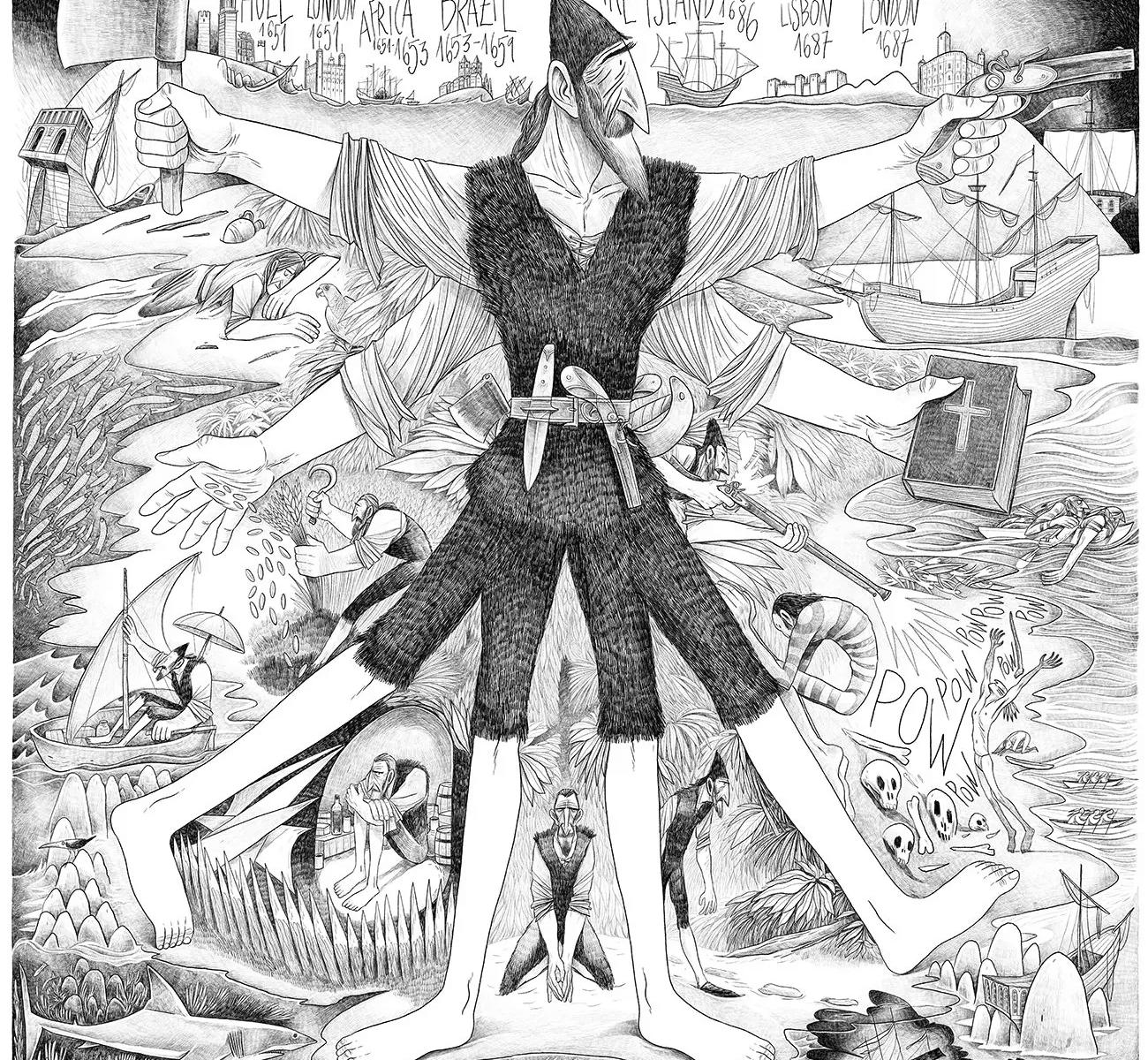
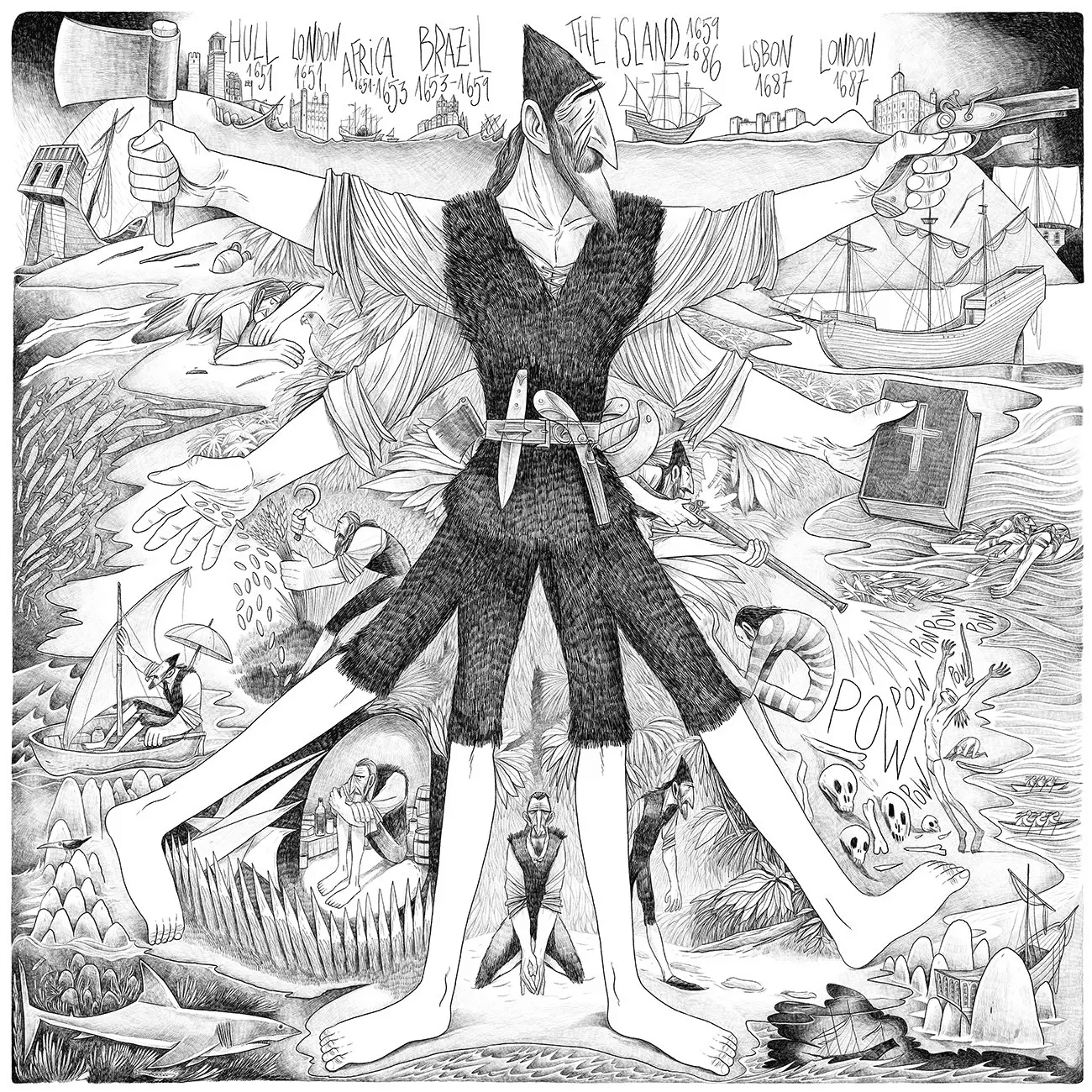
*A brief about a puritanical simpleton who created a micro-commonwealth of Christian clichés
The following is an excerpt from Manifesting the Liquid Continent, my paper published in the 1st International Conference on Asia Pacific Ethnology and Anthropology, Kunming China, 2019.
Civilization as we have come to understand it, was built the moment we begin to understand the benefits of our division of labor and our understanding of exchange, markets, and supply chains. We gave it those us-and-them names, and also numbers like “many” and “none.” Now those numbers, define the Anthropocene, numbers like 8 billion, which some futurists predict may one day become none if this planet should soon become an uninhabitable wasteland. Totemic identifiers may soon become little more than placeholders establishing legitimacy of an imagined historicism suggesting that to be civilized means to have been found. The seminal political theorist and sociologist Karl Popper writes, “Robinson Crusoe and his isolated individual economy can never be a valuable model of an economy whose problems arise precisely from the interaction of individuals and groups.”[i] And yet, since we have never been as isolated as Daniel Dafoe’s shipwrecked and stranded character, then why should we strive for that insularity. There are some who reimagine the architecture of human space in the natural world, and will willingly leapfrog the millennia of our social evolution back to a solitary social contract dismissing the entire acquired knowledge of the Anthropocene to a pre-totemic place: a tree house on a deserted island.
Yet, the problems that Popper alludes to are “problems” because we are not fictive like Robinson Crusoe living in an island bubble away from cannibals. Our engagement in the world is economic. Whether islands in oceans, or mountain villages, or floating above the earth as in Jonathan Swift’s floating island of Laputa, we have evolved far beyond the historicist’s vision of an origin story. Ours is a story of supply chains. We divide our labor, we engage in exchange. Whether we walk or sail or fly whether we journey or aimlessly drift, the geography of islands, deserts, oceans, and mountains may, to some degree, have determined how natural partitions give boundaries to totems, but the movement of people towards markets of exchange reject the imposed partitions of states and islands and instead recognize oceans, mountains and deserts as merely the spectacle between markets, the interstitial space that would eventually define the breeding ground for military campaigns and conquest and the wastelands of nuclear testing.
It is in the classical political imagination of Euro-American culture that the asymmetrical relationship between main-lands and is-lands evolved, and it was Robinson Crusoe, who Peter Sloterdijk describes as the “puritanical simpleton who created a micro-commonwealth of British Christian clichés,” supplied a “formula for the relationship between self and world in the age of European world-taking.”[ii] The problem is that islands are also mainlands. Dafoe writes, “The savage was now a good Christian,” “we had here the Word of God to read and no farther off from his Spirit to instruct, than if we had been in England.”[iii]
The island of England was the mainland, precisely because of the puritanical self-identifiers that claim rights and property and determine the rules of exchange. Poor Robinson Crusoe left his middle class parentage to become a slave on a ship that was wrecked in a storm. Marooned on an island with savage cannibals, a commerce of which he had no taste for, Crusoe provided no service except for the guns he used to kill the savages and the conversion he applied to subjugate his native man-servant that he called Friday, whose name he never asked. Is it by coincidence, prognostication, or the persistent repetition of religious doctrine that the journals of Capt. Cook’s voyages into the Pacific should reproduce those very same narratives? Is that not the lesson learned from the apotheosis of Capt. Cook, that the self-fulfilling narratives of conquest, imperialism, and civilization are the myths of Christianity?[iv]
And yet these myths persist, invoking the same narrative tropes as if our future could only move forward by rubberstamping its approval of authority. It is the hypocrisy that is maddening. We may self identify as puritans, yet we trade as cannibals, as violent traders that cannibalize markets.
Our economy is predatory and fierce. In the history of the world, there is no greater example of a cannibalistic system than the waning days of neoliberalism when Wall Street’s Lehman Brothers and Bear Stearns spectacularly imploded our financial system as investment markets consumed their own debt, hungered for credit default swaps, and feasted on derivatives and debt securities.
The economy of Robinson Crusoe killed the people not the cannibal. The system still remains as we have imposed the capitalist moniker atop every totem of each locale as if the logic of human development evolved to only reach this place, as if this matrix were the zenith of power. Economic historians may one day understand as Foucault has, that “this form of power is salvation-oriented (as opposed to political power). It is oblative (as opposed to the principle of sovereignty); it is individualizing (as opposed to legal power); it is coextensive and continuous with life; it is linked with a production of truth—the truth of the individual himself.” [v]
How can we approach western geography or the stratifications of trade and commerce seriously, when the basic assumptions continue to privilege a discourse that governs the flow of trade towards a center of power that is neither political, sovereign, nor legal, yet is linked with the production of truth, the manufacturing of consent, and punishes difference and deviancy with tactics of exclusion, obfuscation, and containment?
go to next: The in-between space is a Caravanserai
previous: What is Data
References
[i] Popper, Karl. The Poverty of Historicism. Routledge. 1997. pp. 8
[ii] * Sloterdijk, Peter. Spheres Volume III: Foams Plural Spherology. Semiotext(e). 2016. pp. 287-88.
[iii] Defoe, Daniel. Robinson Crusoe. Random House. 2001. p. 203.
[iv] Obeyesekere, Gananath. The Apotheosis of Cpatain Cook: European Mythmaking in the Pacific. Princeton University Press. 1992. p.3.
[v] Foucault, Michel. Power. “The Subject and Power.” The New Press. 2000. p.333.
*This is the 2nd of a five-part series called Sequence of the Seashells, outlining decolonial data governance and translocal market infrastructure, which is all about describing how communities can reclaim authority over the compliance chains that determine the value of their own ecological and social data.
The sections are What is Data, The Crusoe Economy, The in-between space is a Caravanserai, Behold! The World Data Organization, and Translocal Intermediaries.Please share and subscribe!