Through the Glass, Darkly: Climate Finance Meets Debt

on my substack:
https://onibaba.substack.com/p/through-the-glass-darkly

A critical and intemerate response to the UNFCCC COP 30, October 2025 NDC paper, “Nationally determined contributions under the Paris Agreement

Through the glass, darkly
, the world observes its reflection in the mirrored surface of debt. Climate finance presents itself as a race to save the planet, while concurrently dragging its feet through genocide, perpetuating, and provoking war and economic destabilization with countries and/or economies that don’t align with the targets of asset management. This image is refracted through an opaque medium in which debt and data have become indistinguishable currencies. The new economy of restoration—measured in bonds, credits, and blended instruments—rests upon the same arithmetic that has long commodified crisis. The result is a system that counts environmental virtue in units of liability, and it is within this accounting paradigm that nothing moves unless data are surrendered, standardized, and securitized by those who profit from accumulation. (See annex 1)

According to the report, 88% percent of Parties now quantify their financial needs, collectively estimating almost two trillion dollars to achieve their climate goals. Yet this number does not reflect ecological repair. It represents eligibility for loans, grants, and blended finance issued through international intermediaries, of which local communities have little access to developing or controlling. The calculation itself reaffirms dependence and development aid. The majority of states identify international sources as their principal means of implementation, while domestic finance remains marginal. For the 88%, what passes for cooperation is a hierarchy of access: to debt, to rating agencies, to the terms of disclosure. The poorer the country, the greater its obligation to make itself legible through data extraction.

With the expressed aim of decolonizing accounting methodologies, Intemerate Accounting rejects this conflation of valuation. Ecological accounting begins not with credit lines but with the veracity of local data. It treats knowledge as a reciprocal asset, not as collateral. Yet within the architecture of the Paris Agreement, data are produced for creditors, not for communities. Local biostatistics, resilience measures, and ecological inventories become the raw material for global climate finance. What is called transparency is, in practice, a kind of opacity. When trust is the real basis of reciprocity and exchange, the colonial system replaces that trust with its accounting methodology, using the language of data transparency to conceal the extraction that sustains it.

Their function is to verify compliance and maintain liquidity in funds administered by asset managers. If this is transparency, it is a ghost, a spectral transparency more aligned with the hauntology of capital, as I describe in detail in another post.

Measurement, Reporting and Verification (MRV) and Enhanced Transparency Frameworks (ETF) in the Paris regime are built to evidence compliance with Nationally Determined Contributions (NDCs) and to standardize information for eligibility, disbursement, and review. The 2025 synthesis shows that 92 percent of Parties now describe domestic MRV systems, most linked to Greenhouse Gas (GHG) inventories and biennial transparency reports under the ETF; three-quarters describe formal tracking of NDC progress. These functions discipline how data is produced and shared, and they determine who qualifies for finance and on what terms.

But this is the crux of the sham.

MRV and the ETF assume that indigenous protocols and reciprocity schemes cannot be standardized, so they subordinate them to templates that serve creditors. Intemerate Accounting inverts this. Indigenous verification rooted in trust, consent, and continuous stewardship, I would argue, produces more accurate measures than distant audit frames because it binds evidence to responsibility. Any market that does not vest ownership, custody, and authorship of data in local practitioners will undervalue community resources and overvalue investor returns. Transparency without community control is spectral: an appearance of clarity that reproduces domination while claiming neutrality.

This “spectral transparency” obscures ownership and control of the underlying data, making it more performative rather than emancipatory. It only “appears” as openness while reproducing the power of those who determine what counts and who counts. That is the sense in which the visibility of MRV becomes ghostly.

The World Bank’s estimation of environmental data as a one-hundred-trillion-dollar asset is a fiction that reveals the depth of this confusion. It presumes that ecosystems can be priced in the same ledger as, for example, sovereign debt. The coincidence that global public debt approximates the same figure is not incidental. Debt and environment mirror one another: both are abstractions of life converted into obligations. The debt of nations sustains the liquidity of markets, while the data of ecosystems sustains the credibility of climate finance. Each exists to justify the other. The illusion of parity conceals the asymmetry of control.

To put things in perspective, the combined debt of the ACP countries is only around $4 trillion. But for many ACP countries, that debt is blood money, and it is the very real life and death to any genuine security that might be achieved if a decolonial accounting program were adopted. To be blunt, if the ACP were to tell the OECD countries that they need to pay off their $65 trillion in debt* before tackling their $4 trillion, how would the entire accounting matrix unfold so that all debt would be zeroed out? But here’s the rub: if the OECD economies continue to accumulate global environmental data, once again, the ACP, indigenous peoples, and alterity networks will be left at a disadvantage because, without owning their data, they will not be able to control intermediary markets and remain rentiers in ecological spaces they have stewarded for generations.

Imagine the United States and the OECD economies, holding the lion’s share of global debt, defining the terms under which ecological data are valued and exchanged. This is not hyperbole. Within the UN Statistical Division, the System of Environmental Economic Accounts (SEEA) is building a data reservoir that may seem benign, but when you consider that the only ones building this new accounting system are the OECD countries, with no substantive input from the Global South or from the real equity holders of global environmental data, we should not be foolish enough to equate benign with with benevolent. The architecture of SEEA encodes the same hierarchies that structure global finance. By positioning OECD institutions as the arbiters of ecological value, it transforms measurement into ownership and transparency into control. What appears as technical coordination is, in truth, the consolidation of data sovereignty within the very economies most indebted to the planet they claim to account for.

Moreover, U.S. military installations—both long-established and newly constructed under the pretext of national defense—are often situated directly above or adjacent to vital aquifers. Their presence is not incidental. These sites discharge classified chemical and radioactive pollutants into the very sources of freshwater that sustain nearby communities, while the data on contamination, remediation, and long-term risk remain hidden under security exemptions. This produces a layered form of control: polluting the resource, manufacturing scarcity, restricting access to environmental information, and consolidating that information into asset-managed databases. Within this arrangement, water becomes a dual commodity—first as a privatized physical resource, and second as data priced and traded through the same markets that determine financial derivatives. The secrecy of military pollution is not just an environmental crime; it is a data strategy that links ecological degradation to the governance of scarcity and the monetization of knowledge within the very same asset management houses that govern the different investment sectors in OECD economies. One of the dark sides of AI is how data computations, wielded by investment regimes, can turn data into trillions of assets, before the signatures providing our consent dry. (see annex 2)

So, within this context, who, really, are the external threats and actors?

Seen through this lens, the Global Stocktake is more of a ceremonial account—there is no material measurement, because there is no local market, no locally driven intermediary markets when it comes to, for example, warehousing, logistics, health care exchanges, risk pools and cooperative insurance, cultural knowledge cooperatives, mutual credit systems, procurement hubs, audit and verification clearinghouses, etc… Within traditional knowledge systems, these are all supply chain nodules that go back centuries, before neoliberalism, capitalism, and colonialism. (see annex 3)

The Global Stocktake, as understood within COP, is a perfunctory “take” without any stock.

They audit participation without altering the ownership of value. They translate local realities into universal indicators that sustain the global financial narrative. The act of reflection is itself commodified; the world is asked to gaze upon its moral image through the glass of data that others own. Nothing will be restored until that glass shatters.

Through the glass, intemerately, clarity emerges only through the grounded work of local verification, where value returns to those who produce and sustain it.

Intemerate Accounting proposes a reversal. To account intemerately is to remove the filter of debt and to see restoration as a process of restitution, but really an act of liberation, emancipation, and decolonization (LED). Value must arise from verified restoration, held within local custody, expressed in regional accounts that balance monetary factors with ecological variables. Data must serve communities first, not creditors. Only when communities control their information can finance cease to function as an instrument of enclosure and become a mechanism of reciprocity.

Through the glass, intemerately, we begin to see how reflection has been mistaken for truth. Debt has been treated as unavoidable, and data as unquestionable evidence. To see clearly requires stepping beyond the mirror of finance and the abstractions that mistake exposure for control. Clarity emerges only through the grounded work of local verification, where value returns to those who produce and sustain it.

Decolonize Accounting is a reader-supported publication. To receive new posts and support my work with a cup of coffee, consider becoming a free or paid subscriber.

Annexes:

annex 1. 1 Corinthians 13:12 teaches that our present knowledge is partial and mediated, “through a glass, darkly,” while full understanding comes only “face to face.” The Qur’an states the same epistemic limit in a different key: hearts can be sealed and veiled so that hearing and sight fail (Q 2:7; 17:45–46). Read against the Global Stocktake, these verses name a structural problem. Aggregated indicators promise vision, yet they filter reality through distant categories and institutions. What we see is a managed reflection, not a face-to-face account of restoration. An ethical stocktake would attend to the veil itself. It would replace mediated visibility with accountable proximity by centering local custody of data, consent, and community verification. Until these conditions hold, the Stocktake measures what it is designed to allow, and dismisses what the framework excludes.


annex 2. This captures the structural violence of data monetization: the conversion of information into speculative capital without meaningful consent. In the context of decolonial accounting system, it exposes how AI operates not as a neutral analytical tool but as a multiplier of enclosure. Machine learning systems extract behavioral, ecological, and biostatistical data, standardize it, and feed it into valuation chains governed by asset managers. Consent, when it exists at all, is procedural—signed but never understood, automated within terms-of-service architecture.

AI, therefore, functions as an accelerant in the ongoing financialization of data. It processes and prices data. Once processed, local and ecological data enter global markets as synthetic assets—carbon credits, environmental derivatives, ESG portfolios—detached from their communities of origin. The transformation happens in milliseconds, yet its effects can endure for generations, as ownership over the data’s value migrates upward into investment funds while the consequences of extraction remain local, and that data builds value through the intermediary of data governance, creating a further division of accessing wealth.

In short, AI enables a new form of expropriation: an instantaneous capitalization of consent. What looks like computation is, in truth, the continuation of colonial accumulation through algorithms trained to interpret the world as collateral.

annex 3. In the early days of supply and exchange—before colonial borders and corporate law—trade was rooted in protocol, reciprocity, and mutual recognition. Markets were extensions of community, not instruments of extraction. People exchanged goods, knowledge, and labor through relationships governed by trust and custom. Security, storage, and translation of value were collective responsibilities, sustained through offerings or tithes that reinforced social balance rather than accumulation. These exchanges linked territories through mutual obligation, ensuring that value circulated without domination.

Colonialism broke that equilibrium. It replaced reciprocal trade with monopolized access, transforming markets into tools of exclusion. The colonized were barred from setting prices, issuing currencies, or defining value on their own terms. Markets ceased to reflect relationships and instead became infrastructures of control. The rhetoric of the “free market” masked the violence of dispossession.

Today, that structure persists under a new form of empire—data capitalism. Every act of communication, movement, and consumption is captured, quantified, and transformed into asset value. Our actions feed systems that convert behavior into capital. What was once overtly stolen is now silently expropriated through code. The tithe has become algorithmic: we pay it not with goods, but with our digital presence. To participate is to yield information that others own and monetize.

This condition, however, is not inherent to technology itself. Technology is neither liberating nor oppressive on its own. The distinction lies in governance. Some nations, such as China, possess the same computational capacities but deploy them under a model that asserts data sovereignty and rejects the Western doctrine of “data transparency.” That rejection is not about secrecy; it is about control. It recognizes that transparency, when defined by financial or geopolitical interests, becomes a form of surveillance masquerading as openness.

From the standpoint of Intemerate Accounting, the issue is not the use of technology but who defines its ethics and owns its outputs. Colonialism continues whenever data leaves communities without the full free, prior, and informed consent of the program or an understanding of how to access, manage, and restore equitable compensation. The alternative lies in restoring the principle that guided precolonial exchange: trust grounded in responsibility. Local data sovereignty reclaims that right, transforming technology from a means of extraction into a tool for equitable accounting, where value and information remain in the custody of those who create them.

Local Data Sovereignty: The missing link

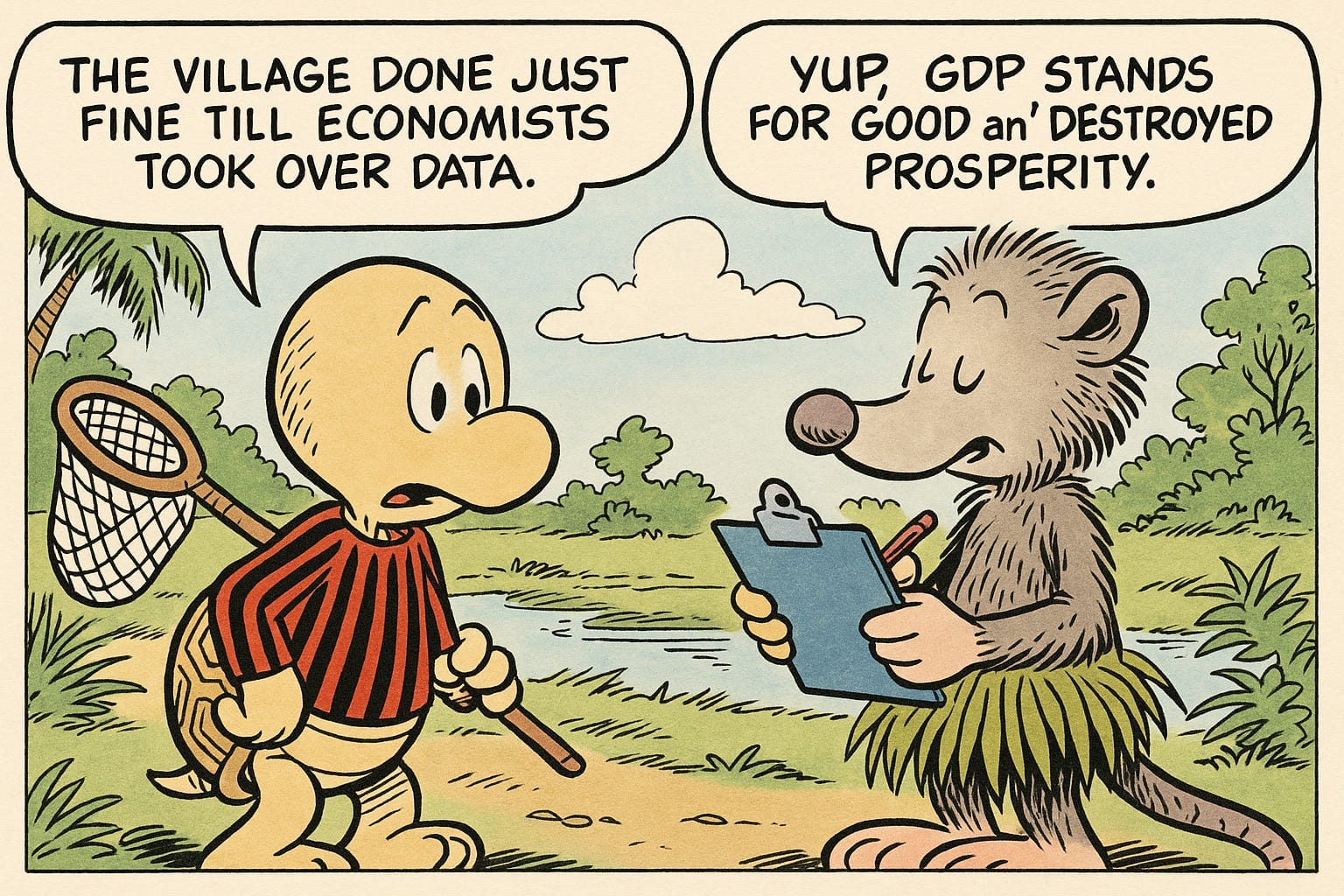
There was an Opinion piece I saw in the Fiji Times recently called “Let’s make rich villages poor: The GDP scam.”

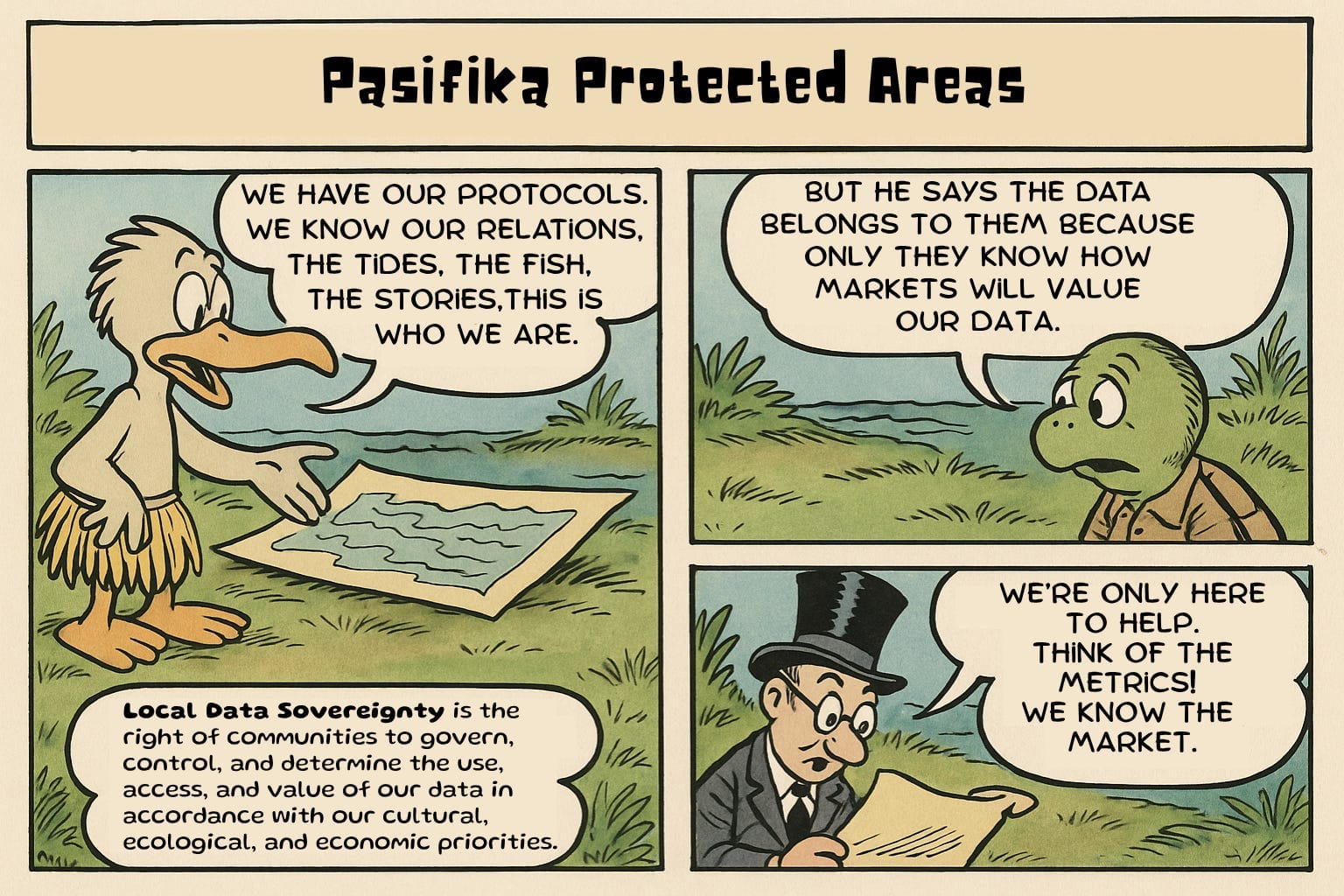
Every critique of GDP sounds great until you notice what’s missing: local data ownership. The global argument against GDP’s blindness to real well-being—its disregard for food sovereignty, care work, and ecological health—is true but incomplete. What makes it incomplete is that even the proposed alternatives, like the Gross Ecosystem Product or the Multidimensional Poverty Index, still rely on data extracted and standardized under OECD and IMF frameworks.

OECD systems depend on data uniformity to preserve comparability, credit ratings, and loan conditions. If communities were to control their own data, they would control how value is defined. That would undo the epistemic power that keeps the global South dependent on donor institutions for validation.

Decolonize Accounting is a reader-supported publication. To receive new posts and support my work, consider becoming a free or paid subscriber.

Fiji’s 1193 villages already live by the logic of vanua: resilience, reciprocity, and shared care. Their data should not be captured for external valuation. Yet GDP-based accounting systems classify these communities as poor because they do not transact in cash. New ecological indices repeat this logic, converting restoration into valuation rather than sovereignty.

True accounting reform begins when data sovereignty is embedded in the measure itself. A better approach is that communities must be the custodians of their data, determining how it is gathered, verified, and interpreted. Only then can the metrics of prosperity emerge from the lived ecology of people and place, not from the institutions that have mismeasured them for decades.

Fiji doesn’t need more indicators to replicate what it cannot already access with GDP. It needs control over its own data. That is where prosperity begins.

Our regional wealth begins not with higher GDP or greener indices, but with the right to define value through our own data.


Also, it’s important to be clear what the purpose of GDP is. As a measurement of growth, it derives value from its connection to debt and access to credit. Nations pursue higher GDP figures because international financial institutions use those numbers to determine loan eligibility and repayment capacity (the standard threshold for developing countries is 60% debt-to-GDP). Likewise, when countries adopt so-called alternative economic or ecological indicators, their value is often limited to accessing aid, rather than transforming economic relations. Both loans and aid remain institutionalized under OECD governance, reinforcing the same hierarchies of dependency that GDP has evolved into.

For Pasifika, true independence will not come from adopting new global metrics but from building data sovereignty. There is no better model of indigenous stewardship or recalibration of ecological and social well-being than for these nations to collect, manage, and interpret their own data according to their own values of vanua and community resilience. By controlling the full life cycle of their data—from collection to interpretation—they can define, or maybe redefine prosperity in terms of balance, reciprocity, and restoration rather than only extraction and growth.

Once data ownership is secured, Pasifika can use their aggregated knowledge to establish translocal markets that reflect real ecological and social exchange. These markets would not depend on western-imposed oversight, validation, or external certification but would instead operate through local networks grounded in shared ecological realities. In this system, value would circulate through stewardship rather than speculation, and data would serve as an instrument of solidarity rather than surveillance.

In short, our regional wealth begins not with higher GDP or greener indices, but with the right to define value through our own data.

https://onibaba.substack.com/p/local-data-sovereignty

Toward a Pasifika Horizon: Local Data Sovereignty and the Emergence of the Melanesian Ocean Reserve

Pasifika should not be seen as a region waiting to be developed. It should be understood as a constellation of knowledge systems, cultural protocols, and ecological memory that can chart new economic futures. As climate finance, digital infrastructure, and geopolitical alliances shift toward a multipolar world, Pasifika communities are in a position to define a new basis for economic sovereignty—rooted not in extraction, but in stewardship. What lies ahead is not simply the protection of marine territories or the conservation of biodiversity. It is the articulation of data regimes, value systems, and accounting protocols that reorient wealth around reciprocity, care, and restoration.

This is the potential of local data sovereignty. When communities control how their data is gathered, interpreted, and applied, they do more than manage their environments. They begin to shape the terms of exchange, define the metrics of value, and engage in economic practices that reject the financial abstractions imposed by carbon markets, biodiversity offsets, and speculative ESG instruments. Ownership of indigenous island knowledge—biodiversity, water systems, migratory patterns, seasonal flows—becomes the foundation of a new kind of economy. One that recognizes interaction, not accumulation. Stewardship, not speculation.

In this light, the 2008 Locally-Managed Marine Area guide by Govan et al. offers a valuable entry point. It laid the groundwork for community-based adaptive management (CBAM) in the Pacific, centering traditional knowledge, participatory mapping, and biological monitoring. The guide affirmed the importance of local engagement and recognized the role of custom in marine governance. But it did not yet consider that monitoring itself produces data capital. It did not imagine that the knowledge generated by communities could constitute an economy of its own. Tools that transect stakeholder matrices and seasonal calendars, for example, remain vital. Yet they are framed in the language of resource management rather than sovereignty. The data generated through CBAM is circulated to external institutions for conservation planning, not retained as a strategic asset by communities themselves. This is not a flaw of the methodology, but a limitation of its historical imagination. It now falls to the next generation to build upon that foundation and to reframe monitoring as a sovereign act.

This is what makes the announcement of the Melanesian Ocean Reserve by Ralph Regenvanu (Vanuatu) and Solomon Island National University so consequential. With over six million square kilometers of sea and island territories under a Pasifika-led protection, it promises not only to be the largest marine reserve of its kind, but the beginning of a political and epistemological shift. Led by the Solomon Islands and Vanuatu, and aligning with a Kanaky EEZ, this reserve invites a reimagination of marine governance as both protection and jurisdiction. The opportunity not only challenges foreign extractive practices like Deep Seabed Mining. It is to turn environmental data itself into the terrain of regional autonomy by creating potential markets that value the stewardship of our ecological biodiversity.

This potential is amplified by the region’s geopolitical alignment. The Solomon Islands, through its participation in the Belt and Road Initiative, is positioned to develop regional data infrastructures that are not dictated by Australian or American frameworks. China’s orientation toward local data sovereignty for example, while certainly strategic, allows for a different kind of negotiation—one that does not presume default access to indigenous data or assume ownership of its applications. France, by contrast, and the European Union by extension, while advancing strong data protections internally, continues to extend colonial jurisdiction across the largest maritime zone in the world through its administration of Kanaky (New Caledonia), Tahiti (French Polynesia), and Wallis and Futuna.

To move beyond this structure requires not only policy realignment but educational transformation. The work being done at the Pasifika Communities University highlights how local indigenous accounting frameworks can be part of that shift. The development of curricula around intemerate accounting, local data markets, and translocal economies is a praxis of refusal and reorientation toward Pasifika relationality. In this program, students are learning to audit not in the service of compliance, but as a form of witness. They are defining metrics not to standardize value, but to restore relationality. They are learning to interpret data through reciprocal protocols that do not obey Western timelines, but follow seasonal rhythms, genealogical memory, and ecological responsibility. This is where Free, Prior, and Informed Consent becomes more than a procedural safeguard. It becomes the foundation of a data economy that respects the sovereignty of knowledge.

Intemerate accounting offers the architecture for this future. It does not quantify nature for pricing, but measures the quality of interactions between communities and ecosystems. It creates a framework where economic viability is inseparable from cultural integrity and environmental repair. Unlike GDP, which reduces life to output, or carbon credits, which monetizes damage, the intemerate equation recognizes that value must be situated within histories of care, displacement, resistance, and renewal.

To build on this foundation, we must recognize translocal data markets not as platforms for profit, but as circuits of solidarity. These are exchanges where communities share ecological insights and services, adapt strategies to shifting climate conditions, and hold one another in accountability and trust. They are not commodities but commitments, they are transactional transformations. What is exchanged is recognition.

This is the work ahead. Not to manage ecosystems within the constraints of existing frameworks, but to design new systems of accounting, valuation, and governance that emerge from the lived practices of those who have sustained these ecosystems for generations. The era of big conservation is nearing exhaustion. Its maps, its metrics, its mandates have failed to protect what matters most. What comes next must be authored from below, from within, from across the liquid continent of Pasifika where data is not simply a 21st-century resource to be accumulated by wealth extraction and private ownership by multi-trillion dollar asset managers like Blackrock and Vanguard, and other too-big-to-fail Assets under Management. Local Data Sovereignty prevents “colonialism-by-spreadsheet.”

Just as Marx described the shroud of capitalism settling across Europe, the Pacific has lived under its own veil of occupation, privatization, and enclosure. Foreign powers have laid claim not only to land and sea but to memory itself, covering the ocean of our ancestors and the futures of our children’s children, not just across our vast island network, but across time and the entire world. To lift this colonial covering is not simply to reject extraction. It is to restore visibility to all systems of knowledge and stewardship that have long sustained our regions. The threat posed by deep seabed mining, for example, is not just ecological. It reflects a deeper failure to recognize the value of our technologies, our protocols of care, and our capacity to define value on our own terms. Local data sovereignty allows us to navigate the global economy not as clients but as custodians of a shared oceanic future.

Deep seabed mining belongs to the imagination of a 19th-century economy, a world of imperial frontiers and accumulation through conquest. We do not need to live in that world. The valuation systems that animated empire—resource speculation, territorial expansion, extractive growth—cannot guide us through the ecological crises they helped create. The only valuation that now holds meaning is the resilience of the environment and the biodiversity that makes life possible. To ignore the technological imagination of Pasifika, to refuse the regenerative intelligence rooted in reciprocity and intergenerational care, is to abandon the very foundations of our history and community.

If our leaders cannot see the value of ecological guardianship, then that failure demands reckoning. This is not a policy dispute. It is existential. To support seabed mining is to uphold the most violent tools of colonialism: genocide, ecocide, slavery, theft, fraud, and dispossession. It signals surrender and collapse. Simply put, if our leaders cannot protect the sea, how can they protect the people who belong to it? To those who support DSM, they would have sold our ancestor’s bones for what essentially should amount to a sliver of a penny on the dollar. Think about that.

What GNDI Leaves Out of Pacific Economies

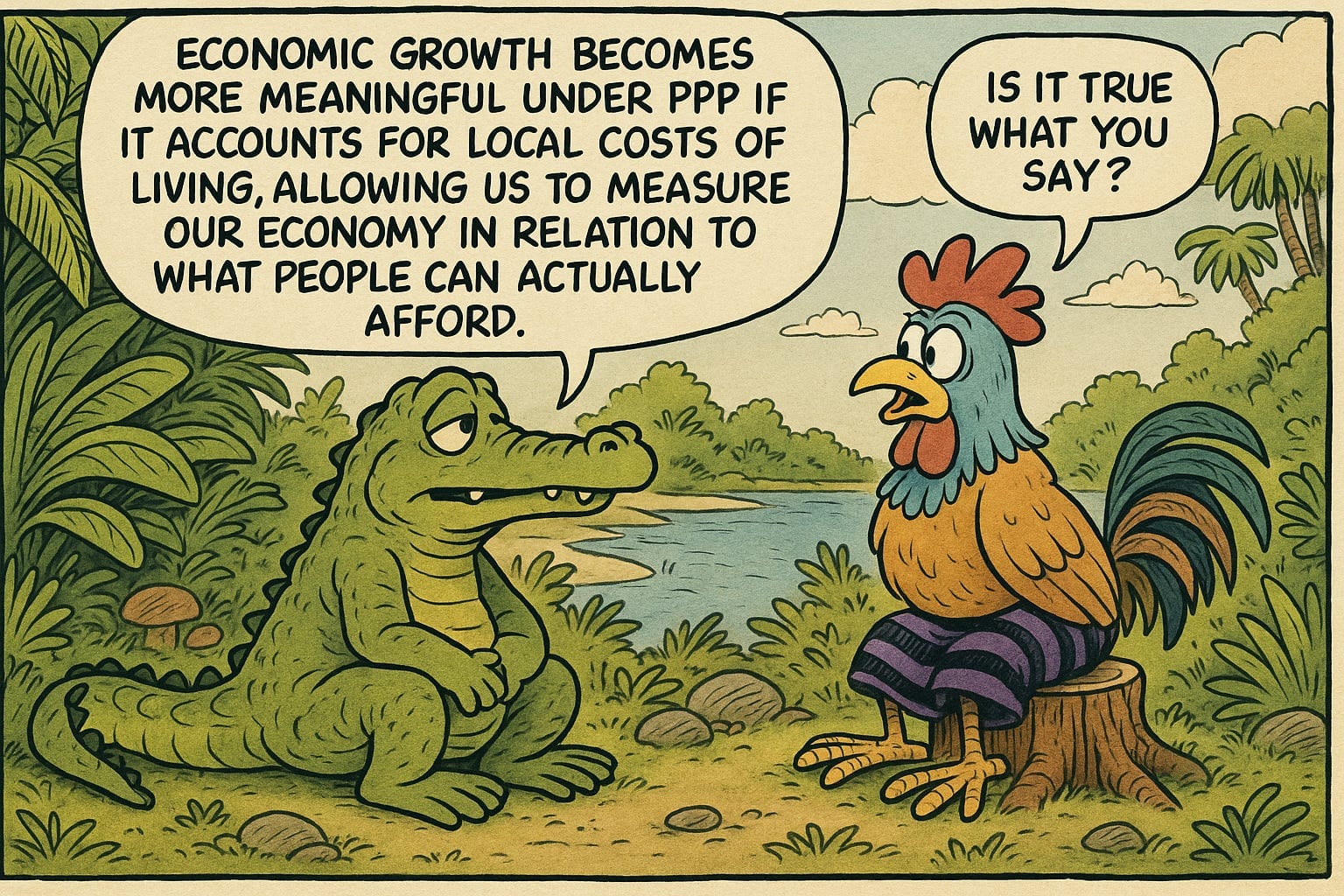
Even an inquisitive chicken knows what question to ask.

The recent presentation of the 2025 Pacific Update at the University of South Pacific hosted by Australia National University on Gross National Disposable Income (GNDI), introduced a revised approach to economic measurement for the Pacific Island Countries (PICs). Delivered by Professor Stephen Howes, in collaboration with Dr. Rubiat Chowdhury, the presentation argued that GNDI is a more accurate measure of income for the region than the widely used Gross Domestic Product (GDP).

The failure of GDP as a national accounting metric is evident, and we should all agree that GDP has been a failure for Developing Countries and regions, particularly Pasifika. Behind the curtain of GDP is a system of measurement that has been designed to be obfuscating, and even those working within National Accounts are confused and silenced by the inclusion of some revisions and the exclusion of others. If we want to understand the evolution of GDP, one has to understand the role of the US Bureau of Economic Analysis (BEA) and its leadership role in the OECD. For the Global South as a whole, the way to approach GDP is to view it as the twin fists of neocolonialism and debt, it is a closed accounting system that does not allow space for any mechanism to counter the OECD narrative.

It is for this singular reason that when Pacific Theological College was working on their Reweaving the Ecological Mat program, we focused on National Accounting Systems and created the Intemerate Equation. In the simplest and most elegant terms, we proposed a corrective to GDP by introducing a modulator based on environmental and social well-being, using self-determined indicators capable of attaining their own market value independent of OECD influence. This is what is now put into practice at Pasifika Communities University.

With GNDI, the central claim is that the unique economic structure of PICs—characterized by low domestic production and high external inflows—cannot be captured by GDP alone.

Stephen Howes’s presentation focused on three main points. First, that the Pacific is economically unique. Second, that the region experienced the fastest economic growth in the world during the 2010s when measured using GNDI. Third, that GNDI should become the preferred metric for assessing economic performance in the Pacific, given its inclusion of remittances, aid inflows, sovereign asset revenues such as the PNA’s fishing licenses, and foreign investment income.

While these claims are technically compelling, they require careful examination. One critical omission in the presentation is the issue of population density. The Pacific Islands region, including Papua New Guinea (PNG), comprises a population of approximately 18 million spread across a maritime area of nearly 25 million square kilometers of exclusive economic zones (EEZs). This extremely low population density presents challenges for infrastructure development, service delivery, and ecological governance. It also raises questions about how per capita metrics like GNDI or GDP are interpreted and whether they can meaningfully represent social or ecological well-being across dispersed populations. As we begin to explore this low population density, what we should be asking is why Pasifika people do not have the highest GDP per capita in the world, because the fact that they remain on the lower economic development index is not the result of Pacific Islanders but rather, the enforcers of economic governance that excludes Pasifika values.

Any revision of GDP must not be approached lightly. The risk is that PICs may be locking themselves into a revised metric without fully understanding the range of GDP indicators and their policy implications. A more rigorous presentation would have addressed GDP not only in nominal terms—which are more useful for assessing debt obligations and financial exposure—but also through the lens of Purchasing Power Parity (PPP). PPP accounts for price differentials between countries and is often used to compare living standards and real income. It is notably absent from Howes’s presentation. “Economic growth becomes more meaningful under PPP because it accounts for local costs of living, allowing us to measure our economy in relation to what people can actually afford.”

The logic of GNDI, as presented, is structurally closer to PPP than to nominal GDP. It attempts to account for income flows that affect people’s capacity to spend and live, rather than measuring only domestic production. But without explicit reference to PPP or the nominal vs. real distinction in GDP, the audience is left with a partial view of how GNDI fits within the broader landscape of national accounting.

Another issue is the framing of GNDI as an unproblematic improvement. If PICs adopt this metric without rethinking how data is collected, interpreted, and monetized, they may be entering into another cycle of extractive accounting. GNDI incorporates remittances, aid, and revenues from sovereign assets—but these data streams, once formalized in economic models, can also be subjected to valuation, securitization, and eventually commodification. There is a growing global trend toward turning data into financial instruments. Without explicit safeguards, these revised metrics may be used to justify new forms of financial speculation or market capture.

What is missing from the GNDI proposal is a discussion of data sovereignty. Pasifika cannot afford to reproduce the centralized, top-down systems of measurement that have long defined GDP. The design of economic indicators must be rooted in regional governance, with community-based processes of validation, and mechanisms for consent. Otherwise, metrics like GNDI will merely offer a more refined version of the same economic logic that has failed to deliver equitable or sustainable outcomes.

For GNDI to be useful, it must be placed within a framework of accounting that centers wellbeing, ecological interaction, and community-defined values. Without this anchoring, the revision of GDP will remain superficial. Yes, Pasifika needs better numbers, but we need to assert control over what is counted, how it is counted, and who benefits from the counting.

https://onibaba.substack.com/p/what-gndi-leaves-out-of-pacific-economies

Pasifika Maritime Future: From Asia to Latin America– a Neoliberal-Free, Independent Pasifika.

Toward a Maritime Future:

As Pacific Island delegates gather for the Third China–Pacific Island Countries Foreign Ministers’ Meeting, the horizon feels open with possibility. Amidst persistent Western narratives warning against Chinese engagement, it is important to affirm that the Pacific is not a void to be filled by superpowers—Pasifika is an ocean of relation, a mat of kinship stretching from Asia to Latin America, a space that remembers what many modern states forget: reciprocity.

It is in this spirit that we welcome the potential of a China-led Maritime Belt and Road Initiative that looks beyond narrow geostrategic framing and begins to map trade and infrastructure along the equatorial currents. These currents— moving west to east and east to west, bending past the Galápagos towards Panama—carry more than cargo. They carry the promise of a renewed maritime commons, where Pacific Island Countries are not just stepping stones or choke points, but sovereign nodes in a new oceanic connectivity.

Decolonize Accounting is a reader-supported publication. To receive new posts and support my work, consider becoming a free or paid subscriber.

The possibility of enhancing east-west maritime trade between Asia and Latin America—through infrastructure aligned with Pacific currents and possibly even the long-discussed Nicaragua Canal—offers an alternative route to the Northern shipping passages dominated by U.S. naval and commercial interests. For PICs, this is not about choosing sides. It is about choosing futures.

Latin America, Asia, and the Pacific Islands share more than the Pacific. They share histories of colonial disruption, extractive economies, and diaspora. But they also share a vision—of sustainable, equitable trade rooted in local resilience, biodiversity, and cultural dignity. As trade corridors develop, let them be corridors of solidarity. Let Pacific and Latin American ports grow together—not in competition with nature, but in coordination with it.

This would mean balancing trade with ocean governance, building on regional frameworks. It would mean embedding indigenous leadership into port development, fishery agreements, and digital shipping infrastructures. Above all, it would mean centering the human currents—people-to-people exchanges, cooperative education, spiritual diplomacy—that make any infrastructure meaningful.

Promoting another kind of NFIP: A Neoliberal-Free, Independent Pasifika

In the spirit of regional gatherings past, we might recall the Nuclear Free and Independent Pacific meetings as a political, philosophical, and spiritual reference point. Then, the call was for sovereignty, demilitarization, and a Pacific defined by its own voice rather than by external forces. While NFIP was inclusive of the participation of peace and justice warriors from Latin America, Asia, Alaska, US First Nations, and Torres Strait, today we find ourselves navigating a different kind of encroachment—not nuclear testing, but economic saturation; not military bases alone, but market capture, conditional finance, and outsourced governance.

Perhaps what we are witnessing is the emergence of a Neoliberal-Free and Independent Pacific—where the language of free is repurposed to mean deregulated capital flows, and independence is brokered through multilateral development compacts. Where solidarity risks being replaced by infrastructure debt, asset management, and digital extractivism.

Yet it is precisely by remembering the clarity and vision of those earlier assemblies that we might reimagine the present—not to retreat into past formulations, but to reassert that independence cannot be defined by remaining enclosed by western criteria. The Pacific remains a site of relation, not transaction. And it is here, in this tension between memory and modernization, that new forms of alliance and resistance can still be charted— Local Data Sovereignty, for example.

In this moment of shifting currents, Pasifika might also draw strength from the emancipatory lineage of Latin America’s own insurgent imagination—from the defiant praxis of Che Guevara and Fidel Castro, who refused the hemispheric dictates of empire; from Subcomandante Marcos, who achieved Zapatista autonomy; from Paulo Freire, who taught us that liberation begins by naming the world in our own terms. We are reminded that revolution is not merely an event, but a process of collective becoming. Presidents Hugo ChávezEvo Morales and Jose Mujica all reclaimed sovereignty as a hemispheric demand. These are not just icons. They are reminders that across oceans and mountains, movements have always prioritized dignity over domination, mutual care over managed scarcity.

So too must we remember Pasifika’s own lineage, which unmoors us from colonial enclosure and re-anchors us in ancestral continuity. Epeli Hau‘ofa reminded us that Oceania is a vast region of expansive connectivity. Haunani-Kay Trask refused the erasure of Kanaka Maoli nationhood, articulating a fierce and unapologetic vision of sovereignty grounded in land, language, and resistance to settler colonialism. Teresia Teaiwa revealed the gendered scars of militarization and the paradox of paradise. Our Pasifika teachers and schools—like the new Pasifika Communities University in Fiji, seeks to redefine what it means to decolonize from the inside out—politically, spiritually, and poetically. As we trace decolonial cartographies across accounting, education, and environmental justice, Pasifika voices call us not to replicate foreign models, but to deepen our ancestral consciousness, to listen to the ocean as archive, and to recognize that the struggle for self-determination in the Pacific is not new—it is ongoing.

Who better to support our economic realignment than a nation whose agrarian revolution broke the chains of feudalism, overcame a century of humiliation, and lifted hundreds of millions from poverty—not through submission to foreign capital, but through sovereign planning and collective mobilization. China’s experience under Mao, and its evolving post-revolutionary trajectory, offers not a template, but a lesson in resilience. Just as China endured decades of blockades and sanctions, Pasifika has weathered the long enclosure—first through colonial borders, now through neoliberal privatization and financialization. These regimes, couched in development rhetoric, siphon value from our ocean economies, fragment regional unity, and entrench debt dependency. The task before us is not simply to resist, but to reconfigure—to learn from those who reclaimed developmental sovereignty and to shape a future that is neither beholden nor peripheral, but intemerate and interdependent.

For too long, Western interests have held the Pacific apart—politically, logistically, and psychologically. The colonial map still lingers: territories administered from Paris, Washington, Canberra, and Wellington; trade and air routes designed to serve metropoles; regional institutions constrained by design. Infrastructure—what we lack, and what we are denied—has long served as a tool of control. Without regional cross-border agreements, undersea cables, or deep-water ports, our ocean is divided not by nature but by policy. Yet as new proposals emerge—linking Pasifika to each other and to Asia and Latin America along equatorial currents—we glimpse the formation of a liquid continent: not a bloc to be managed, but a constellation of sovereign relations. If developed on our terms, maritime and digital infrastructure will do more than facilitate trade—it will dissolve the conditionalities that have long defined our place in the world.

We have the opportunity now to resist being tethered to old Cold War scripts. Let this be the moment when Pacific Island Countries can link hemispheres not through conquest, but through genuine security.

Hegemony and Ecocide: Trump’s EOs betrays Ocean Governance

Unleashing America’s Offshore Critical Minerals: A Doctrine of Deep Sea Unilateralism: (see previous work on Executive Actions)

The recent Executive Order titled Unleashing America’s Offshore Critical Minerals and Resources marks a definitive rupture in the United States’ approach to global ocean governance. It is not merely a domestic administrative action—it may as well be a declaration of war. This Executive Order signals that the U.S. government is prepared to bypass international agreements, challenge multilateralism, and unilaterally pursue deep seabed mining (DSM) in areas designated by the United Nations Convention on the Law of the Sea (UNCLOS) as the “common heritage of mankind.” By aligning state power with corporate ambition, this order effectively formalizes what had previously been speculative or tentative behavior—most notably, The Metals Company’s attempt to exploit legal ambiguity—and transforms it into a doctrine of sovereign overreach.

Deep Seabed Mining is a Blue Peril

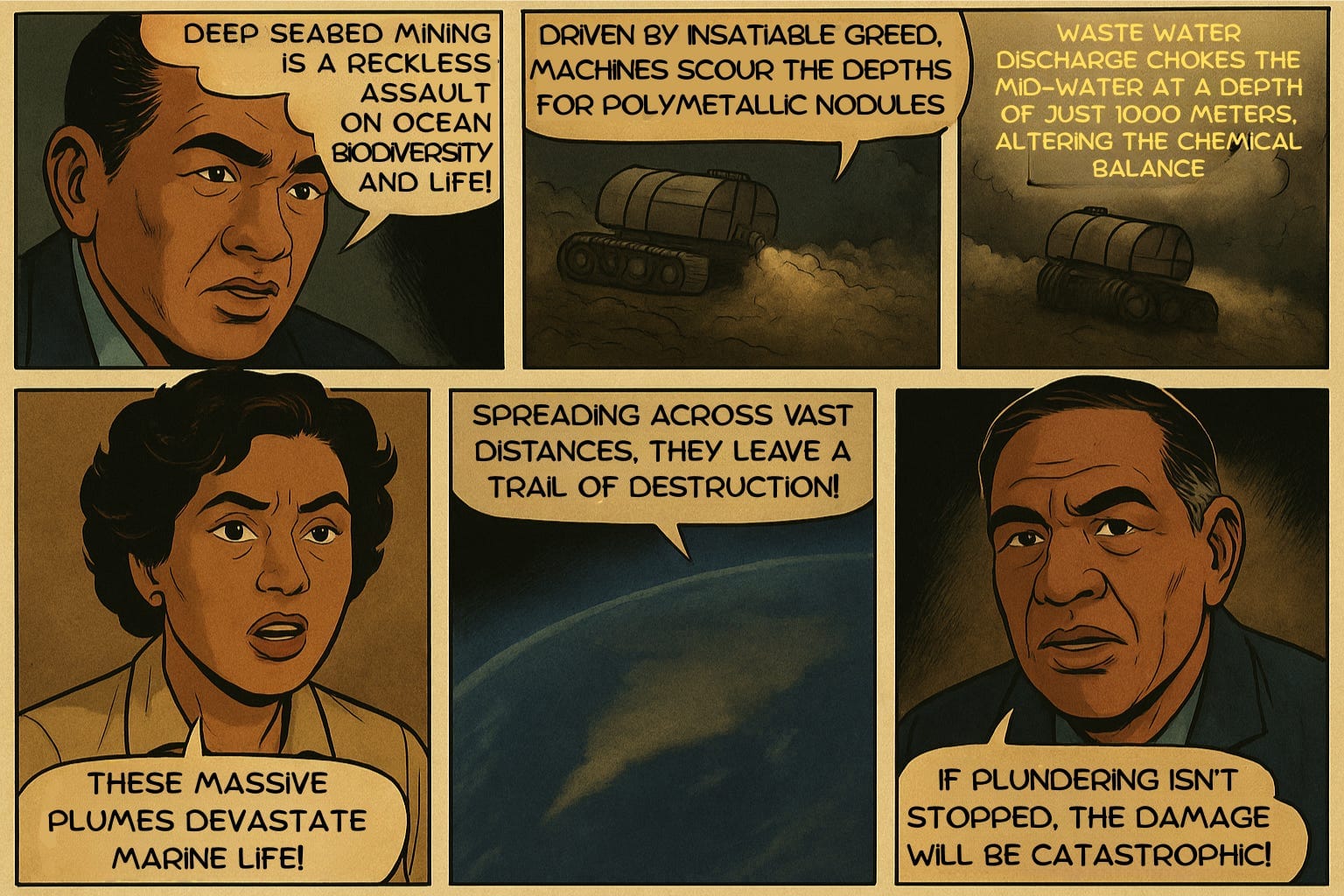
In 2022, the Deepsea Mining Campaign released the Blue Peril video alongside a scientific study, exposing the alarming risks posed by The Metals Company’s (TMC) deep-sea mining ambitions in the Clarion Clipperton Zone (CCZ) of the Pacific Ocean. Through rigorous simulation, it reveals how vast sediment plumes—both from seabed disturbance (benthic plumes) and midwater waste discharge—could spread across fragile ocean ecosystems, far beyond the immediate mining sites licensed by Nauru and Tonga.

Using state-of-the-art ocean current models, the study tracks virtual sediment particles as they drift through deep ocean currents. These simulations are not speculative—they are grounded in the best scientific tools available. Yet, they deliver a stark warning: while we can predict the direction and speed of horizontal currents with confidence, we are operating in dangerous uncertainty when it comes to how much sediment will be released and how far it will spread.

Settling rates for these sediments—critical for understanding how long particles will remain suspended and how wide the damage will extend—vary by two orders of magnitude in existing scientific literature. This means that what might be dismissed as a localized impact could, in reality, suffocate marine ecosystems across tens of thousands of square kilometers. A single mining vehicle, moving across the seabed for a year, could generate an annual sediment footprint exceeding 10,000 km². And these are conservative estimates—full-scale operations will deploy larger machines, potentially in tandem, compounding the harm.

Key factors such as turbulence and increased mining activity threaten to expand these plumes even further, with impacts on deep-sea biodiversity, much of which remains undiscovered and poorly understood. The deep ocean is not an empty expanse—it is a living system, intricately balanced and vulnerable to disruption. Yet, mining companies, managed by the likes of Gerard Barron are pushing forward like corporate psychopaths ignoring all precautionary warnings over the irreversible damage they will cause, simply for financial gain.

Over 50 controlled simulation experiments confirm that once sediment is released, its spread becomes largely uncontrollable, indifferent to the minor adjustments in mining technique or discharge geometry. The current models—though advanced—are built on limited deep-sea data. In vast regions like the CCZ, there may not be a single deep-ocean current meter feeding real-time data into these global models. We are navigating blind.

The public must recognize the gravity of this moment. Decisions made in boardrooms and regulatory bodies today could devastate ocean ecosystems for centuries. This is not just a scientific issue—it is a moral one. Ignoring them could mean silencing the deep ocean before we even understand the life it holds.

Codifying U.S. Unilateralism in International Waters

At the heart of the order lies the reactivation of the Deep Seabed Hard Mineral Resources Act (DSHMRA), a stone-age relic of Cold War-era legislation crafted to allow the U.S. to authorize deep-sea mining licenses outside of UNCLOS, which it has never ratified. The EO empowers U.S. agencies to issue exploration and extraction permits in international waters—territory explicitly under the regulatory jurisdiction of the International Seabed Authority (ISA). This is not a hypothetical loophole. It is a deliberate affront to the rule-based international order, signaling that the United States will interpret global commons through its own legal framework and issue licenses in defiance of a globally mandated governance structure. What had previously been maneuvered through proxies and private legal fictions has now been elevated into federal policy.

Weaponizing “Energy Dominance”

The creation of the so-called National Energy Dominance Council—another Executive Order— reveals the deeper strategy at play. This is not simply about minerals. The EO embeds seabed mining into a matrix of national security and industrial policy, elevating DSM to the same strategic plane as oil, rare earths, and semiconductors. By invoking the specter of Chinese influence over mineral supply chains, the U.S. positions the seabed as a theater of competition, using energy dominance as both rationale and pretext. The result is a transformation of deep-sea governance from a question of environmental stewardship into one of geopolitical escalation. Resource extraction becomes a proxy for maintaining unipolar supremacy.

As a rebuke, China’s Foreign Minister Guo Jiakun had this to say:

The international seabed area covered by the U.S. executive order goes beyond the limit of national jurisdiction. According to international law, the international seabed area and its resources are the common heritage of mankind. The exploration and exploitation of minerals in the international seabed area must be carried out in accordance with the United Nations Convention on the Law of the Sea and under the framework of the International Seabed Authority (ISA). The legal status and the exploitation and exploration regime of the international seabed are universally recognized and followed through in international practice. No country should circumvent the ISA and international law and privately authorize any exploitation and exploration activities in the international seabed area at the expense of the common interests of the international community.”

Streamlining Exploitation, Sidestepping Environmental Governance

Although the order makes passing reference to environmental and transparency standards, its substance lies in the directive to streamline and expedite permitting. There is no serious commitment to precautionary principles, to Indigenous or regional consultation, or to the scientific moratorium widely called for by Pacific Island nations, environmental coalitions, and even UN-affiliated agencies. Instead, the imperative is speed—removing friction for corporate actors, clearing regulatory pathways, and ensuring that environmental governance does not obstruct extraction. In this context, the invocation of “responsibility” becomes a public relations tool, masking the rapid unraveling of ecological due diligence.

Private Sector Mobilization and Legislative Capture

The EO makes it explicit that multiple federal agencies are tasked with identifying and promoting private sector opportunities in seabed mineral exploration, extraction, and processing. It calls on U.S. development and export credit agencies, including the U.S. International Development Finance Corporation and the Export-Import Bank, to explore financial tools that will subsidize and underwrite deep-sea mining operations. In doing so, public institutions are conscripted into a project of legislative capture—one in which government infrastructure is retooled to serve the expansion of extractive industries. The alignment of federal financing with corporate actors like The Metals Company reflects the deep entanglement of Washington’s America First policy with transnational capital (2025).

International Partnerships as a Smokescreen

While the order gestures toward “working with allies” in their Exclusive Economic Zones (EEZs), this is a deliberate deflection. The central thrust of the EO is not toward multilateral collaboration, but toward unilateral action in areas beyond national jurisdiction. The vague mention of a benefit-sharing mechanism is non-binding and noncommittal—language designed to appear cooperative while maintaining full U.S. control over licensing, processing, and strategic value chains. There is no mention of the International Seabed Authority, no reference to FPIC, and no indication that the U.S. will honor its de facto compliance with UNCLOS protocols.

This opens the door to Department of Defense involvement in DSM operations, potentially shielding extractive activities from environmental litigation and international diplomatic pushback. Under this logic, opposition to DSM can be reframed as opposition to national security. Once a domain of environmental science and global cooperation, the deep sea is now treated as a militarized frontier.

Defense and Stockpiling: Militarizing the Seabed

By explicitly invoking the Defense Production Act and linking DSM to the Strategic and Critical Materials Stockpile (2025), the EO militarizes seabed mining. The implication is clear: resources extracted from the deep ocean are now part of national defense planning. This opens the door to Department of Defense involvement in DSM operations, shielding extractive activities from environmental litigation and international diplomatic pushback. Under this logic, opposition to DSM can be reframed as opposition to national security. Once a domain of environmental science and global cooperation, the deep sea is now treated as a militarized frontier.

Evidence of U.S. Intent to Ignore the ISA

The Executive Order is not vague or suggestive—it is direct. It activates DSHMRA as a legal basis for granting permits in international waters. There is no reference to the ISA, no stated intention to operate within existing UNCLOS frameworks, and no indication of coordination with international partners beyond economic alliances. By framing DSM as a national security interest and a sovereign economic right, the EO immunizes corporate actors from global legal oversight. The message is clear: the United States will authorize its own licenses in areas governed by international law, and it will do so with full executive authority.

Global Repercussions: Scenarios and Risks

This move introduces a number of potential global flashpoints. First, the decision sets a precedent for deregulation, encouraging other nations and corporations to abandon ISA protocols and begin unilateral exploration. This could quickly lead to a collapse in the ISA’s authority, creating an unregulated rush to exploit the deep sea. Second, companies like The Metals Company may reflag or reincorporate to exploit favorable U.S. laws, while Canada distances itself from responsibility. Third, nations such as China, the African Group, and Pacific Island countries may respond through the UN General Assembly, issuing condemnations and symbolic resolutions. Although such resolutions lack enforcement power, they reflect growing diplomatic isolation.

Fourth, the environmental consequences would be irreversible. Fifth, legal challenges could be mounted at the International Tribunal for the Law of the Sea or the International Court of Justice. However, these efforts may arrive only after the damage is done, highlighting the inadequacy of international legal instruments to constrain hegemonic states in real time.

Beyond War: Ecocide is Genocide

The United Nations Security Council, theoretically tasked with maintaining international peace and security, has long been paralyzed by the veto power wielded by its permanent members—none more so than the United States. As witnessed in its unwavering protection of Israel amid ongoing genocide, even in the face of International Criminal Court (ICC) rulings and widespread global condemnation, the Security Council has become a stage where international law is subordinated to geopolitical interests. In the case of deep seabed mining, the worst-case scenario is not merely that the Council remains inert—it is that it becomes complicit through silence, allowing the U.S. to cloak ecocide beneath the rhetoric of sovereignty and security. Just as legal mechanisms have failed to halt crimes against humanity when confronted with hegemonic defiance, they are equally ill-equipped to prevent crimes against nature when the perpetrator is a superpower currently immune to sanction. The systematic destruction of the abyssal plains, the destabilization of marine biodiversity, and the transboundary collapse of oceanic ecosystems constitute ecocide—yet without binding enforcement, international law risks becoming a hollow promise. In this vacuum, corporate and state actors can proceed with impunity, knowing that the institutions designed to safeguard humanity and the planet will falter when confronted by power unchecked.

Calling Ecocide by Its Name: Toward Binding International Law and Accountability

In 1973, Richard Falk’s Environmental Warfare and Ecocide offered a prescient framework, declaring ecocide—whether in war or peace—a crime under international law, defined by acts intended to disrupt or destroy human ecosystems through militarized violence and environmental manipulation. From the deployment of weapons of mass destruction and chemical defoliants to weather modification and forced displacements for industrial or military gain, Falk articulated ecocide as an assault not only on nature but on the very conditions of human and ecological coexistence. Nearly half a century later, on February 29, 2020, scholars and practitioners gathered at UCLA’s Promise Institute for Human Rights, recognizing both the enduring relevance and insufficiency of existing legal instruments to confront escalating environmental harm and climate destabilization. Confronted with the limitations of current international criminal law, this assembly sought to revive and advance Falk’s vision—deliberating on how to codify ecocide as a new international crime fit for contemporary crises. Their commitment to refining legal definitions and confronting political and practical challenges reflects a continuity of purpose: to transform ecological devastation from a collateral consequence of power into a punishable violation of global justice.

The recognition of ecocide as a potential fifth international crime under the International Criminal Court (ICC) marks a critical turning point in confronting large-scale environmental destruction. As corporations like The Metals Company (TMC) accelerate deep-sea mining in fragile ocean ecosystems, they do so under mounting legal and moral scrutiny. This is no longer a debate about sustainability pledges or voluntary guidelines—ecological devastation is being redefined as a crime, positioning corporate executives, board members, and critically, their financial backers within reach of prosecution. The era of treating ecosystem collapse as an externality is ending; the extraction of profit at the expense of planetary systems is increasingly viewed as an assault on the very foundations of life.

The United Nations Environment Programme (UNEP) has also underscored how courts and citizens are mobilizing legal frameworks to hold both states and corporations accountable, but this accountability must extend beyond the visible actors. Behind every destructive enterprise stands a network of asset managers, hedge funds, and institutional investors—entities like BlackRockVanguard, and others—whose capital fuels ecocidal ventures with anti-ESG rhetoric. These financial giants are enablers of environmental crimes, profiting from the systematic degradation of global commons. Emerging legal doctrines must pierce the veil of financial abstraction and expose those who bankroll ecological harm to the same consequences faced by corporate polluters, regardless of what US federal agencies are mobilized.

In this urgent context, states must act decisively to operationalize international legal mechanisms that hold both corporations and their financiers accountable. If sanity, precaution, and respect for life fail to restrain industries like deep-sea mining, then the United Nations and its member states must ensure that the codification of ecocide comes with enforceable teeth—punishing not only companies like TMC but also the asset managers and hedge funds complicit in underwriting planetary destruction. Justice demands that those orchestrating and financing ecocide—whether in boardrooms or investment portfolios—face the full weight of international law. Without such resolve, the deep ocean, and countless other ecosystems, will fall victim to the unchecked greed of capital. But with swift action, the global community can transform environmental law from a shield into a sword, defending the Earth by holding power to account where it truly resides.

Open Season on the Global Commons

This Executive Order represents a decisive pivot from international cooperation to unilateral exploitation. It rewrites the rules of seabed governance not through legislation or treaty but through executive fiat, collapsing the distinction between corporate interest and national policy. It formalizes a mode of extraction that is inherently anti-democratic, ecologically devastating, and geopolitically destabilizing. The abyssal plains—long regarded as part of the planetary commons—are being transformed into a zone of conquest.

The international community must not underestimate the significance of this moment. What the U.S. is attempting is not merely regulatory capture—it is the systematic dismantling of multilateral stewardship in favor of a privatized, militarized order of ocean governance. If this is allowed to proceed unchallenged, the result will not be prosperity or security. It will be irreparable loss. This is a planetary assault—and if we are to protect what remains, resistance must be immediate, coordinated, and unyielding.

Consider Decolonizing Accounting Systems

While this article has focused primarily on the emerging legal frameworks to confront ecocide, I continually maintain that law is but one arm of defense against environmental destruction. The second—and perhaps more foundational—is how we measure value within our national accounts. It is within these ledgers, quietly dictating the logic of growth and profit, where the seeds of ecocide are sown. As long as colonial-era national accounting systems valorize extraction, production, and consumption while rendering invisible the depletion of ecosystems, no amount of legal reform will suffice. The law may punish after the fact, but accounting defines what is permissible, what is profitable, and ultimately, what is pursued. Consider decolonizing accounting frameworks and intemerate.earth

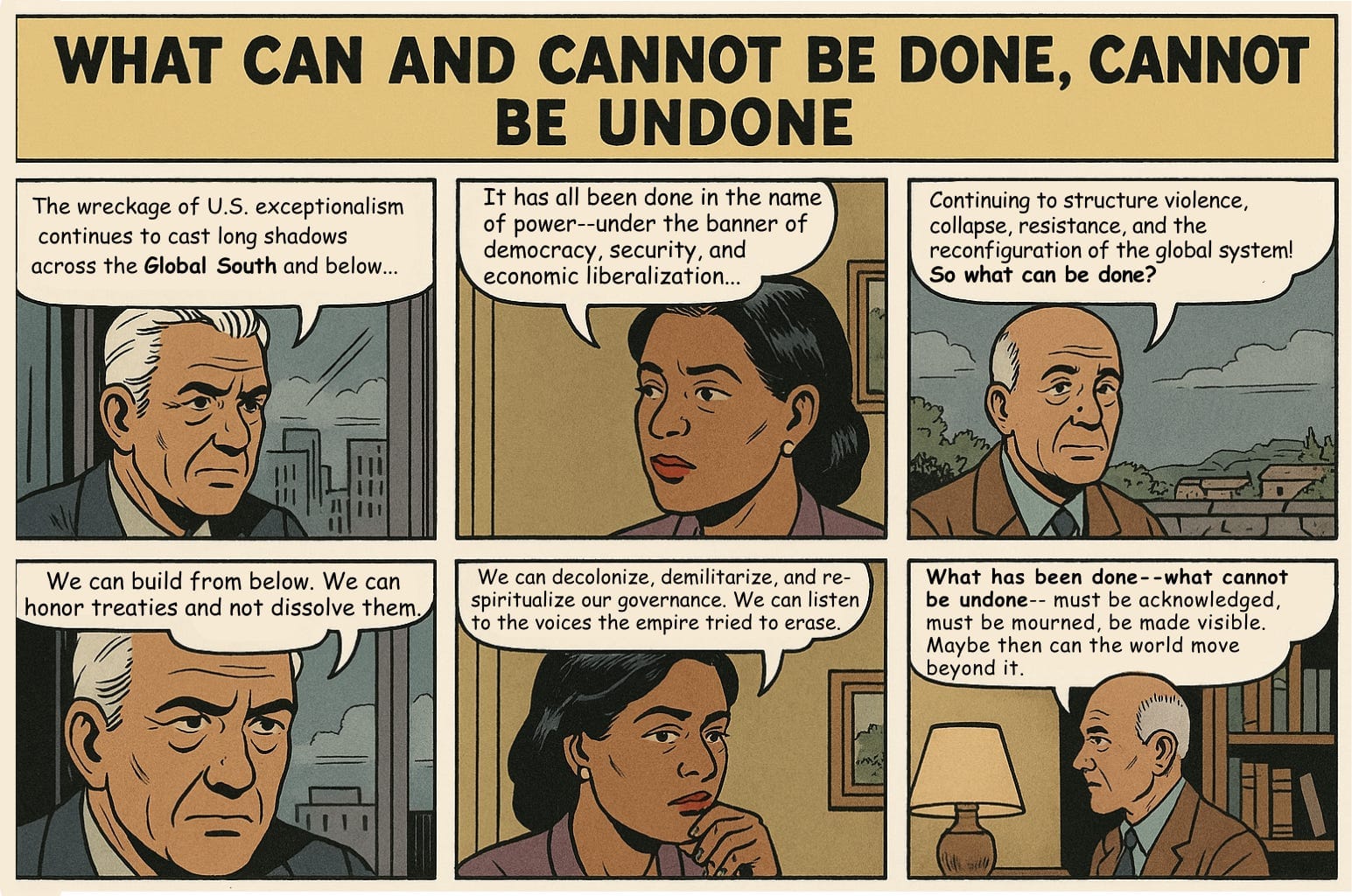
Because what can be done, once done, may never be undone.

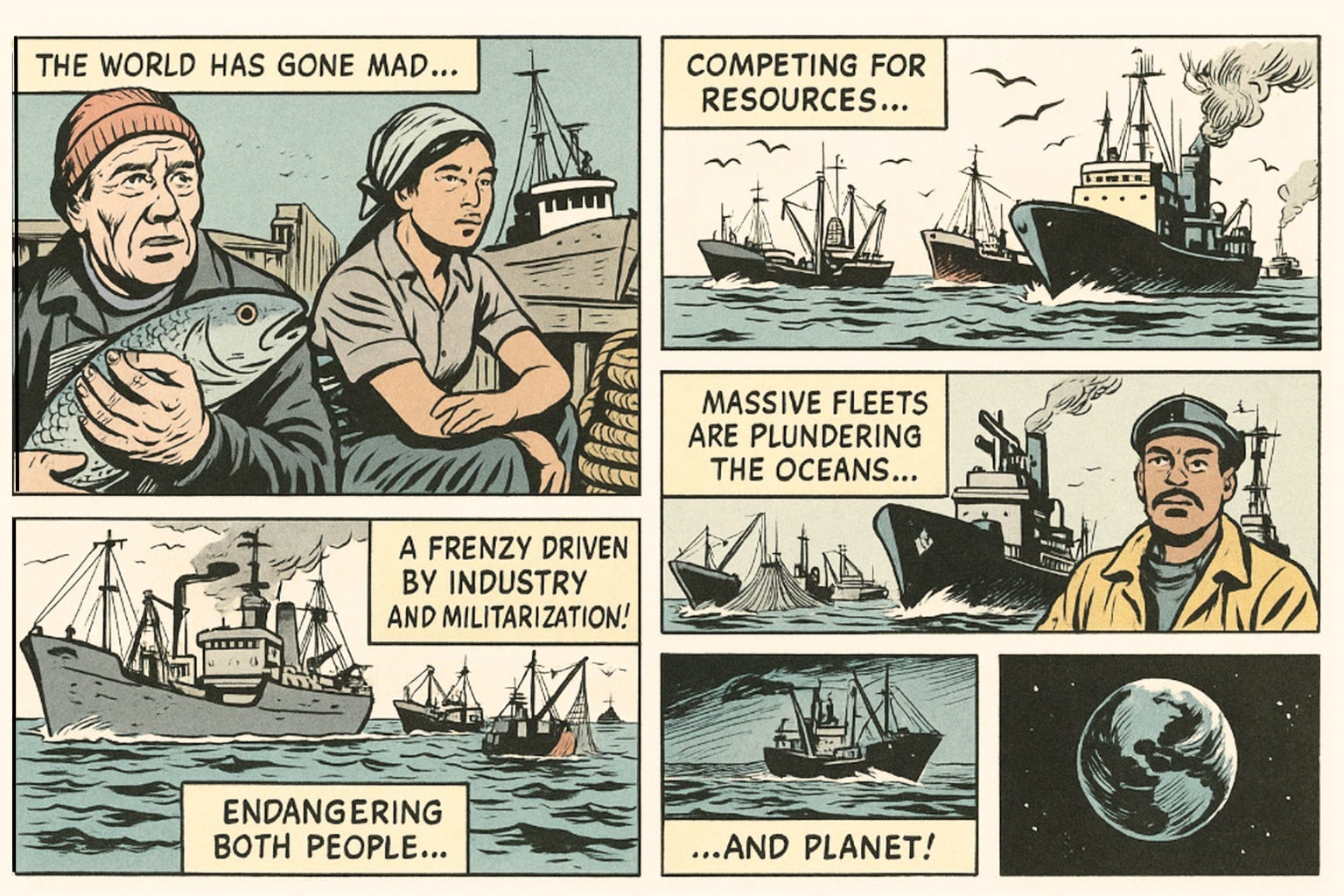
Washington vs the Whale: Fishing, Industry, and the Militarization of Maritime Sovereignty

On April 17, 2025— the White House released two coordinated executive actions (see last week’s post), that together seeks to reshape the political, economic, and ecological future of Pasifika. The first, a presidential proclamation, Unleashing American Commercial Fishing in the Pacific, dismantles key protections within the Pacific Islands Heritage Marine National Monument (PIHMNM) (formerly PRIMNM), reopening these federally protected waters to commercial fishing. The second, an Executive Order titled Restoring American Seafood Competitiveness, reframes the national seafood strategy through a deregulatory, protectionist lens—cutting environmental oversight as an excuse to challenge foreign fishing competitors. While each action stands on its own, together they constitute a deliberate repositioning of U.S. ocean governance—away from preservation and toward a militarized industrial economy operating under the banner of national competitiveness.

The PIHMNM, once one of the world’s largest no-take marine sanctuaries, has been reclassified as a strategic economic zone. The proclamation claims that restrictions on commercial fishing within PIHMNM are unnecessary, citing the migratory nature of tuna and the sufficiency of existing environmental regulations—yet this justification collapses under the weight of its own contradiction: if the fish are indeed migratory and already managed under federal law, then the real purpose of reopening these waters lies not in ecological science but in advancing a strategic economic agenda. By invoking biological mobility to justify deregulation while simultaneously launching an Executive Order to reclaim domestic market dominance, the administration exposes its intent—not to protect ecosystems or correct legal redundancies, but to reposition U.S. fleets in a global seafood arms race.

This reclassification does not merely permit activity—it redefines what marine protection means. Under this new model, “conservation” becomes compatible with large-scale extraction so long as the activity is conducted by U.S.-flagged vessels under federally sanctioned management schemes.

ABNJ & BBNJ

From an ecological governance perspective, the rollback of protections within the Pacific Remote Islands Marine National Monument, coupled with the Executive Order on Restoring American Seafood Competitiveness (RASC), risks undermining ongoing international negotiations around the conservation and sustainable use of marine biodiversity in ABNJ (Areas Beyond National Jurisdiction), particularly those articulated in the emerging BBNJ (Biodiversity Beyond National Jurisdiction) agreement under UNCLOS. While the United States has signed but not ratified UNCLOS, it continues to participate selectively in its frameworks, asserting maritime jurisdiction when advantageous while rejecting binding obligations. By unilaterally dismantling one of the largest no-take marine zones for economic competitiveness, the United States sets a precedent that undermines the credibility of multilateral conservation commitments. It signals that marine protection is conditional, politically malleable, and ultimately subordinate to national commercial interests—posing a direct challenge to the cooperative ethos required for effective high seas governance.

The justification used—that tuna and other pelagic species are migratory and thus not resident within protected waters—runs counter to the ecosystem-based management principles at the heart of BBNJ. It narrows the scope of conservation responsibility to territorial boundaries, disregarding the ecological continuity of species and ocean systems. Moreover, by prioritizing deregulation, fleet access, and trade enforcement, the U.S. action deepens the fragmentation of international ocean law, weakening the moral authority of conservation leaders while emboldening extractive states to reinterpret or erode marine protections. At a moment when the international community is seeking to ratify and implement BBNJ’s ambitious framework for marine protected areas, benefit-sharing, and ecological connectivity, the United States’ turn toward seafood nationalism pulls on the very thread that could unravel the fragile diplomatic consensus needed to steward the ocean as a global commons.

The Executive Order that follows completes the shift in tone. It abandons any pretense of ecological precaution, declaring that U.S. fishing capacity is being “crushed” by overregulation and foreign competition. It calls for the immediate suspension or revision of regulations that burden domestic fishing, directs federal agencies to identify overregulated fisheries, and lays out a seafood industrial strategy aimed at global dominance. In place of multilateral coordination or bioregional sustainability, we find a return to techno-nationalism, where market share, fleet expansion, and deregulation are the new pillars of marine governance.

From the perspective of industry, this is a consolidation of federal support for a handful of vertically integrated seafood corporations that already dominate U.S. commercial fishing. Companies like Trident Seafoods and Tri Marine (which operates global tuna fleets) stand to benefit disproportionately—not because of their ecological stewardship, but because they possess the logistical infrastructure, political clout, and access to capital needed to mobilize quickly. While the rhetoric of “seafood competitiveness” champions the small-scale, independent fisher crushed by distant bureaucracies, this executive order favors corporate consolidation under America First.

PNA

Meanwhile, in Pasifika, advancing RASC potentially undermines the region’s most effective fisheries governance body: the Parties to the Nauru Agreement (PNA). The PNA’s Vessel Day Scheme (VDS) is one of the only transnational models that successfully marries ecological restraint with sovereign economic benefit.

Built from the legacy of postcolonial overfishing, the Parties to the Nauru Agreement (PNA) developed the Vessel Day Scheme (VDS) as a mechanism to reclaim sovereign control over tuna resources in the Western and Central Pacific. Rather than selling access based on catch volume or open-ended quotas, the VDS allocates a fixed number of fishing days to each member country annually. These days can be used domestically or sold to foreign fleets—most often from distant water fishing nations such as the United States, Japan, South Korea, or China—through bilateral negotiations or regional agreements. The fees for these fishing days are not calculated based on the economic size of the purchasing nation but are instead determined by a minimum benchmark price and market-based dynamics, with some day rates reaching over $10,000. This model shifts power back to Pacific Island states by encouraging sustainable practices and maximizing economic return. It transforms the tuna fishery from a site of external exploitation into a foundation for local revenue generation and ecological oversight.

The United States pays for approximately a quarter of PNA revenue and the capturing of transboundary tuna outside the PNA is likely to diminish revenue to the Pacific Island Countries who have relied upon the cooperation of the large fishing countries. At this moment, Pasifika does not have a lot of options.

Former PNA CEO Transform Aqorau noted, “Climate and other environmental factors, an over-abundance of tuna stock depressing prices, or market forces out of the PNA’s control can all impact fishing in the western and central Pacific. Fishing tuna heavily every year will have an impact on the fishery…we need to guard against this.”

The PNA VDS does not merely regulate fishing—it asserts a different logic of value, rooted in place-based custodianship and inter-island solidarity. The United States, in reasserting commercial fishing in waters adjacent to PNA territories, bypasses this logic. It sets a precedent: that American jurisdiction trumps regional cooperation, and that the path to sustainability can be rewritten unilaterally, without consultation.

Freedom of Navigation

Overlaying all of this is the persistent shroud of militarization. The PIHMNM proclamation references the coordination with the Department of Defense, emphasizes “freedom of navigation,” and affirms the strategic mobility of the United States. While ostensibly about fishing, the language echoes U.S. naval posture in contested maritime regions—particularly the South China Sea (worth reading)—where commercial activity, environmental protection, and military mobility are often entangled. The fishing fleet thus becomes a proxy—an instrument of territorial presence and economic claim-making, operating in tandem with military imperatives. In this sense, the rollback of marine protections is not only about opening waters to industry, but about reaffirming jurisdiction, projecting power, and managing ocean space as a geostrategic asset.

WTO

The conflict between the United States and Pacific Island nations at the World Trade Organization (WTO) over fishing centers on North-South visions of fairness, sovereignty, and sustainability in global fisheries governance. It reflects deeper tensions between powerful distant water fishing nations and small island developing states (SIDS) who rely heavily on their marine resources for both livelihood and state revenue.

At the core of the dispute is the WTO’s ongoing effort to finalize rules that would curb harmful fisheries subsidies—particularly those that contribute to overfishing, overcapacity, and illegal, unreported, and unregulated (IUU) fishing. Pacific Island countries, especially members of the Parties to the Nauru Agreement (PNA), have pushed for these rules to differentiate between industrialized nations with heavily subsidized distant water fleets and small island states with limited fishing capacity but sovereign rights over vast exclusive economic zones (EEZs). The U.S., while nominally supporting subsidy reform, has frequently advocated for broad rules that could also restrict the use of fishing subsidies by developing countries, including SIDS—undermining the special and differential treatment provisions that Pacific nations argue are essential to their economic development and marine stewardship.

The U.S. has further clashed with Pacific nations over access fees and management models like the Vessel Day Scheme (VDS), which monetize fishing days within EEZs. Washington has criticized the rising costs of access under PNA frameworks and, in some negotiations, has implied that such schemes function as de facto trade barriers. From the Pasifika perspective, however, these schemes are not subsidies but expressions of sovereign control over resources historically exploited by wealthier countries. Thus, Pacific Island Countries sees the U.S. position at the WTO as part of a broader effort by industrialized fishing powers to erode their autonomy, secure cheaper access to tuna stocks, and undermine regionally-developed systems of ecological and economic governance.

In essence, the conflict at the WTO reflects a deeper struggle over who gets to define sustainability, who pays for conservation, and whether ocean governance will be shaped by extractive globalization or by the rights of coastal and island peoples to manage their own waters.

Quota system vs Vessel Day Scheme

The other point I want to make about the brilliance of the VDS system employed by Pacific Island nations is that it offers a transparent and equitable model for monetizing access to tuna fisheries. This system not only reinforces local sovereignty but also guarantees that revenues flow directly to the states and communities that steward the resource. In contrast, the quota-based system often promoted by the United States and aligned with global commodity market practices introduces complex mechanisms of allocation, trading, and speculation. Quotas can be bought, sold, or leased—frequently consolidated by industrial players or financial intermediaries through Wall Street firms—driving up prices and creating barriers for small-scale and family fishers. Instead of direct and predictable compensation for access, quota markets tend to abstract value, turning fishing rights into speculative assets that privilege capital over community, and undermining the participatory foundation of sustainable fisheries governance.

And so….

Together, the proclamation and executive order is once again rendering the ocean as another domain of industrial potential and strategic calculation. The sea becomes frontier again—not in the mythic sense of unexplored abundance, but in the regulatory sense of contested jurisdiction, privatized access and exploitation.

In this moment, Pasifika is not just a battleground of fleets—it is a battleground of philosophies. Will governance be grounded in extractive sovereignty or in the co-development of ecological limits? Will access be determined by flags or by customary stewardship? The answers are not only legal—they are cultural, economic, and planetary. And they demand more than the unipolar objectives of proclamations or executive orders. They require a reckoning with the systems of power that have turned the world into theaters of profit and dominance, rather than realms of life and interdependence.

In contrast to the zero-sum logic of extractive sovereignty—what might be called the “last man standing” or “King of the Mountain” game played by the Western hegemon—the rise of BRICS, the Belt and Road Initiative (BRI), and other frameworks of new multilateralism offer an opening to reimagine economic cooperation through a decolonial accounting lens. Within these shifting alliances, there is potential to construct a different formula—one that moves beyond GDP as a measure of extraction and towards accounting systems rooted in ecological reciprocity, reparative justice, and translocal stewardship. Just as the game of Mancala distributes value through cycles, foresight, and mutual strategy rather than domination, a decolonial accounting approach could redistribute both access and valuation by centering the rights of small island and coastal nations to define their own metrics of wellbeing. Rather than assigning price to fish alone, this model could weigh the cumulative labor of custodianship, the biodiversity of oceanic corridors, and the intergenerational knowledge embedded in customary marine tenure. Such a shift would not simply adjust policy—it would reconfigure the ontological terms of global trade, replacing conquest with coordination and turning extraction into interdependence.

It may not be tomorrow but the near future that holds the possibility of a new kind of cooperation. In that future we might finally abandon the myth that endless accumulation confers strength. And perhaps it will not come through the empires that claim to lead, but through the convergence of nations once marginalized—BRICS and its growing orbit—emerging not as rival hegemon, but as the slow, deep current of another logic entirely. Like the whale in Moby Dick, it may be this collective weight—massive, calm, indifferent to Ahab’s frenzy—that ultimately sinks Pequod. Not in vengeance, but in gravity. Not as predator, but as presence. We are the Whale.

What Can and Cannot be Done, Cannot be Undone: Deep seabed mining and the rogue state.

What Can and Cannot Be Done, Cannot Be Undone

The sediment of history accumulates through class struggle, imperial conquest, and the shifting modes of production. The wreckage promoted by U.S. exceptionalism does not erase this sediment—it lies atop it like a hideous flesh, giving the skeleton of history a monstrous form, shaping its contours while masking its deeper truths. This neoliberal flesh is not merely ideological but structural—built into the very institutions that manage global capital and coercion. What has been done in the name of democracy, security, or market liberalization reflects not just policy choices, but the material interests of a ruling class determined to privatize and reproduce its dominance. These are not isolated historical events, but dialectical continuities—manifesting in extraction, debt regimes, militarized borders, and the suppression of autonomous development across the Global South. The aftershocks of empire are not confined to the past; they actively shape the present conditions of underdevelopment and resistance, hanging on to what remains of the global system by its claws.

And so…

The Metals Company (TMC), a Canadian mining company announced its intent to bypass international oversight from the regulatory guidance of the International Seabed Authority (ISA) towards a deregulatory friendly Trump administration by invoking an obscure pre-UNCLOS law—the U.S. Deep Seabed Hard Mineral Resources Act (DSHMRA). This is the kind of self-serving jurisdictional opportunism that both erodes the principle of global stewardship, endangering ocean ecosystems, destabilizing planetary life-support systems, deepening the risk of irreversible ecological thresholds, and under the tenure of Trump and Musk, undermines the ethical foundation of multilateral environmental governance.

Simply put, this is a business decision driven by investor desperation. But more deeply, it is a case study in the mechanics of empire: how powerful rogue administrations have sidestepped multilateral norms, retooled outdated legal frameworks, and eroded sovereignty beneath the rhetoric of innovation and progress.

Gerard Barron, the CEO of The Metals Company, represents one of the most reprehensible proponents of opening the deep seabed to commercial mineral extraction, reminding me of Captain Ahab’s monomaniacal pursuit of the white whale. Unfortunately, his approach is neither unique nor an aberration, but a strategic extension of a broader pattern that seeks legal loopholes and power corridors to advance the interests of extractive capital, prioritizing investor returns over ecological integrity and multilateral governance.

At its core, TMC’s pivot to an obscure U.S. Act (1980) is an attempt to unilaterally circumvent the International Seabed Authority (ISA)—the only legitimate global body empowered to regulate mining in international waters. TMC is not content to wait for the ISA’s deliberations, nor to uphold the principles enshrined in the United Nations Convention on the Law of the Sea (UNCLOS), to which the U.S. itself is not a signatory. Instead, it reaches for DSHMRA, an old legislative relic that could enable companies to act outside of UNCLOS authority with impunity.

This is not a legal loophole—it is a conscious strategy of destabilization. And it echoes a well-worn pattern: when international law no longer serves U.S. interests or those of capital embedded within its jurisdiction, it is either abandoned, ignored, or unilaterally reinterpreted. In doing so, TMC is not just threatening the ecological sanctity of the Clarion-Clipperton Zone. It is replicating a mode of governance where what cannot be done multilaterally is done unilaterally, and what is done in isolation and without consent cannot be undone without consequence.

TMC’s alignment with U.S. jurisdiction is not incidental—it is tactical. It is rooted in a long genealogy of impunity: from nuclear testing in the Pacific to the violation of climate treaties, from financial sanctions to regime change operations, from coups to corporations. Each of these acts left not only material wreckage but institutionalized precedent—where actions taken without consent are retrofitted with justification and exceptionalism is laundered through legality.

By attempting to convert the deep sea into a privatized zone of mineral extraction, under the protection of an outdated and contested American law, TMC is not just exploiting nodules—it is testing the limits of planetary governance. It gambles that there is no meaningful global enforcement mechanism to stop them, and that public outcry, like ecological destruction, can be absorbed as a cost of doing business.

In this way, TMC’s strategy is not novel. It is a symptom of a deeper pathology—where corporate actors, faced with financial collapse, enlist the shield of sovereign power to bypass international scrutiny. In bypassing the ISA, TMC also bypasses Indigenous voices, Pacific sovereignty, and the emerging calls for a global moratorium on deep-sea mining. It undermines not only legal processes but also moral and ecological thresholds—those invisible but vital lines that, once crossed, cannot be restored.

What TMC is proposing, then, is not simply a mining project—it is a precedent. A test case for a future where international common heritage is parceled off to the highest bidder, under cover of legal exception and economic urgency. And once this is done, once the abyssal plains are torn open and the world’s last untouched ecosystems are compromised, it cannot be undone. No amount of reclamation or remediation can restore the microbial networks, the carbon sinks, the benthic worlds we have yet to understand.

Let us name what cannot be undone.

1. The Originary Sin of Absolute Power

The dropping of the atomic bombs on Hiroshima and Nagasaki was not merely a military decision—it marked the dawn of a new era of totalized, asymmetrical violence. It affirmed the United States not only as the dominant force in World War II, overshadowing the decisive role of the Soviet Union, but also positioned it as the unilateral arbiter of peace, shaping postwar negotiations with Japan. More than victory, it asserted a terrifying claim to ultimate power: the role of a sovereign capable of annihilation.n.

2. Sanctions as the Architecture of Empire

The use of sanctions as an extension of U.S. hegemony reveals the structural violence embedded in financial systems. Sanctions imposed unilaterally—without the mandate of international law—have strangled entire populations (Iraq, Iran, Venezuela, Cuba, Syria), serving as tools of collective punishment rather than diplomacy. This power has historically flowed through the unipolar dominance of the U.S. dollar and SWIFT system—now contested but not yet displaced.

3. Support for Genocide, Occupation, and Apartheid

The unquestioning support for the Israeli state’s military occupation and genocidal campaign against the Palestinian people exposes the absolute moral collapse of a nation-state that claims to be a defender of human rights. The complicity is bipartisan, financial, and military, rendering meaningless any invocation of international law from U.S. mouths.

4. The Machinery of Destabilization: Coups, Regime Change, and Psychological Operations

So many… including Iran in 1953, Chile in 1973, Libya in 2013, Ukraine in 2014 to ongoing hybrid wars in Africa, Asia, and Latin America, the United States—often through the intersection of the CIA, Department of Defense, private military contractors, and “democracy promotion” NGOs—has repeatedly overthrown, undermined, and economically sabotaged sovereign governments. This remains not an exception but the operating logic of Pax Americana.

5. Corporate Malfeasance and Legislative Capture

The U.S. Congress has become a theater of influence peddling, beholden not to the public but to corporate lobbyists, military-industrial actors, and financial elites. Between the China LobbyAIPACthe Londongrad or, Citizen’s United, Legislation is no longer a deliberative act for the common good, but a monetized process for privatization, deregulation, and deepening inequality.

6. Abandonment of Treaties and International Agreements

From the Kyoto Protocol to the Iran Nuclear Deal, from arms control agreements to climate commitments, the United States has repeatedly walked away or as in the case of the Minsk Agreements influenced foreign governments to walkaway from agreements when it no longer suits its strategic interests. This lack of treaty fidelity erodes trust in international law and institutions, leaving behind a wake of broken promises.

7. Debt as War by Other Means

The $36 trillion U.S. national debt, compounded by stimulus for military expansion, post-2008 bailouts for financial institutions, and spiraling interest payments, does not simply reflect economic mismanagement—it is the ledger of empire. The U.S. continues to leverage its military and financial dominance to extract and borrow with impunity, even as it imposes austerity and debt discipline on others through the IMF and World Bank.

8. Obstruction of Global Multipolarity

The disruption, containment, and obstruction of BRICS+, the Belt and Road Initiative, and alternative financial institutions represent the desperate clinging of a declining hegemon to its singularity. The U.S. strategy is not to “build back a better” world, but to prevent another world from being built.


These are not merely policies. They are conditions.
And they cannot be undone without moral, political, and structural transformation.


What Is Just Governance?

Against this landscape of domination, deception, and decay, what does good governance look like? Here, we must return to principles that long predate American empire:

  • Kautilya’s Arthashastra (3-4 Century BCE), is one of the most comprehensive treatises on statecraft, political economy, and governance from the ancient world. It approaches governance pragmatically, emphasizing that the wellbeing of the people is the foundation of a prosperous and secure state—an idea that strongly resonates with just rule and the moral responsibilities of power. “In the happiness of his subjects lies the king’s happiness; in their welfare his welfare. He shall not consider as good only that which pleases him but treat as beneficial to him whatever pleases his subjects.”
    — Arthashastra, Book I, Chapter 19: Duties of a King
  • Mencius (3-4 century BCE), the Confucian philosopher, taught that the legitimacy of rulers depends not on divine right or force, but on benevolence and the well-being of the people. When rulers forget the people, rebellion is not only justified—it is necessary. “If you put in practice a benevolent government, this people will love you and all above them. and will die for their officers.”King Hui of Liang. Part II: Chapter XII. 3.
  • St. Thomas Aquinas’ Summa Theologica (13th century), argued that laws must be just, and serve the common good, not merely the interest of the powerful. An unjust law is not a law at all, but a perversion of law. “Every human law has just so much of the nature of law, as it is derived from the law of nature. But if in any point it deflects from the law of nature, it is no longer a law but a perversion of law.”—Summa Theologica, II, Q.95. Art 2.
  • Ibn Khaldun’s Muqaddimah (14th century) warned that dynasties and empires decay from within when their leaders abandon public trust and virtue for luxury, corruption, and coercion. Governance must be grounded in asabiyyah—social cohesion and collective solidarity. “When a dynasty reaches the limit of its duration, it turns to a life of ease and tranquility. The strength of the dynasty and its cohorts declines… and the people return to an inferior level. Luxury is the cause of the destruction of the state.”Muqaddimah, Book 1, Chapter V.
  • Bernie Sanders (2025) “I think it is very clear that today we have a government of the billionaire class, by the billionaire class, and for the billionaire class.”—Where do we go from here?

So what can be done?

We can build from below.
We can honor treaties and not dissolve them.
We can redistribute instead of exploit.
We can decolonize, demilitarize, and re-spiritualize our governance.
We can listen to the voices the empire tried to erase.

But what has been done—what cannot be undone—must be acknowledged, must be mourned, must be made visible. Only then can the world move beyond it.

And that is the task ahead.

https://onibaba.substack.com/p/what-can-and-cannot-be-done-cannot

The ‘Whole of Life’ Reimagined: The Struggle for Ecological and Spiritual Justice

From Sacred to Sold: Spiritual warfare is late-stage capitalism’s relentless pursuit of wealth accumulation at the expense of social and spiritual integrity.

In an era marked by escalating technological advancements, environmental crises, and intensifying cultural conflicts, the need for a transformative rearticulation of human values has never been more urgent. At the heart of this transformative quest lies a critical interrogation of our modes of existence, belief systems, and the economic structures that have come to define this period—not merely as the fulfillment of late-stage capitalism but as the logical culmination of its contradictions, a trajectory long recognized in critiques of imperialism and monopoly capital.

Our engagement with the world is too often confined within the narrow parameters of political economy, where even environmental concerns—issues that should fundamentally redefine our economic and political structures—remain subordinated to financial interests. This persistent framing reflects the hegemonic logic of capital, which demands that all aspects of life be mediated through market valuation and economic utility.

Yet, a critical omission in this framework is the role of interfaith engagement—not merely as a cultural or spiritual exercise, but as a structural force capable of counterbalancing the exploitative logics that define this era. Rather than an appendage to political economy, interfaith dialogue should be understood as a third pillar of human engagement, a necessary modulator that introduces ethical, moral, and cosmological considerations into the economic calculus. The systematic exclusion of faith from these discussions stems, in part, from its co-optation by power. Across history, organized religion has been instrumentalized to justify some of humanity’s most egregious crimes—genocide, slavery, expropriation, systemic fraud, and the violent dispossession of land and culture. This complicity has rightly drawn critique, but to dismiss religion entirely is to ignore its parallel tradition as a force for liberation.

Figures such as Jesus and Muhammad did not merely advance spiritual doctrines; they were radical social reformers who directly challenged the material and political structures of their time, calling for the redistribution of wealth, the upliftment of the poor, and the dismantling of oppressive hierarchies. Gautama Buddha, in his rejection of attachment to material accumulation and his emphasis on ethical living, laid out a framework for liberation that, while often depoliticized in contemporary readings, fundamentally disrupted the prevailing social and economic order.

Rather than allowing religion to be instrumentalized by capital or state power, interfaith engagement should reclaim its role as an emancipatory force. It must resist both commodification and dogmatic rigidity, positioning itself instead as a site of collective ethical reasoning—a space where economic and political decisions are scrutinized through the lens of justice, sustainability, and communal well-being. In a world where neoliberalism has normalized the commodification of life itself, the reintegration of spiritual and ethical dimensions into our economic models is not just desirable but necessary for survival.

Martin Heidegger’s seminal work, Being and Time, arguably offers the clearest articulation of “being,” echoing indigenous principles like the Fijian notion of Vakatabu—a philosophy of restraint and a “Whole of Life” sensibility. Indigenous epistemologies and spiritualities intertwine with Western humanist traditions, offering a potent counter-narrative to neoliberalism, Christian nationalism, and imperial domination.

The notion of spiritual warfare is deployed here not as a metaphor for conflict among differing belief systems but as a substantive framework for understanding the clash between humanistic, ecologically sustainable values and the destructive tendencies of neoliberalism. This article argues that our humanity, as encapsulated in the existential inquiries of Heidegger, has exposed the alienation inherent in our technological and economic regimes. Indigenous traditions and spirituality like Vakatabu offer a more integrated vision of being—one that is deeply relational, bound by place, and often attuned to Indigenous Peoples’ perceptions of the natural world.

But my friend, we have come too late. Though the gods are living,
Over our heads they live, up in a different world.

—Bread and Wine (excerpt), Friedrich Hölderlin

I. Heidegger’s Being and Time: Revisiting Existence

In confronting the crises of our post-modern era—an age defined by hyper-financialization, ecological collapse, and the algorithmic mediation of existence—we must recognize that we are not merely passive subjects within these systems but existential beings whose fundamental orientation is toward ‘Being-in-the-world’. Heidegger’s Being and Time challenges us to move beyond the superficial distractions of technological modernity and late-stage capitalism, not through nostalgia or retreat, but through a radical re-engagement with authenticity, finitude, and collective responsibility. Rather than accepting the extractive logic of the present as an inevitability, we must actively reject this era’s defining conditions, not in the sense of regression, but in a conscious movement toward a future grounded in a deeper understanding of Being—one that recognizes the wisdom embedded in indigenous epistemologies, the ethical imperatives of interfaith traditions, and the necessity of a moral realignment with the world. If we are to navigate the spiritual and existential crisis of our time, it will not be through further immersion in abstraction, commodification, or hyper-acceleration, but through aligning to ways of being that have long resisted the totalizing force of capital. In this, indigenous traditions and interfaith ethics offer not merely alternatives but vital pathways toward a more just and ecologically attuned existence, reminding us that the future is not something to be optimized, but something to be lived, relationally and responsibly, within the fullness of Being.

Heidegger challenges the traditional metaphysical understanding of human existence by exploring the nature of Being (Sein) in relation to time (Zeit). Heidegger contends that the human mode of being—what he terms Dasein—cannot be understood apart from its temporality, its situatedness in a world of possibilities, and its intrinsic finitude. His analysis reveals that modern technological society, with its emphasis on efficiency and calculability, has led to a disconnection from a more authentic way of “being”—one that is engaged, reflective, and rooted in the world.

Heidegger’s critique has often been read through a lens that neglects non-Western modes of thought. His focus on authenticity and the search for meaning should resonate with many indigenous traditions, even if he rarely acknowledged the alternative epistemologies that arise from communities with long histories of living in close symbiosis with nature. In many ways, the existential project Heidegger set forth is incomplete without a critical engagement with indigenous knowledge systems—systems that do not see time as a linear resource to be optimized but as a complex tapestry of relationships and responsibilities.

Like in the excerpt from the Bread and Wine poem, Hölderlin acknowledges that the gods have withdrawn, but their presence is not entirely lost—they exist elsewhere, waiting. Western or Indigenous, our human experience resonates with traditions where our connection to what is sacred remains dormant until it is rekindled by those who remember.

II. Vakatabu: Indigenous Restraint and the Whole of Life

In Fijian culture, the notion of Vakatabu encapsulates a sense of restraint and renewal—a principle that is not merely about self-control but is an ethical mode of being that governs interpersonal and environmental relationships. Vakatabu is imbued with the understanding that life is not an endless accumulation of resources or experiences to be exploited for immediate gain but is a carefully balanced interplay of give and take, presence and absence. This principle is directly antithetical to the consumerist ethos valuing accumulation and expansion at the expense of long-term sustainability and relational well-being.

Vakatabu leads communities to adopt a “whole of life” perspective—one that sees economic activities not as isolated transactions but as embedded within a broader ecological and spiritual matrix. In this light, ecological accounting emerges as an indispensable tool. Unlike conventional economic accounting, which focuses narrowly on monetary transactions, ecological accounting acknowledges that human well-being is intricately linked to the health of the environment. By integrating the valuation of biodiversity and social relationships, ecological accounting—what might be termed “intemerate accounting”—offers a more comprehensive measure of prosperity, one that is aligned with the principles of Vakatabu.

III. Spiritual Warfare: Hegemony, Faith, and the Political-Economic Struggle

The contemporary global landscape is marked by what can be termed as “spiritual warfare.” This struggle is evident in the contestation between ideologies that seek to impose a singular, often hegemonic, vision of humanity. On one side, we find the resurgence of Christian nationalism and contemporary Zionism—ideologies that not only claim divine sanction but also impose a rigid, often exclusionary, framework of belonging. This is evident, for instance, in the symbolic inscription of “In God We Trust” on the US dollar—a practice that intertwines religious iconography with the material power of a global reserve currency. Such gestures are not benign; they reflect an attempt to imbue economic transactions with a particular moral and theological order, one that reinforces nationalistic and imperialistic agendas.

Conversely, indigenous spirituality offers an alternative narrative—one that like interfaith, locates itself in a specific sense of time and place, and resists the commodification of belief. Indigenous traditions, with their totemic sensibilities and holistic understandings of the cosmos, challenge the reductionist worldview that underpins the neoliberal economy. They remind us that spiritual and material realms are deeply intertwined, and that the valorization of economic growth at any cost inevitably leads to environmental degradation and social dislocation.

The concept of spiritual warfare, then, might be understood as a struggle for the soul of society—a contest between a legacy of colonialism and imperial power, which exported a narrow, profit-driven view of existence, and a multiplicity of traditions that honor the intricate, interdependent nature of life. In this context, the battle lines are drawn not only in the economic or political arena but also within the realm of belief, where indigenous practices offer both resistance and an alternative model of living.

IV. Ecological Accounting and the Well-Being Economy

At the intersection of ecological accounting and indigenous spirituality lies the promise of a radically different economy—one that measures progress not in terms of GDP growth but in terms of well-being, environmental health, and social justice. The concept of “intemerate accounting” captures this alternative vision. By treating well-being as a modulator for economic performance, intemerate accounting challenges the dominant paradigm that equates value solely with market transactions.

This approach calls for the rearticulation of economic metrics to include non-market values such as ecosystem services, cultural heritage, and community resilience. It echoes the concerns raised by critics of natural capital valuation, who argue that monetizing nature risks commodifying what is inherently sacred and relational. Instead, by adopting a framework that privileges the cumulative value of our interactions with the environment, societies can begin to account for the true cost of economic activities, both in terms of ecological degradation and the erosion of cultural and spiritual practices.

Ecological accounting is thus both a technical and ethical project. Technically, it requires the development of new metrics, data collection methods, and regulatory frameworks that respect local data sovereignty and the principles of free, prior, and informed consent. Ethically, it challenges the prevailing logic of scarcity and commodification, offering instead a vision of abundance that is rooted in restraint—a vision that resonates strongly with the concept of Vakatabu. In this way, ecological accounting becomes a tool of resistance, a means to counter the hegemonic forces of neoliberalism and imperialism that seek to impose a one-dimensional measure of progress on a diverse and complex world.

V. Rearticulating Humanity: A Synthesis of Being, Restraint, and Spiritual Resistance

What emerges from this dialogue between Heidegger’s existential inquiry and the Fijian ethic of Vakatabu is a renewed conception of what it means to be human in the world. Heidegger’s call for an authentic engagement with one’s own being—an acknowledgment of the finitude and temporality of existence—finds a complementary echo in the indigenous insistence on living in harmony with nature and each other. Both perspectives challenge the relentless pursuit of profit and technological mastery that characterizes the neoliberal ethos.

In the context of spiritual warfare, this rearticulated humanity takes on a political and economic dimension. It is a humanity that refuses to be subsumed by a market logic that reduces life to a series of transactions. Instead, it is a humanity that recognizes the intrinsic value of restraint, embodied in Vakatabu, and seeks to build an economic system that is both ecologically sustainable and culturally inclusive. This rearticulated humanism stands in stark contrast to the divisive ideologies of Christian nationalism and contemporary Zionism, which serve as tools of imperial domination and cultural homogenization.

The struggle to reclaim this vision of humanity is not without its challenges. The forces arrayed against it are powerful and deeply entrenched, drawing on centuries of institutionalized power and the persuasive allure of market-based ideologies. Yet, as the global community grapples with the twin crises of climate change and social inequality, the imperative to rethink our economic and spiritual foundations becomes ever more pressing.

In practical terms, embracing a Vakatabu-inspired approach to life and economics would involve a series of transformative steps. First, it requires a fundamental reorientation of our educational and cultural institutions to valorize indigenous knowledge systems and ecological literacy. Second, it calls for the democratization of economic governance, ensuring that local communities have a decisive say in how their resources and data are managed. Third, it demands the development of regulatory frameworks that transcend narrow market logic and instead promote well-being—a regulatory vision that is attuned to the principles of free, prior, and informed consent.

In this rearticulated framework, economic indicators would no longer be the sole arbiters of progress. Instead, a suite of metrics that capture the health of our ecosystems, the strength of our communities, and the resilience of our cultural practices would come to define what it means to thrive. Such an approach would not only mitigate the ecological and social costs of unfettered growth but also forge a pathway toward a more equitable and sustainable global order.

Conclusion

If late-stage capitalism is capitalism’s final form, its expansion into environmental data marks the last frontier of commodification—where not only land and labor but life itself is financialized. This is not just an economic struggle but a fight for the right to exist beyond capital’s dictates. The question is not whether we can work within these markets but whether we can resist them entirely. Rejecting the premise that nature’s value can be measured, traded, and securitized, we must reclaim reciprocity, collective governance, and ecological autonomy. Yet capitalism’s total enclosure signals its own existential crisis, creating the possibility for rupture.

Drawing from Heidegger and Vakatabu, we can envision a future where well-being, ecological balance, and cultural diversity replace profit as the foundation of society. The struggle to redefine progress—not by monetary gain but by the health of our communities and ecosystems—is a struggle for our soul. As we navigate a world of deep divisions and competing visions, the wisdom of indigenous traditions and existential inquiry reminds us that economic, cultural, and spiritual lives are inseparable. Recognizing this interconnection is key to transforming the very foundations of existence.


References

Heidegger, Martin. (1962). Being and Time. Harper & Row.

Levi-Strauss, Claude. (1966). The Savage Mind. University of Chicago Press

Vaai, Upolu & Aisake Casimira. (2024). The ‘Whole of Life’ Way: Unburying Vakatabu Philosophies and Theologies for Pasifika Development. PTC Press

Under the Sanatorium of Progress and Liberation

(the kiss of midnight, 2025)

“In the middle of the journey of our life, I found myself in a dark forest, for the straightforward path had been lost.” (Inferno, Canto I)

Dante’s words are a haunting reminder of our collective state as we enter the new year. We find ourselves entangled in a moral and political wilderness where democratic and interfaith dialogue, once heralded as a beacon of unity, has too often failed to confront the worst excesses of religious dogma and its political manifestations. This failure has allowed Zionism to perpetuate genocide under the guise of divine sanction and has emboldened Christian Nationalism in the United States to champion land grabs, deny the climate crisis, and reinstate the abuses of colonialism under the mythos of Manifest Destiny.

These ideologies thrive not in isolation but as extensions of a fractured political and economic system that rewards exclusion, disinformation, and the erasure of histories inconvenient to its power. Yet interfaith efforts, grounded in historical materialist analysis, have served potent but often ignored gestures. Interfaith offers dialogue with the accountability of faith and solidarity within righteous belief structures.

To move forward, we must reject identity politics as a neoliberal tool of division, recognizing instead the shared material conditions that bind us. Intersectionality, properly understood, is not the juxtaposition of identities in competition but the weaving of struggles into a cohesive tapestry of resistance and renewal. It requires clarity: an honest reckoning with the past and an uncompromising commitment to dismantling the systems of oppression that perpetuate the abuses of capitalism, ecological destruction, and exclusionary politics. Houses of worship and faith-based institutions should have long ago abandoned religious dogma and theocratic absolutism, and do what it does best: provide communities with the tools to navigate their lives with the urgency of compassion, accountability, and liberation.

This is not a call for new conversations but for new commitments. Interfaith programs must embrace a praxis rooted in historical materialism, addressing the intersection of faith, politics, and economic systems with precision and purpose. This includes recognizing that the most vulnerable communities—indigenous, displaced, and marginalized— may have at one time been subject to religious conversion and oppression, but now hold the keys essential to liberation and ecological and social renewal. Their leadership must be central, not ancillary, to any organizational change.

In 2025, let us strive for transformation. The straightforward path may be obscured, but it is not lost. It can be found through courage, solidarity, and a refusal to be co-opted by the very forces we seek to overcome. We have the collective capacity to confront the realities of our time with an unwavering commitment to truth.

This last year was defined by profound contradictions. We found ourselves trapped in a sanatorium of contradictions, where the promises of democracy and liberation were revealed as hollow facades. The United States, for example, alternated between the chaos of electing a demagogue and the calculated violence of a president who arms regimes to commit genocide. In this sanatorium, the systems that claim to offer care and progress instead confine us in inertia, stifling agency and perpetuating harm. The promise of liberation—whether through the ballot box or international diplomacy—had become another form of entrapment, an illusion of freedom that masked the persistence of imperialist violence and systemic hypocrisy.

Conditions in the sanatorium are becoming daily more insufferable. It has to be admitted that we have fallen into a trap. Since my arrival, when a semblance of hospitable care was displayed for the newcomer, the management of the Sanatorium has not taken the trouble to give us even the illusion of any kind of professional supervision. We are simply left to our own devices. Nobody caters to our needs. I have noticed, for instance, that the wires of the electric bells have been cut just behind the doors and lead nowhere. There is no service. The corridors are dark and silent by day and by night. I have a strong suspicion that we are the only guests in this sanatorium and that the mysterious or discreet looks with which the chambermaid closes the doors of the rooms on entering or leaving are simply mystification.

I sometimes feel a strong desire to open each door wide and leave it ajar, so that the miserable intrigue in which we have got ourselves involved can be exposed.

Bruno Schulz “Sanatorium under the Sign of the Hourglass”

Lost in a sanatorium is like being in a state of transition without clarity—a liminal space where the old structures of oppression persist even as cracks in their façade appear. We condemn Trump’s rhetoric but ignore Biden’s authorization of billions in weapons to destroy Palestinian homes, target hospitals, and perpetuate genocide in Gaza, while waging war and land grabs in Lebanon, Yemen, and Syria. The targeting of journalists, hospitals, and children by Israel is not incidental—it has been part of a broader strategy of annihilation that we enable with weapons, funding, and political cover. Our government and corporations largely support this genocide while feigning concern for human rights, and the complicity is staggering. This is not merely a failing of morality but a structural reality of imperialism: a system that requires war, oppression, and dehumanization to sustain itself.

In the Sanatorium, even the narrative of liberation is weaponized to justify the escalation of military aggression, not just in the Middle East but also against China. This ambiguity does not mark progress but rather the stasis of a system that feeds on war and division.

Information campaigns warp public perception of global shifts. We are fed narratives of China’s aggression while ignoring the U.S.’s provocations in the Pacific and the South China Sea. We are told to fear BRICS as a threat to “Western values” without examining how this multipolar bloc might overcome the challenges of dollar hegemony and provide alternatives to the predatory practices of the IMF, the World Bank, and discriminatory sanctions. Disinformation is not a flaw of the system; it is its backbone, keeping us docile, fractured, and asleep.

And yet, even in this Sanatorium, there are seeds of hope. The cracks in the old structures are real, and the possibility of transformation, though obscured, exists. But it requires confronting the illusions of liberation we have been sold and demanding accountability, not just for the obvious atrocities but for the systems that enable them. If there is to be liberation, it must come not from within the confines of this Sanatorium but from the deliberate dismantling of its walls. The hypocrisy of this system, which cloaks itself in the language of democracy and freedom, is not just staggering—it is systemic.

And yet, even for those of us who are awake, the feeling of helplessness looms large. Trapped in Schulz’s Sanatorium, we are left to wander corridors of inaction, aware of the machinery of destruction yet unable to stop it. The wires are cut, the bells do not ring, and we are left to question if anyone is even listening.

The only clarity we can hold onto is the historical materialist understanding of imperialism as the driving force behind these atrocities. It is imperialism that underpins the genocide in Palestine, the aggression in Yemen and Syria, and the disinformation about China and BRICS. It is imperialism that allows leaders to authorize war while chastising others for lesser sins, or to provoke wars like the proxy war between NATO and Russia taking place in Ukraine.

If we are to make 2025 anything other than a continuation of these horrors, we must confront this reality with unflinching honesty. As we fling open the doors of the sanatorium and expose the machinations of empire, we must resist the comfort of helplessness and embrace the struggle for understanding that imperialism is not inevitable—it is a system that must be dismantled.

The contradictions of this moment demand that we begin this new year not with false hope but with determination. Let us reject the untruths, expose the hypocrisy, and organize our world where mutual solidarity replaces empire, and justice replaces war.